

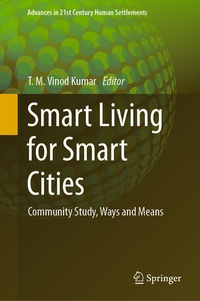
Smart Living for Smart Cities
Community Study, Ways and Means
Published on 6. May 2020
Book
Hardback
XVI, 222 pages
978-981-15-4602-0 (ISBN)
Description
This book, based on extensive international collaborative research, highlights the state-of-the-art design of smart living for metropolises, megacities, and metacities, as well as at the community and neighbourhood level. Smart living is one of six main components of smart cities, the others being smart people, smart economy, smart environment, smart mobility and smart governance. Smart living in any smart city can only be designed and implemented with active roles for smart people and smart city government, and as a joint effort combining e-Democracy, e-Governance and ICT-IoT systems. In addition to using information and communication technologies, the Internet of Things, Internet of Governance (e-Governance) and Internet of People (e-Democracy), the design of smart living utilizes various domain-specific tools to achieve coordinated, effective and efficient management, development, and conservation, and to improve ecological, social, biophysical, psychological and economic well-being in an equitable manner without compromising the sustainability of development ecosystems and stakeholders. This book presents case studies covering more than 10 cities and centred on domain-specific smart living components. The book is issued in two volumes and this volume focus on community studies and ways and means.
More details
Series
Edition
2020 ed.
Language
English
Place of publication
Singapore
Singapore
Target group
Professional and scholarly
Illustrations
9 s/w Abbildungen, 81 farbige Abbildungen
XVI, 222 p. 90 illus., 81 illus. in color.
Dimensions
Height: 241 mm
Width: 160 mm
Thickness: 21 mm
Weight
582 gr
ISBN-13
978-981-15-4602-0 (9789811546020)
DOI
10.1007/978-981-15-4603-7
Schweitzer Classification
Other editions
Additional editions
Book
05/2021
Springer
€128.39
Shipment within 3-4 weeks
E-Book
05/2020
1st Edition
Springer
€117.69
Available for download
Person
Professor T. M. Vinod Kumar has 50 years of professional experience and is specialized in Urban and Regional Planning, Urban and Regional Infrastructure, Urban Environmental Management, Application of GIS in Urban Planning, Models in Planning, Urban Design and Smart Cities. He has extensive consultancy experience in urban and rural development, infrastructure, tourism, and health care throughout India, and in new town planning and development, city centre and housing planning, and structure planning in Malaysia. He has worked in Bhutan, China, Pakistan, Nepal and India as a Regional Program Coordinator for the International Centre for Integrated Mountain Development. Academically, he has worked at the School of Planning and Architecture, New Delhi as a Professor, Head of the Department of Urban Planning, Head of the Centre for Analysis and Systems Studies, Head of the Centre for Urban Studies, and finally Dean of Studies at the School of Planning and Architecture, New Delhi. He also worked as a Planner-Engineer with the Ford Foundation, India. He is a former Visiting Professor at Bandung Institute of Technology Indonesia, and current Visiting Professor at the National Institute of Technology, Calicut. He has authored numerous books and journal articles, and been a Project Manager for many consulting projects in India and abroad. He coordinated and edited Geographic Information System for Smart Cities (Copal:2014), E-Governance for Smart Cities (Springer:2015), Smart Economy in Smart Cities (Springer:2016), E-Democracy for Smart Cities (Springer:2017), Smart Metropolitan Regional Development-Economic and Spatial Design Strategies (Springer-Nature:2018) and Smart Environment for Smart Cities (Springer-Nature:2019).
Content
Part 1: Introduction.- Chapter 1: Smart Living for Smart Cities.- Part 2: Community studies.-Chapter 2: Urban Transformation for Sustainable Growth and Smart Living: The Case of the Atlanta BeltLine.- Part 3: Ways and means.- Chapter 3: Exploring Livability in the era of Smart City: A case of Bhopal.- Chapter 4: Using Geospatial intelligence for smart living: Case study-Delhi.- Chapter 5: Smart Landscape Architecture for Smart Living: Dubai.- Part 4: Conclusion.- Chapter 6: International Collaborative Research Smart Living for Smart Cities and Conclusions of city studies.