

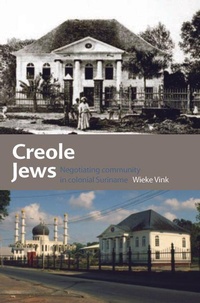
Creole Jews
Negotiating Community in Colonial Suriname
Published on 1. January 2010
Book
Paperback/Softback
320 pages
978-90-6718-343-7 (ISBN)
Description
This study presents a refined analysis of Surinames-Jewish identifications. The story of the Surinamese Jews is one of a colonial Jewish community that became ever more interwoven with the local environment of Suriname.
More details
Series
Language
English
Place of publication
Leiden
Netherlands
Target group
Professional and scholarly
Product notice
Paperback (trade)
Unsewn / adhesive bound
Illustrations
13 s/w Abbildungen
13 Illustrations, black and white
Dimensions
Height: 234 mm
Width: 152 mm
Thickness: 23 mm
Weight
454 gr
ISBN-13
978-90-6718-343-7 (9789067183437)
Copyright in bibliographic data and cover images is held by Nielsen Book Services Limited or by the publishers or by their respective licensors: all rights reserved.
Schweitzer Classification
Person
Wieke Vink (1971) obtained her Master's in social history at the Erasmus University Rotterdam. She then combined PhD research with an assignment at the Dutch Department of Integration policy (Ministry of VROM). Vink received her PhD from the Erasmus University in 2008; for her dissertation she received the Preamium Erasmianum Research Prize 2009.
Content
Acknowledgements v
List of figures and tables xi
Glossary xiii
I Introducing Jewishness, creolization and the colonial domain Memories of bygone days 1
Connecting Judaism, creolization and colonialism 5
Browsing through history: On periodization and archival research 10
Outline 14
Some notes on terminology 16
PART ONE: FORGING A COMMUNITY 18
II A colonial Jewish community in the making Pattern of migration and places of settlement 21
Port of origin: Amsterdam 21
Dynamics and dimensions of a small-scale Jewish community 23
The birth of a Jewish community in Suriname 24
Growth 26
Colonial adventures, poor migrants and the Amsterdam connection 29
Decline 34
Places of settlement 37
Jodensavanne: Heart of the Portuguese Jewish planters' community 37
The multi-ethnic environment of Paramaribo 41
III Making a living in the colony
Social context, economic activities and cultural life 45
Economic activities 47
The fate of the Jewish planters' class 47
Reorientation: Making a living in an urban colonial environment 53
A community losing ground: Economic hardship and declining fi nta revenues 57
Socio-cultural life in the colony: Societies and lodges 59
Societies and lodges 59
Informal interactions and cross-cultural contacts 63
IV Colonial confi gurations and diasporic connections
Patterns of rule, civil status and religious authority 69
Authority and citizenship 69
Political structures in Suriname's plantocracy 69
Controlling the community: The Jewish privileges 71
Negotiating civil rights (1816-1825) 78
After 1825: Between marginalization and political domination 82
The limits of tolerance 87
Diasporic connections 91
The Chief Commission of Israelite Affairs 93
Negotiating the Askamoth 95
Dutch rabbis in Suriname 95
How a community was forged 101
PART TWO: CULTIVATING DIFFERENCES, LOCALIZING BOUNDARIES 105
V Echoes of the other Locating Jews and imagining Jewish difference in Suriname 107
Perspectives on Jewish whiteness, dominance and colonial 'otherness' 109
The 'white man': A Maroon's perspective 109
Echoes of the 'other': The image of the cruel Jewish planter 113
The Surinamese Jew as colonial 'other'? A painting by P.J. Benoit (1839) 125
'White but Jewish': Locating Jews in Suriname's colour system 130
Shem's legacy: An undefi ned status in the age of colonial expansion 132
Confronting Jewish difference: The case of the civil guard 134
From 'white' to 'native': Jewish and the senses 138
VI Spaces of death, mirror of the living The cemetery as a site of creolization 147
Spaces of death, mirror of the living 148
A tour of Suriname's Jewish cemeteries 152
Cassipora and Jodensavanne cemeteries 152
Jewish cemeteries and creole grave markers in Paramaribo 160
Critical events at the Surinamese-Jewish cemeteries 165
The burial of the coloured Jew Joseph de David Cohen Nassy 166
'Bad' Jews at the Beth Haim? The burial of Isaq Simons (1825) 171
Creating a precedent: Mr Pinto and Mrs Pinto-Fernandes (1891) 172
Dario Saavedra (1911): Allegro and andante 175
Inappropriate ceremonies? The burial of Coenraad Samuels (1913) 179
Sarah's Hofje 181
The cemetery as a site of creolization? 183
VII New World identifi cations, Old World sensibilitiesOn eliteness, religiosity and social status 187
Colonial elites and religious superiority 188
Negotiating an elite status 196
Good Jews 196
Making and breaking boundaries 196
Forced inclusion and community control 196
Marrying the other (I): High German-Portuguese mixed marriages 201
Belonging and widowhood: The story of the widows Da Fonseca and Levij Hart 205
Blurring boundaries and prevailing notions of difference 209
Reluctant overtures 210
In search of authenticity and differentiation 212
Colonial nostalgia 214
VIII Black, white, Jewish? Colour, Halakha and the limits of Jewishness 221
Racialized boundaries: The shifting status of coloured Jews 223
Coloured Jews and Halakha 223
The story of Darhe Jessarim 229
Marrying the other (II): White-coloured mixed marriages
and dissolving colour lines 237
The last boundary: Jews and non-Jews, coloureds and Christians 243
Marrying the other (III): Jewish-Christian mixed marriages and
the revival of Halakha 243
Defi ning Surinamese Jewishness: Between colour and Halakha 253
IX Conclusion: The Creole, the colonial and the metropole 259
Delimiting 'white' creolization 260
The colonial and the diaspora 265
Creole Jews or European whites? The semantics of colonizers and Creoles 266
Bibliography 271
Index 295
List of figures and tables xi
Glossary xiii
I Introducing Jewishness, creolization and the colonial domain Memories of bygone days 1
Connecting Judaism, creolization and colonialism 5
Browsing through history: On periodization and archival research 10
Outline 14
Some notes on terminology 16
PART ONE: FORGING A COMMUNITY 18
II A colonial Jewish community in the making Pattern of migration and places of settlement 21
Port of origin: Amsterdam 21
Dynamics and dimensions of a small-scale Jewish community 23
The birth of a Jewish community in Suriname 24
Growth 26
Colonial adventures, poor migrants and the Amsterdam connection 29
Decline 34
Places of settlement 37
Jodensavanne: Heart of the Portuguese Jewish planters' community 37
The multi-ethnic environment of Paramaribo 41
III Making a living in the colony
Social context, economic activities and cultural life 45
Economic activities 47
The fate of the Jewish planters' class 47
Reorientation: Making a living in an urban colonial environment 53
A community losing ground: Economic hardship and declining fi nta revenues 57
Socio-cultural life in the colony: Societies and lodges 59
Societies and lodges 59
Informal interactions and cross-cultural contacts 63
IV Colonial confi gurations and diasporic connections
Patterns of rule, civil status and religious authority 69
Authority and citizenship 69
Political structures in Suriname's plantocracy 69
Controlling the community: The Jewish privileges 71
Negotiating civil rights (1816-1825) 78
After 1825: Between marginalization and political domination 82
The limits of tolerance 87
Diasporic connections 91
The Chief Commission of Israelite Affairs 93
Negotiating the Askamoth 95
Dutch rabbis in Suriname 95
How a community was forged 101
PART TWO: CULTIVATING DIFFERENCES, LOCALIZING BOUNDARIES 105
V Echoes of the other Locating Jews and imagining Jewish difference in Suriname 107
Perspectives on Jewish whiteness, dominance and colonial 'otherness' 109
The 'white man': A Maroon's perspective 109
Echoes of the 'other': The image of the cruel Jewish planter 113
The Surinamese Jew as colonial 'other'? A painting by P.J. Benoit (1839) 125
'White but Jewish': Locating Jews in Suriname's colour system 130
Shem's legacy: An undefi ned status in the age of colonial expansion 132
Confronting Jewish difference: The case of the civil guard 134
From 'white' to 'native': Jewish and the senses 138
VI Spaces of death, mirror of the living The cemetery as a site of creolization 147
Spaces of death, mirror of the living 148
A tour of Suriname's Jewish cemeteries 152
Cassipora and Jodensavanne cemeteries 152
Jewish cemeteries and creole grave markers in Paramaribo 160
Critical events at the Surinamese-Jewish cemeteries 165
The burial of the coloured Jew Joseph de David Cohen Nassy 166
'Bad' Jews at the Beth Haim? The burial of Isaq Simons (1825) 171
Creating a precedent: Mr Pinto and Mrs Pinto-Fernandes (1891) 172
Dario Saavedra (1911): Allegro and andante 175
Inappropriate ceremonies? The burial of Coenraad Samuels (1913) 179
Sarah's Hofje 181
The cemetery as a site of creolization? 183
VII New World identifi cations, Old World sensibilitiesOn eliteness, religiosity and social status 187
Colonial elites and religious superiority 188
Negotiating an elite status 196
Good Jews 196
Making and breaking boundaries 196
Forced inclusion and community control 196
Marrying the other (I): High German-Portuguese mixed marriages 201
Belonging and widowhood: The story of the widows Da Fonseca and Levij Hart 205
Blurring boundaries and prevailing notions of difference 209
Reluctant overtures 210
In search of authenticity and differentiation 212
Colonial nostalgia 214
VIII Black, white, Jewish? Colour, Halakha and the limits of Jewishness 221
Racialized boundaries: The shifting status of coloured Jews 223
Coloured Jews and Halakha 223
The story of Darhe Jessarim 229
Marrying the other (II): White-coloured mixed marriages
and dissolving colour lines 237
The last boundary: Jews and non-Jews, coloureds and Christians 243
Marrying the other (III): Jewish-Christian mixed marriages and
the revival of Halakha 243
Defi ning Surinamese Jewishness: Between colour and Halakha 253
IX Conclusion: The Creole, the colonial and the metropole 259
Delimiting 'white' creolization 260
The colonial and the diaspora 265
Creole Jews or European whites? The semantics of colonizers and Creoles 266
Bibliography 271
Index 295