

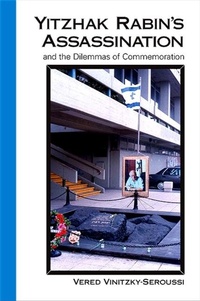
Yitzhak Rabin's Assassination and the Dilemmas of Commemoration
Published on 2. July 2010
Book
Paperback/Softback
227 pages
978-1-4384-2832-1 (ISBN)
Description
Examines how Israeli society has commemorated Yitzhak Rabin.
How does a society cope with the challenge of acknowledging and commemorating difficult aspects of its past? In Yitzhak Rabin's Assassination and the Dilemmas of Commemoration, Vered Vinitzky-Seroussi develops a timely sociology of commemoration, drawing on the public memory of Israel's Prime Minister Yitzhak Rabin, who was assassinated at the end of a peace rally in Tel Aviv in 1995. She identifies and analyzes the building blocks from which commemoration is made: agency, space, time, and narrative. Acting as a guide, she leads the reader through monuments and gravestones, memorial services and political demonstrations, rituals both moving and banal, and individuals determined to remember, as well as those who wish to forget. Yitzhak Rabin's Assassination and the Dilemmas of Commemoration examines the meanings, boundaries, opportunities, and limits of commemoration, a phenomenon not unique to Israel but shared by many nations across the globe.
How does a society cope with the challenge of acknowledging and commemorating difficult aspects of its past? In Yitzhak Rabin's Assassination and the Dilemmas of Commemoration, Vered Vinitzky-Seroussi develops a timely sociology of commemoration, drawing on the public memory of Israel's Prime Minister Yitzhak Rabin, who was assassinated at the end of a peace rally in Tel Aviv in 1995. She identifies and analyzes the building blocks from which commemoration is made: agency, space, time, and narrative. Acting as a guide, she leads the reader through monuments and gravestones, memorial services and political demonstrations, rituals both moving and banal, and individuals determined to remember, as well as those who wish to forget. Yitzhak Rabin's Assassination and the Dilemmas of Commemoration examines the meanings, boundaries, opportunities, and limits of commemoration, a phenomenon not unique to Israel but shared by many nations across the globe.
Reviews / Votes
"The empirical analysis is very rich and highlights the political divisions in Israeli society ... the book is a valuable contribution to the study of Israeli politics and to a 'difficult past' that the literature has neglected." - Political Studies Review"Somewhat unconventionally but provocatively, sociologist Vinitzky-Seroussi locates in her acknowledgments how the 1995 assassination of Israel's prime minister prompted this study of the complexities and significance of commemoration. What follows is a richly theorized and well-researched exploration of the contours and toponymy of the 'map of memory' that locates Rabin as 'a highly present absence' in time and space." - CHOICE
More details
Series
Language
English
Place of publication
Albany, NY
United States
Target group
Professional and scholarly
US School Grade: College Graduate Student and over
Product notice
Paperback (trade)
Illustrations
7 Illustrations, black and white
Dimensions
Height: 234 mm
Width: 150 mm
Thickness: 20 mm
Weight
386 gr
ISBN-13
978-1-4384-2832-1 (9781438428321)
Copyright in bibliographic data and cover images is held by Nielsen Book Services Limited or by the publishers or by their respective licensors: all rights reserved.
Schweitzer Classification
Other editions
Additional editions
Vered Vinitzky-Seroussi
Yitzhak Rabin's Assassination and the Dilemmas of Commemoration
E-Book
07/2010
State University of New York Press
€35.99
Available for download
Person
Vered Vinitzky-Seroussi is Associate Professor of Sociology at the Hebrew University of Jerusalem and the author of After Pomp and Circumstance: High School Reunion as an Autobiographical Occasion.
Content
List of Illustrations
Acknowledgments
1. Introduction
2. Agents of Memory: Voice and Exit
3. Times to Remember
4. Spaces to Remember
5. Escorting the Mnemonic Narrative
6. Forced to Remember
7. Concluding Remarks: Commemoration, Fragmentation, Israeli Society and Beyond
Appendix: On Methods
Notes
Bibliography
Index
Acknowledgments
1. Introduction
2. Agents of Memory: Voice and Exit
3. Times to Remember
4. Spaces to Remember
5. Escorting the Mnemonic Narrative
6. Forced to Remember
7. Concluding Remarks: Commemoration, Fragmentation, Israeli Society and Beyond
Appendix: On Methods
Notes
Bibliography
Index