

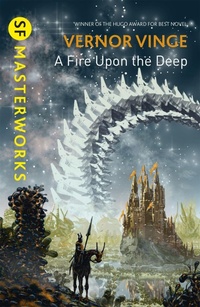
A Fire Upon the Deep
Published on 7. January 2016
Book
Paperback/Softback
608 pages
978-1-4732-1195-7 (ISBN)
Description
Thousands of years hence, many races inhabit a universe where a mind's potential is determined by its location in space - from superintelligent entities in the Transcend, to the limited minds of the Unthinking Depths, where only simple creatures and technology can function. Nobody knows what strange force partitioned space into these 'zones of thought', but when the warring Straumli realm use an ancient Transcendent artefact as a weapon, they unwittingly unleash an awesome power that destroys thousands of worlds and enslaves all natural and artificial intelligence.
Fleeing the threat, a family of scientists, including two children, are taken captive by the Tines - an alien race with a harsh medieval culture - and used as pawns in a ruthless power struggle. A rescue party, not entirely composed of humans, must free the children - and retrieve a secret that may save the rest of interstellar civilization.
Fleeing the threat, a family of scientists, including two children, are taken captive by the Tines - an alien race with a harsh medieval culture - and used as pawns in a ruthless power struggle. A rescue party, not entirely composed of humans, must free the children - and retrieve a secret that may save the rest of interstellar civilization.
Reviews / Votes
A tale that burns with the brazen energy of the best space operas of the golden age. Vinge has created a galaxy for the readers of the '90s to believe in . . . immense, ancient, athrum with data webs, dotted with wonders - InterzoneThe first grand SF I've read in ages . . . Vinge is one of the best visionary writers of SF today
Vinge's climax is suitably mind-boggling. This epic combines the flash and dazzle of old-style space opera with modern, polished thoughtfulness
Wide-screen science fiction epic of the type few writers attempt any more. A novel of great ingenuity, energy and narrative sweep - Washington Post
Thoughtful space opera at its best, this book delivers everything it promises in terms of galactic scope, audacious concepts and believable characters both human and non-human - The New York Times
More details
Series
Language
English
Place of publication
London
United Kingdom
Publishing group
Orion Publishing Co
Product notice
Paperback (UK-B)
Dimensions
Height: 198 mm
Width: 128 mm
Thickness: 43 mm
Weight
435 gr
ISBN-13
978-1-4732-1195-7 (9781473211957)
Copyright in bibliographic data and cover images is held by Nielsen Book Services Limited or by the publishers or by their respective licensors: all rights reserved.
Schweitzer Classification
Other editions
Additional editions
Person
Vernor Vinge (1944-2024)
Vernor Steffen Vinge was born in Wisconsin in 1944. He was a retired San Diego State University Professor of Mathematics, a computer scientist and science fiction author. He is best known for his two epic space operas A Fire Upon the Deep (1992) and A Deepness in the Sky (1999), both of which won the Hugo Award and were shortlisted for the Nebula. He is the winner of 5 Hugos, 4 Prometheus Awards and the John W. Campbell Memorial Award, among many others. In addition to his works of science fiction, Vinge authored the influential 1993 essay 'The Coming Technological Singularity', in which he argued that the creation of superhuman artificial intelligence will mark the point at which 'the human era will be ended', such that no current models of reality are sufficient to predict beyond it.
Vernor Steffen Vinge was born in Wisconsin in 1944. He was a retired San Diego State University Professor of Mathematics, a computer scientist and science fiction author. He is best known for his two epic space operas A Fire Upon the Deep (1992) and A Deepness in the Sky (1999), both of which won the Hugo Award and were shortlisted for the Nebula. He is the winner of 5 Hugos, 4 Prometheus Awards and the John W. Campbell Memorial Award, among many others. In addition to his works of science fiction, Vinge authored the influential 1993 essay 'The Coming Technological Singularity', in which he argued that the creation of superhuman artificial intelligence will mark the point at which 'the human era will be ended', such that no current models of reality are sufficient to predict beyond it.