

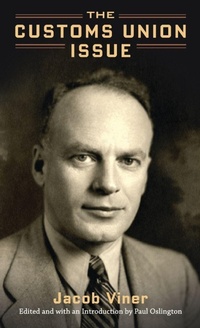
The Customs Union Issue
Published on 27. February 2014
Book
Hardback
248 pages
978-0-19-975612-4 (ISBN)
Description
Jacob Viner's The Customs Union Issue was originally published in 1950 by the Carnegie Endowment for International Peace. It set the framework for the contemporary debate over the benefits or otherwise of preferential trading agreements such as the European Union, NAFTA, and APEC. Viner developed the concepts of trade creation and diversion in this work as he pioneered the analysis of the global politics of trade agreements. This revival of Viner's classic work includes an introduction that places this book in the context of his life's work and the post-WWI economic and political situation. The introduction also traces the reception of Viner's work and discusses its continuing relevance for international economists, political scientists, and historians.
Reviews / Votes
Due to the proliferation of preferential trading arrangements, the questions Viner addresses and some of his insights are more important and relevant today...Jacob Viner's classic work, The Customs Union Issue, edited and with an introduction by Paul Oslington, has a special significance.The book is accessible to a broad range of readers, including trade students, trade economists, policy-makers and business people. The book will benefit anyone who is interested in non-discriminatory free trade in general and in free trade agreements in particular. * Chunlai Chen, Economic Record * Jacob Viner's seminal work on customs unions drew attention to the key fact that preferential free trade agreements are different from, and generally inferior to, non-discriminatory free trade. While the issues we confront today over the downside of preferential trade agreements have shifted and multiplied, Viner's work remains as a warning that policymakers cannot afford to ignore. * Jagdish Bhagwati, University Professor (Economics, Law and International Affairs), Columbia University; author of Termites in the Trading System: How Preferential Agreements Undermine Free Trade *More details
Language
English
Place of publication
New York
United States
Target group
College/higher education
Professional and scholarly
Dimensions
Height: 222 mm
Width: 145 mm
Thickness: 17 mm
Weight
448 gr
ISBN-13
978-0-19-975612-4 (9780199756124)
Copyright in bibliographic data and cover images is held by Nielsen Book Services Limited or by the publishers or by their respective licensors: all rights reserved.
Schweitzer Classification
Other editions
Additional editions

Jacob Viner | Paul Oslington
The Customs Union Issue
E-Book
01/2014
1st Edition
OUP eBook
€36.99
Available for download
Persons
Jacob Viner (1892-1970) was an Economist and Professor at Unviersity of Chicago and Princeton University. He was one of the early members of the modern day Chicago School of Economics.
Paul Oslington is Professor of Economics at Australian Catholic University.
Paul Oslington is Professor of Economics at Australian Catholic University.
Content
Acknowledgements ; Preface by Gene Grossman ; Foreword by George A. Finch ; Introduction by Paul Oslington ; I. Introduction ; II. The Compatibility of Customs Union with the Most-Favored-Nation Principle ; 1. The Criteria of a "Customs Union" ; 2. Diplomatic Controversies Arising out of Most-Favored-Nation obligations of Members of Customs Unions ; 3. The Most-Favored-Nation Principle Not a Serious Barrier to Customs Unions ; III. Exemption from Most-Favored-Nation Obligations of Preferential Arrangements other than Customs Union ; 1. Imperial Preference ; 2. Regional Agreements ; 3. Plurilateral Agreements ; IV. The Economics of Customs Unions ; 1. Customs Union as an Approach to Free Trade ; 2. Customs Union and the "Terms of Trade" ; 3. Administrative Economies of Customs Union ; 4. Revenue Duties ; 5. The <"Level>" of the Customs Union Tariff ; 6. Increased Tariff Protection as the Major Economic Objective of Customs Unions ; 7. Cartels in Relation to Customs Unions ; 8. The Allocation of Customs Revenues ; V. Political Aspects of Customs Unions ; 1. The Location of Administrative Authority in Customs Unions ; 2. Customs Union and Neutrality Obligations ; 3. Customs Union and Political Unification ; 4. The Austro-German Treaty of 1918 ; VI. The Havana Charter and Customs Union ; 1. The Most-Favored-Nation Principle ; 2. Exemptions from Most-Favored-Nation Obligations of Customs Unions, Free-Trade Areas, and Interim Agreements ; 3. Exemptions from Most-Favored-Nation Obligations of Agreements in the Interest of Economic Development, Including Regional Agreements ; 4. Relations with Non-Members ; 5. Significance of the Havana Charter for the Customs Union Question ; VII. Prospects for Customs Unions ; 1. Customs Unions Now in Operation or in Active Process of Negotiation ; 2. Customs Union in Western Europe ; 3. Obstacles to the Formation of Customs Unions ; Bibliography ; Index