

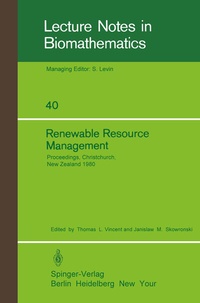
Renewable Resource Management
Proceedings of a Workshop on Control Theory Applied to Renewable Resource Management and Ecology Held in Christchurch, New Zealand January 7 - 11, 1980
1st Edition
Published on 1. April 1981
Book
Paperback/Softback
XII, 236 pages
978-3-540-10566-4 (ISBN)
Description
As society becomes stressed by economic and population pressures, in turn, nature's renewable resources become stressed by harvesting pressures. For our own survival and euphoria, it is paramount that such resources remain as their name implies and not be driven to extinction through short term programs of over exploitation. Consideration of the harvesting of renewable resources leads to a simple question that was the theme of the workshop and is the focus of these proceedings: SUPPoRe you are assigned the role of manager for a specific renewable resource eco system. How would you decide on harvesting policies so that the system can be exploited economically yet at the same time maintain the integrity of the system? This, of course, is a loaded question. First of all, it is not clear that there is ever anyone single decision maker who is able to set the rules for all of the harvesters in an exploited ecosystem. The political process is complicated and to some extent unpredictable. This aspect of the question is recognized to be important, but could not be addressed here. Assuming then that someone really is in charge, what would be involved in the * decision making process? As Clark points out, "there is no alternative but first to model the system. " We agree. However, if the original question was loaded, modeling is the adulterate.
More details
Series
Language
English
Place of publication
Berlin
Germany
Publishing group
Springer Berlin
Target group
Professional and scholarly
Research
Illustrations
XII, 236 p.
Dimensions
Height: 235 mm
Width: 155 mm
Thickness: 14 mm
Weight
388 gr
ISBN-13
978-3-540-10566-4 (9783540105664)
DOI
10.1007/978-3-642-46436-2
Schweitzer Classification
Content
Mathematical Models and Resource Management.- More Realistic Fishery Models: Cycles Collapse and Optimal Policy.- Age-Structure and Stability in Multiple-Age Spawning Populations.- Optimal Management of Optimal Foragers.- Modelling and Management of Fish Populations with High and Low Fecundities.- Adaptive Identification of Models Stabilizing under Uncertainty.- Computational Difficulties in the Identification and Optimization of Control Systems.- Economic Models of Fishery Management.- Vulnerability of a Prey-Predator Model under Harvesting.- Nonvulnerability of Two Species Interactions.- Estimating Controllability Boundaries for Uncertain Systems.- Estimating the Effect of Krill Harvesting on the Southern Ocean Ecosystem.- Appraisal of the Commercial Potential of the New Zealand Deepwater Fishery.- Subinjurious Maintenance Strategies for Optimal Control of Nematodes.- A Plant-Water Model with Implications for the Management of Water Catchments.- Mathematical Modelling of the Transport and Loss of Leachable Plant Nutrients in Field Soils.