

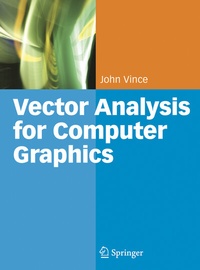
Vector Analysis for Computer Graphics
Published on 18. June 2007
Book
Hardback
XIII, 259 pages
978-1-84628-803-6 (ISBN)
Description
In my last book, Geometry for Computer Graphics, I employed a mixture of algebra and vector analysis to prove many of the equations used in computer graphics. At the time, I did not make any distinction between the two methodologies, but slowly it dawned upon me that I had had to discover, for the first time, how to use vector analysis and associated strategies for solving geometric problems. I suppose that mathematicians are taught this as part of their formal mathematical training, but then, I am not a mathematician! After some deliberation, I decided to write a book that would introduce the beginner to the world of vectors and their application to the geometric problems encountered in computer graphics. I accepted the fact that there would be some duplication of formulas between this and my last book; however, this time I would concentrate on explaining how problems are solved. The book contains eleven chapters: The first chapter distinguishes between scalar and vector quantities, which is reasonably straightforward. The second chapter introduces vector repres- tation, starting with Cartesian coordinates and concluding with the role of direction cosines in changes in axial systems. The third chapter explores how the line equation has a natural vector interpretation and how vector analysis is used to resolve a variety of line-related, geometric problems. Chapter 4 repeats Chapter 3 in the context of the plane.
Reviews / Votes
From the reviews:
"Vince's book applies to more than computer graphics: it is a resource for many areas in applied mathematics. . Students in computer graphics courses would find it very useful if their class discussions moved into the mathematical fundamentals underlying the tools. . Undergraduate students especially lack the mathematics background that this book provides. . It is comprehensive and coherent, and a good addition to the library of any computational scientist." (Anthony J. Duben, ACM Computing Reviews, Vol. 49 (8), August, 2008)
More details
Edition
2007 ed.
Language
English
Place of publication
London
United Kingdom
Target group
Primary & secondary/elementary & high school
Product notice
sewn/stitched
Cloth over boards
Illustrations
185 s/w Abbildungen
XIII, 259 p. 185 illus.
Dimensions
Height: 241 mm
Width: 183 mm
Thickness: 20 mm
Weight
668 gr
ISBN-13
978-1-84628-803-6 (9781846288036)
DOI
10.1007/978-1-84628-804-3
Schweitzer Classification
Other editions
New editions
John Vince
Vector Analysis for Computer Graphics
Book
06/2021
2nd Edition
Springer
€69.54
Shipment within 15-20 days
Additional editions
John Vince
Vector Analysis for Computer Graphics
Book
10/2010
Springer
€85.55
Article exhausted; check for reprint
John Vince
Vector Analysis for Computer Graphics
E-Book
05/2007
1st Edition
Springer
€53.49
Available for download
Person
Professor John Vince began working in computer graphics at Middlesex Polytechnic in 1968. His research activities centered on computer animation software and resulted in the PICASO and PRISM animation systems. Whilst at Middlesex, he designed the UK's first MSc course in Computer Graphics and developed a popular program of short courses in computer animation for television designers. In 1986 he joined Rediffusion Simulation as a Research Consultant and worked on the development of real-time computer systems for commercial flight simulators. In 1992 he was appointed Chief Scientist of Thomson Training Simulation Ltd. In 1995 he was appointed Professor of Digital Media at the National Centre for Computer Animation at Bournemouth University and in 1999 he was made Head of Academic Group for Computer Animation. He was awarded a DSc by Brunel University in recognition of his work in computer graphics. He has written and edited over 40 books on computer graphics, computer animation and virtual reality, including the following Springer titles:
¿ Mathematics for Computer Graphics (2014)
¿ Calculus for Computer Graphics (2013)
¿ Matrix Transforms for Computer Games and Animation (2012)
¿ Expanding the Frontiers of Visual Analytics and Visualization (2012)
¿ Quaternions for Computer Graphics (2011)
¿ Rotation Transforms for Computer Graphics (2011)
Content
Scalars and Vectors.- Vector Representation.- Straight Lines.- The Plane.- Reflections.- Intersections.- Rotating Vectors.- Vector Differentiation.- Projections.- Rendering.- Motion.