

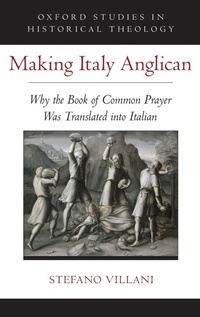
Making Italy Anglican
Why the Book of Common Prayer Was Translated into Italian
Published on 29. April 2022
Book
Hardback
308 pages
978-0-19-758773-7 (ISBN)
Description
For almost three hundred years there were those in England who believed that an Italian translation of the Book of Common Prayer could trigger radical change in the political and religious landscape of Italy. The aim was to present the text to the Italian religious and political elite, in keeping with the belief that the English liturgy embodied the essence of the Church of England. The beauty, harmony, and simplicity of the English liturgical text, rendered into Italian, was expected to demonstrate that the English Church came closest to the apostolic model. Beginning in the Venetian Republic and ending with the Italian Risorgimento, the leitmotif running through the various incarnations of this project was the promotion of top-down reform according to the model of the Church of England itself.
These ventures mostly had little real impact on Italian history: as Roy Foster once wrote, "the most illuminating history is often written to show how people acted in the expectation of a future that never happened." This book presents one of those histories. Making Italy Anglican tells the story of a fruitless encounter that helps us better to understand both the self-perception of the Church of England's international role and the cross-cultural and religious relations between Britain and Italy. Stefano Villani shows how Italy, as the heart of Roman Catholicism, was--over a long period of time--the very center of the global ambitions of the Church of England.
These ventures mostly had little real impact on Italian history: as Roy Foster once wrote, "the most illuminating history is often written to show how people acted in the expectation of a future that never happened." This book presents one of those histories. Making Italy Anglican tells the story of a fruitless encounter that helps us better to understand both the self-perception of the Church of England's international role and the cross-cultural and religious relations between Britain and Italy. Stefano Villani shows how Italy, as the heart of Roman Catholicism, was--over a long period of time--the very center of the global ambitions of the Church of England.
Reviews / Votes
Through careful and meticulous archival research conducted at Italian, English, and American institutions, Villani passionately and meticulously reconstructs a vast and varied world, made up of different characters. Alongside some individuals who are motivated by a sincere desire to reform the Roman Church, other men emerge, including spies and libertine priests, who operate on the margins of legality in search of profit and fame, sometimes resulting in their repentance and return to the Catholic Church in their final years. It is a captivating story also for Villani's ability to follow the individual histories with extreme precision, reconstructing their religious and cultural journeys. * Maria Iolanda Palazzolo, Nuovi Annali della Scuola Speciale per Archivisti e Bibliotecari * Histories of the English Royal Supremacy have generally focussed on its domestic impact, but Villani reminds us that there is also an international story of its influence and reception to be told. His book will be of interest to scholars of England, Italy and 'global Anglicanism' alike. * Eloise Davies, Renaissance Studies * The book delves deeply into a topic that has been previously overlooked in the study of Anglo-Italian relations and will certainly become an essential part of the bibliography for all historians who wish to explore these issues further. * Angelo Condone, Revista de Historia Moderna * Villani's painstaking work has filled a gap in the history [of the Book of Common Prayer]. * Bryan D. Spinks, Journal of Ecclesiastical History * Villani's book shows impressive scholarship and represents a unique contribution to understanding English-Italian religious relations in the modern era. * Gianluigi Gugliermetto, Anglican and Episcopal History * Villani [...] describes a very complicated centuries-old interweaving of migratory flows (economic, political, religious, tourist) between Italy and the British Isles (and Malta and the United States). Scholars of migration in the modern era must forever be grateful for the work he does in this volume. * Matteo Sanfilippo, Studi Emigrazione * This extremely rich book, full of original research, develops in different historical contexts and covers several centuries, from the 1600s to the present day [...]. This extensive work [is] destined to become a point of reference in its field of study. * Luigi Lazzerini, Rivista di Letteratura Storiografica Italiana * The fruit of immense erudition, Villani's book manages to take readers on a grand tour of their own, all the way from the machinations of Stuart diplomats in 1605 to a tearful abjuration of heresy made by Fr. Enrico Campello before the Inquisition in 1902, returning from a schismatic venture to London. Villani's work, unlike that of his protagonists, is a rousing success. * Shaun Blanchard, National Institute for Newman Studies, The Living Church * Stefano Villani here makes a masterful examination in elegant and witty prose, of one of the weirdest and unexpected 'what ifs' of history: how the British Empire tried to convert Italy to Protestantism. * Brian Cummings, Anniversary Professor, University of York * Stefano Villani's wonderful Making Italy Anglican reveals a succession of previously untold stories about the engagement between the Church of England and Italian Christians, focused on the translation, dissemination, and use of the Book of Common Prayer. He uncovers blind alleys and ways not taken that show both the breadth of confessional politics and the often unusual intellectual origins of more modern, ecumenical thought. Bibliographically and historically astute, Villani's book deserves to become a classic in the long history of Anglo-Italian relations, one that puts English Protestantism back at the heart of a story from which it has largely been excluded. Historians of England and the British Atlantic world will be surprised how much Villani can also teach them from his starting point on the shores of the Adriatic. * Scott Mandelbrote, Fellow and Director of Studies in History, Peterhouse, University of Cambridge * The truly transnational history of the astonishing, failed, and repeated attempts to win Catholic Italy for the Church of England, reconstructed from a hitherto little-known angle. With brilliant scholarship, Stefano Villani brings to life an extraordinary array of theologians, missionaries, adventurers, spies, travellers, collectors, and their books, from the Reformation to the Risorgimento. An unknown, fascinating chapter in Anglo-Italian relations that sheds precious light on the culture of both countries. * Filippo de Vivo, Professor of Early Modern History, University of Oxford * Making Italy Anglican: Why the Book of Common Prayer Was Translated into Italian...tells the story of various attempts to commend to Roman Catholics in Italy a more excellent way - a form of Christianity neither papal nor, in the European sense, Protestant, such as had been established in England. That story, to which Villani's main title alludes, is in his phrase the story of a failure. Nothing like the Church of England was ever realized in Italian territory. * Charles Hefling, Church History * Villani's book is a rich one, which tells not only the story of "Italy outside Italy," but also of radicals and dreamers who envisioned a different Italy, distinct from that of Pope Paul V as well as that of Pius IX two and a half centuries later. * Simone Maghenzani, Archivio Storico Italiano * The history, so rich, that emerges from the pages of Villani, the attempt to convert Italians to the "superior" Anglican model, distancing them not only from papal impiety but also from the Protestant temptation, represents somewhat the counterpart of the history of Italian Protestantism in the 19th century, so indebted to the Revival, and of the Risorgimento utopia of Waldensians, Baptists, Methodists, Brothers, and the Free in "making Italy Protestant". * Laura Ronchi De Michelis, Translated from Recensioni * This is nevertheless a wonderful book that offers a gripping story that will surely interest many historians of religion, book historians, and those interested in Anglo-Italian relations. * Richard Calis, Utrecht University, Journal of Religious History * Stefano Villani's book should be rightly greeted as a fine addition to the relevant bibliography on its subject and for shedding light on episodes and personalities which hitherto have been neglected. * James W. Nelson Novoa, Renaissance et Reforme 46.1 * The text is a translation by Frank Gordon from Villani's Italian, and reads engagingly and very smoothly. The volume provides a useful list of the Italian translations of the Book of Common Prayer and the location of copies...Finally, the appendix of Italian translations of the General Confession and the Preface of the Book of Common Prayer is a useful addition, and will be of especial interest to linguists. * Anastasia Stylianou, Modern Language Review * The effort of biographical reconstruction that permeates the entire book has the regenerating outcome of giving voice to a Grub Street of theologian adventurers. Amidst sins of the flesh, espionage on behalf of Italian embassies, and sincere reformist aspirations, they established lasting connections between intellectual circles and groups of readers. * Marco Cavarzere, Rivista di Storia del Cristianesimo * The vicissitudes of the translation of a book and the lives of political and religious exiles, stitched together by the thread of propaganda and sometimes by a sincere religious impulse, tell above all the presumption of a world that believes (still?) it can free others from prejudices. * Michaela Valente, Corriere della Sera * With elegant and straightforward prose, thanks also to Frank Gordon's excellent translation, Villani covers the history of three centuries of linguistic transposition, using various editions as both milestones and litmus tests for the relationship between England and the Italian peninsula. This volume is significant for historiography, bringing together the fruits of a decade's research in a remarkable achievement. * Viviana Tagliaferri, Annali Reviews Online * Even stories of failures prove valuable, as in this case, where the focus is on an accurate reconstruction of events involving a myriad of characters (spies, theologians, missionaries, and priests with sometimes shaky vocations) who played roles in this narrative. This effort, carried out with the extraordinary documentary, philological, and bibliographical expertise that is customary in Stefano Villani's studies, unveils a central and previously unknown aspect of the political and religious history of Anglo-Italian relations. * Mario Infelise, Rivista Storica Italiana * These translations attest to the broad scope of Anglo-Italian intercultural relations in the religious sphere and the long-term missionary ambitions of a significant part of the English political and religious establishment. * Lucio Biasiori, Annali di Storia dell'Esegesi * In Making Italy Anglican, Villani demonstrates the significance of the religious sphere in our understanding of Anglo-Italian relations, opening up a new angle through which they can be explored, not just by historians, but also by linguists and literature scholars. * Angela Andreani, Status Quaestionis * The story of each edition is elucidated in detail, distinguishing between genuinely new editions and, more often, corrected and updated versions based on earlier texts. More importantly, thanks to this documentary excavation, the biographical trajectories of minor figures, little known yet often situated at the centre of extensive international networks, also come to light. * Marco Fratini, Cromohs * Villani's excellent book is a niche study, but one that provides a fascinating account of the potential cultural and political applications of the art of translation; one that explores the nature of the relationship between State and Church as much as that between Britain and Italy. * Owain Wright, Modern Italy *More details
Series
Language
English
Place of publication
New York
United States
Target group
College/higher education
Illustrations
7 b&w halftones
Dimensions
Height: 240 mm
Width: 161 mm
Thickness: 21 mm
Weight
628 gr
ISBN-13
978-0-19-758773-7 (9780197587737)
Copyright in bibliographic data and cover images is held by Nielsen Book Services Limited or by the publishers or by their respective licensors: all rights reserved.
Schweitzer Classification
Other editions
Additional editions
E-Book
01/2022
OUP eBook
€56.99
Available for download
E-Book
01/2022
OUP eBook
€56.99
Available for download
Person
Stefano Villani is Professor of Early Modern European History at the University of Maryland, College Park. He has worked on the cultural and religious links between Italy and Britain and published numerous articles and books in this area.
Content
Introduction Chapter 1. Paolo Sarpi, William Bedell, and the First Italian Translation of the Book of Common Prayer Chapter 2. In Search of Patronage: The Translation by Alessandro Amidei Chapter 3. The Italian Church of London Chapter 4. The First Italian Edition of the Book of Common Prayer (1685) Chapter 5. A Liturgical Use? Chapter 6. Learning Italian: The 1733 Gordon and 1796 Montucci-Valetti Editions Chapter 7. The 1831 Nott Edition Chapter 8. The Italian Editions of the Book of Common Prayer Published in the First Half of the Nineteenth Century Chapter 9. Anglicans, Episcopalians, and the Unification of Italy Chapter 10. The Book of Common Prayer for Immigrants in London and the United States Conclusion Appendix Abbreviations Notes List of the Italian Translations of the Book of Common Prayer Index