

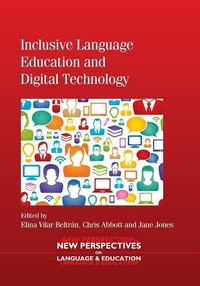
Inclusive Language Education and Digital Technology
Published on 15. May 2013
Book
Hardback
200 pages
978-1-84769-973-2 (ISBN)
Description
This volume brings together chapters which collectively address issues relating to inclusive language education and technology. Topics include language teaching to the Deaf, Hard of Hearing and students with dyslexia, benefits of multimodal approaches for language learning, examples of software use in the language classroom, and copyright matters. The book demonstrates not only a commitment to inclusive practices but suggests practical ideas and strategies for practising and aspiring language teachers and those in support roles. The book also provides case studies and relates the issues to theoretical and policy frameworks. In drawing on different European perspectives, the book aims to promote discussion and collaboration within an international community of practice, especially about the role of technology in widening and strengthening opportunities for teachers and pupils alike and ensuring more effective Modern Foreign Language teaching, learning and assessment for all learners.
Reviews / Votes
A timely and thought-provoking book which will enhance the teaching of MFL for all those with special educational needs. This stimulating book is located sensitively within relevant theoretical, pedagogical and policy frameworks, whilst illuminative case studies and inspirational examples of good practice support the whole most effectively. A 'must' for everyone involved in the development of the inclusive language education agenda and, in particular, the harnessing of digital technologies to this end. -- Catherine Watts, University of Brighton, UK In an age of increasing specialisation a publication that brings together such diverse fields as language learning, inclusive education and digital technology is to be warmly welcomed. The impressive array of practitioners and experts show how these disparate fields can illumine each other and, in so doing, create new opportunities for language learning. Accounts of policy and practice are seamlessly interwoven and will, I am sure, be a source of inspiration and ideas for any teacher seeking to make language learning more accessible to all. -- Hilary McColl, Formerly National Curriculum Development Officer for Modern Languages and Special Educational Needs, Scotland In an age when inclusive language education prevails in schools internationally and competence in languages is considered to be an indispensable skill, this volume is undoubtedly a valuable contribution to language education in general. It definitely serves its purpose, to present how the notion of "languages for all", as expressed in the nine chapters, could be achieved by exploiting all the technologies available. The book is well structured with all the chapters forming a unified whole. The fact that the book is divided into two parts provides an opportunity to become familiar with the theoretical background on some of the most important concepts discussed in the book in the first part and with practical examples of how the theory could be realised in the second part. Therefore, the book could not only be read by teachers, researchers, stakeholders or language education students but also by anyone interested in the field of inclusive education. -- Elis Kakoulli Constantinou, Cyprus University of Technology, Cyprus * the LINGUIST List *More details
Series
Language
English
Place of publication
Bristol
United Kingdom
Publishing group
Channel View Publications Ltd
Target group
Professional and scholarly
Product notice
Unsewn / adhesive bound
Paper over boards
Dimensions
Height: 211 mm
Width: 147 mm
Thickness: 18 mm
Weight
386 gr
ISBN-13
978-1-84769-973-2 (9781847699732)
Copyright in bibliographic data and cover images is held by Nielsen Book Services Limited or by the publishers or by their respective licensors: all rights reserved.
Schweitzer Classification
Other editions
Additional editions
Elina Vilar Beltran | Chris Abbott | Jane Jones
Inclusive Language Education and Digital Technology
Book
05/2013
Multilingual Matters
€40.50
Shipment within 10-20 days
Complete work / Part of the work

Viv Edwards | Phan Le Ha
New Perspectives on Language and Education Collection 2 (Vols 21-40)
Book
Multilingual Matters
€1,032.48
The article will not be published
Viv Edwards | Phan Le Ha
New Perspectives on Language and Education (Vols 21-30)
Book
Multilingual Matters
€1,032.48
The article will not be published
Persons
Dr Elina Vilar Beltran is a language instructor at Queen Mary, University of London. Modern languages education and accessibility have been her main areas of study since she started her post-doctoral training at King's College London. Other areas of interest are digital literacies, intercultural communication and language development in the study abroad context.
Dr Chris Abbott is Reader in e-Inclusion at King's College London. He specialises in teaching and research around literacy, language and assistive technologies, especially with regard to students identified as having learning difficulties. He has led a number of research projects on aspects of technology and disability, and is the author of ICT: Changing Education (2000) and SEN and the Internet: Issues for the Inclusive Classroom (2002).
Dr Jane Jones is Senior Lecturer in MFL Teacher Education at King's College London. Her research interests include the development and embedding of effective formative assessment practices in language teaching and learning, especially with student teachers, and the promotion of self-regulatory strategies by pupils of all abilities and all ages to manage their own learning.
Dr Chris Abbott is Reader in e-Inclusion at King's College London. He specialises in teaching and research around literacy, language and assistive technologies, especially with regard to students identified as having learning difficulties. He has led a number of research projects on aspects of technology and disability, and is the author of ICT: Changing Education (2000) and SEN and the Internet: Issues for the Inclusive Classroom (2002).
Dr Jane Jones is Senior Lecturer in MFL Teacher Education at King's College London. Her research interests include the development and embedding of effective formative assessment practices in language teaching and learning, especially with student teachers, and the promotion of self-regulatory strategies by pupils of all abilities and all ages to manage their own learning.
Content
Introduction: Elina Vilar Beltran, Chris Abbott and Jane Jones
Chapter 1. Jane Jones: Modern Foreign Languages as an inclusive learning opportunity: changing policies, practices and identities in the languages classroom
Chapter 2. Chris Abbott: Technology uses and language - a personal view
Chapter 3. David Wilson: Meeting special educational needs in technology-enhanced language teaching: learning from the past, working for the future
Chapter 4. Elina Vilar Beltran and Auxiliadora Sales Ciges: The 21st century languages classroom - the teacher perspective
Chapter 5. Ewa Domagala-Zysk: Using technology to teaching English as a Foreign Language to the Deaf and Hard of Hearing
Chapter 6. Lynne Meiring and Nigel Norman: ICT- an instrument for developing inclusive practice in the training of Modern Languages teachers
Chapter 7. Margaret Crombie: Foreign languages for learners with dyslexia - inclusive practice and technology
Chapter 8. John Connor: Creative engagement and inclusion in the MFL classroom
Chapter 9. Andreas Jeitler and Mark Wassermann: Conflicts between real-time resources and the storage of digitized materials: issues of copyright
Conclusion: Elina Vilar Beltran, Chris Abbott and Jane Jones
Chapter 1. Jane Jones: Modern Foreign Languages as an inclusive learning opportunity: changing policies, practices and identities in the languages classroom
Chapter 2. Chris Abbott: Technology uses and language - a personal view
Chapter 3. David Wilson: Meeting special educational needs in technology-enhanced language teaching: learning from the past, working for the future
Chapter 4. Elina Vilar Beltran and Auxiliadora Sales Ciges: The 21st century languages classroom - the teacher perspective
Chapter 5. Ewa Domagala-Zysk: Using technology to teaching English as a Foreign Language to the Deaf and Hard of Hearing
Chapter 6. Lynne Meiring and Nigel Norman: ICT- an instrument for developing inclusive practice in the training of Modern Languages teachers
Chapter 7. Margaret Crombie: Foreign languages for learners with dyslexia - inclusive practice and technology
Chapter 8. John Connor: Creative engagement and inclusion in the MFL classroom
Chapter 9. Andreas Jeitler and Mark Wassermann: Conflicts between real-time resources and the storage of digitized materials: issues of copyright
Conclusion: Elina Vilar Beltran, Chris Abbott and Jane Jones