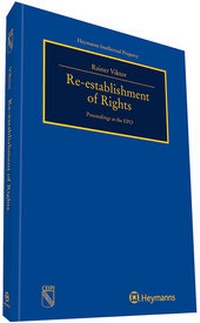
Re-establishment of Rights
Description
Wiedereinsetzungsverfahren beim Europäischen Patentamt aufgrund eines Fristversäumnisses sind eine Herausforderung, geht es doch nicht selten um viel Geld, wenn eine Patentanmeldung oder ein Patent deshalb verloren geht. Es ist somit unabdingbar, die Besonderheiten und Tücken dieses Verfahrens zu kennen. Dieses in englischer Sprache verfasste Werk vermittelt erstmalig ein vollständiges Bild über mehr als 400 Entscheidungen der Beschwerdekammern des EPA und Trends in der Rechtsprechung. Das Buch ist erste Wahl wenn es darum geht, für den konkreten Fall einschlägige Rechtsprechung zu finden. Es gibt außerdem eine Orientierung für die Organisation einer Patentanwaltskanzlei oder Patentabteilung, um das Risiko eines Fristversäumnisses zu minimieren und die Erfolgsaussichten eines Antrags auf Wiedereinsetzung zu maximieren.
Diese Neuerscheinung verschafft einen systematischen Überblick über die Rechtsprechung zu verschiedensten Szenarien und Besonderheiten des Wiedereinsetzungsverfahrens, insbesondere zu den Themen:
Kriterien für Wiedereinsetzung
Aktenanlage
Fristberechnung
Fristnotierung und Cross-Check
Aktenverwaltungssoftware
Einarbeitung neuer Mitarbeiter
Amtspost
Korrespondenz per Email
Der "wahre Wille" der Mandantin
Erinnerungen an Fristen - wann und wie oft?
Jahresgebühren - was tun, wenn nicht zuständig?
Notwendige Informationen an Korrespondenzanwälte
Außerdem sind Muster für den Aufbau und Inhalt eines Antrags auf Wiedereinsetzung zu verschiedenen Fallgestaltungen sowie eine ausführliche Checkliste zur Organisation der Kanzlei oder Patentabteilung enthalten.
Re-establishment of Rights proceedings at the European Patent Office is a remedy of last resort to rectify a missed deadline. Failure to successfully re-establish a patent right represents not only a loss of the patent right but often an opportunity for financial gain. Therefore, every patent practitioner needs to know how to most effectively naviagte this remedy. For the first time, one book conveys a complete overview of more than 400 decisions of the Boards of Appeal of the EPO, including developments over the years as well as recent trends. It is a "go-to" manual for the patent practioner, where the most relevant case law for this remedy can easily be found. On top of that, it also provides critical guidance for organizing a patent law firm or patent department to both minimize the risk of missing a term and maximize the probability that a request for restoration will be successful.
This book systematically organizes the jurisprudence of the Boards of Appeal by various scenarios and the specifc demands of restoration proceedings, in particular according to the topics:
Requirements for re-establishment
Establishing a file
Calculation of Terms
Docketing terms and Cross-Check
File management Software
New staff member
Office mail
Correspondence by email
The "true intention" of the client · Reminders - when and how many?
Renewal fees - what to do, if not in charge of?
Necessary information to other law firms
The book also contains samples for the structure and content of a request for re-establishment of rights for various specific situations, and a detailed check-list for the organization of a patent law firm or patent department.

More details
Other editions
Additional editions