

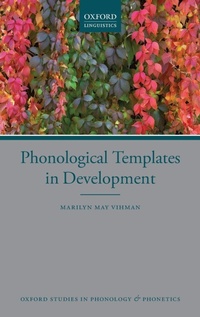
Phonological Templates in Development
Published on 30. October 2019
Book
Hardback
374 pages
978-0-19-879356-4 (ISBN)
Description
This book explores the role of phonological templates in early language use from the perspective of usage-based phonology and exemplar models and within the larger developmental framework of Dynamic Systems Theory. After analysing children's first words and their adult targets, Vihman sets out procedures for establishing the children's later prosodic structures and templates, drawing on data from American and British English, Estonian, Finnish, French, Italian, and Welsh; she also provides briefer longitudinal accounts of template use in Arabic and Brazilian Portuguese. The children are found to begin with simple word forms that match their selected adult targets; this is followed by the production of more challenging words, adapted to fit the child's existing patterns. Early accuracy is replaced by later recourse to an 'inner model' - a template - of a favoured word shape.
The book also examines the timing, fading, quantification, and function of child phonological templates. In addition, two chapters focus on the use of templates in adult language, in the core grammar and in the more creative morphology of colloquial 'short forms' and hypocoristics in French and Estonian and of English rhyming compounds. The idea of templates is traced back to its origins in Prosodic Morphology, but its uses are most in evidence in the informal settings of adult language 'at play'. Throughout the volume, the discussion returns to the issues of emergent systematicity, the roles of articulatory and memory challenges for children, and the similarities and differences in the function of templates for adults as compared with children.
The book also examines the timing, fading, quantification, and function of child phonological templates. In addition, two chapters focus on the use of templates in adult language, in the core grammar and in the more creative morphology of colloquial 'short forms' and hypocoristics in French and Estonian and of English rhyming compounds. The idea of templates is traced back to its origins in Prosodic Morphology, but its uses are most in evidence in the informal settings of adult language 'at play'. Throughout the volume, the discussion returns to the issues of emergent systematicity, the roles of articulatory and memory challenges for children, and the similarities and differences in the function of templates for adults as compared with children.
Reviews / Votes
...the great quantity of data used to support the idea of phonological templates provides a convincing argument for their existence...The theory is well supported with data and suggests a different way to look at children's early phonological and lexical development. The text is suitable for advanced students of phonology, phonologists and speech-language pathologists. * Leah R. Paltiel-Gedalyovich, Achva Academic College, LINGUIST List * Marilyn May Vihman lays out a career's worth of work on the role of templates in children's phonological and lexical development. The book provides rich historical context and compiles a huge wealth of data in one place. It will be of interest to any student of phonological development. * Phonology *More details
Series
Language
English
Place of publication
Oxford
United Kingdom
Target group
College/higher education
Dimensions
Height: 240 mm
Width: 161 mm
Thickness: 27 mm
Weight
810 gr
ISBN-13
978-0-19-879356-4 (9780198793564)
Copyright in bibliographic data and cover images is held by Nielsen Book Services Limited or by the publishers or by their respective licensors: all rights reserved.
Schweitzer Classification
Other editions
Additional editions
Marilyn May Vihman
Phonological Templates in Development
E-Book
10/2019
1st Edition
OUP eBook
€65.49
Available for download
Person
Marilyn Vihman is Professor of Language and Linguistic Science at the University of York, having previously held positions at Stanford and the University of Wales at Bangor. Her research focuses mainly on vocal and perceptual development and word learning in the first two years of life. Her books include Phonological Development: The Origins of Language in the Child (Blackwell, 1996) and its revised edition Phonological Development: The First Two Years (Wiley-Blackwell, 2014), and, as co-editor with Tamar Keren-Portnoy, The Emergence of Phonology: Whole-Word Approaches and Cross-Linguistic Evidence (CUP, 2013).
Content
1: Perspectives on phonological development 2: Whole-word phonology: Historical and theoretical overview 3: Building the evidence: From item learning to templates 4: First words and prosodic structures: A cross-linguistic perspective 5: Phonological templates in development 6: Issues around child templates: Timing, fading, quantification, and function 7: Relation of child to adult templates, I: Parallels in core grammar 8: Relation of child to adult templates, II: Language at play 9: Conclusion Appendix I: Children and language groups Appendix IIa: Chronological list of C's adapted productions Appendix IIb: Week-by-week listing of C's adapted productions Appendix IIIa: French truncated (selected) forms in -o. Appendix IIIb: French adapted forms in -o. Appendix IV: French hypocoristics Appendix V: Estonian short forms Appendix VI: English rhyming compounds