

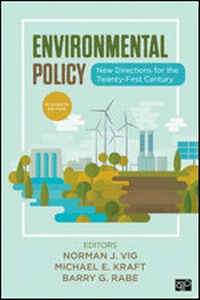
Environmental Policy
New Directions for the Twenty-First Century
11th Edition
Published on 12. April 2021
Book
Paperback/Softback
424 pages
978-1-5443-7801-5 (ISBN)
Description
Authoritative and trusted, Environmental Policy once again brings together top scholars to evaluate the changes and continuities in American environmental policy since the late 1960s and their implications for the twenty-first century. Students will learn to decipher the underlying trends, institutional constraints, and policy dilemmas that shape today's environmental politics.
The Eleventh Edition examines how policy has changed within federal institutions and state and local governments, as well as how environmental governance affects private sector policies and practices. There are five new chapters in this edition that examine the public's opinion on the environment, courts, energy policy, natural resource agencies and policies, and the political economy of green growth. The book has been updated to reflect the Trump administration's four years of policy changes and students will walk away with a measured, yet hopeful evaluation of the future challenges that policymakers will confront as the American environmental movement continues to affect the political process.
The Eleventh Edition examines how policy has changed within federal institutions and state and local governments, as well as how environmental governance affects private sector policies and practices. There are five new chapters in this edition that examine the public's opinion on the environment, courts, energy policy, natural resource agencies and policies, and the political economy of green growth. The book has been updated to reflect the Trump administration's four years of policy changes and students will walk away with a measured, yet hopeful evaluation of the future challenges that policymakers will confront as the American environmental movement continues to affect the political process.
More details
Edition
11th Revised edition
Language
English
Place of publication
Washington
United States
Publishing group
SAGE Publications Inc
Target group
College/higher education
Edition type
Revised edition
Dimensions
Height: 229 mm
Width: 152 mm
Weight
618 gr
ISBN-13
978-1-5443-7801-5 (9781544378015)
Copyright in bibliographic data and cover images is held by Nielsen Book Services Limited or by the publishers or by their respective licensors: all rights reserved.
Schweitzer Classification
Other editions
New editions
Michael E. Kraft | Barry G. Rabe | Norman J. Vig
Environmental Policy
New Directions for the Twenty-First Century
Book
03/2024
12th Edition
SAGE Publications Inc
€115.50
Shipment within 15-20 days
Previous edition
Book
06/2018
10th Edition
CQ Press
€76.94
Article exhausted; check for reprint
Persons
Norman J. Vig is the Winifred and Atherton Bean Professor of Science, Technology,
and Society emeritus at Carleton College. He has written extensively on environmental
policy, science and technology policy, and comparative politics and is coeditor
with Michael G. Faure of Green Giants? Environmental Policies of the United States
and the European Union (MIT Press, 2004) and with Regina S. Axelrod and David
Leonard Downie of The Global Environment: Institutions, Law, and Policy, 2nd ed.
(CQ Press, 2005).
Michael E. Kraft is professor emeritus of political science
and public affairs at the University of Wisconsin-Green
Bay. He is the author of, among other works, Environmental
Policy and Politics, 8th ed. (2022), and coauthor of
Coming Clean: Information Disclosure and Environmental
Performance (2011), with Mark Stephan and Troy D. Abel.
In addition, he is the coeditor of Environmental Policy:
New Directions in the 21st Century, 12th ed. (2025), with
Barry G. Rabe and Norman J. Vig; Toward Sustainable
Communities: Transition and Transformations in Environmental Policy, 2nd ed. (2009), with
Daniel A. Mazmanian; and Business and Environmental Policy: Corporate Interests in the
American Political System (2007) and The Oxford Handbook of U.S. Environmental Policy (2013),
with Sheldon Kamieniecki. For over forty years, he taught courses in environmental policy and
politics, American government, Congress, and public policy analysis.
Barry G. Rabe is the J. Ira and Nicki Harris Family Professor of Public Policy and the
Arthur F. Thurnau Professor of Environmental Policy at the Gerald R. Ford School
of Public Policy at the University of Michigan. He also serves as a nonresident senior
fellow at the Brookings Institution and as a fellow of the National Academy of Public
Administration. He is the author of numerous books and articles, including Statehouse
and Greenhouse: The Emerging Politics of American Climate Change Policy (Brookings,
2004), which received the 2017 Martha Derthick Book Award from the American
Political Science Association for making a lasting contribution to the study of federalism.
His latest books are Can We Price Carbon? (MIT Press, 2018) and Trump, the
Administrative Presidency, and Federalism (Brookings, 2020), coauthored with Frank J.
Thompson and Kenneth K. Wong, and he is currently working on a book examining
the politics of short-lived climate pollutants such as methane.
and Society emeritus at Carleton College. He has written extensively on environmental
policy, science and technology policy, and comparative politics and is coeditor
with Michael G. Faure of Green Giants? Environmental Policies of the United States
and the European Union (MIT Press, 2004) and with Regina S. Axelrod and David
Leonard Downie of The Global Environment: Institutions, Law, and Policy, 2nd ed.
(CQ Press, 2005).
Michael E. Kraft is professor emeritus of political science
and public affairs at the University of Wisconsin-Green
Bay. He is the author of, among other works, Environmental
Policy and Politics, 8th ed. (2022), and coauthor of
Coming Clean: Information Disclosure and Environmental
Performance (2011), with Mark Stephan and Troy D. Abel.
In addition, he is the coeditor of Environmental Policy:
New Directions in the 21st Century, 12th ed. (2025), with
Barry G. Rabe and Norman J. Vig; Toward Sustainable
Communities: Transition and Transformations in Environmental Policy, 2nd ed. (2009), with
Daniel A. Mazmanian; and Business and Environmental Policy: Corporate Interests in the
American Political System (2007) and The Oxford Handbook of U.S. Environmental Policy (2013),
with Sheldon Kamieniecki. For over forty years, he taught courses in environmental policy and
politics, American government, Congress, and public policy analysis.
Barry G. Rabe is the J. Ira and Nicki Harris Family Professor of Public Policy and the
Arthur F. Thurnau Professor of Environmental Policy at the Gerald R. Ford School
of Public Policy at the University of Michigan. He also serves as a nonresident senior
fellow at the Brookings Institution and as a fellow of the National Academy of Public
Administration. He is the author of numerous books and articles, including Statehouse
and Greenhouse: The Emerging Politics of American Climate Change Policy (Brookings,
2004), which received the 2017 Martha Derthick Book Award from the American
Political Science Association for making a lasting contribution to the study of federalism.
His latest books are Can We Price Carbon? (MIT Press, 2018) and Trump, the
Administrative Presidency, and Federalism (Brookings, 2020), coauthored with Frank J.
Thompson and Kenneth K. Wong, and he is currently working on a book examining
the politics of short-lived climate pollutants such as methane.
Content
Preface
About the Editors
About the Contributors
Part I. Environmental Policy and Politics in Transition
1. U.S. Environmental Policy: A Half-Century Assessment
2. Racing to the Top, the Bottom, or the Middle of the Pack? The Evolving State Government Role in Environmental Protection
3. Politics, Prices and Proof: American Public Opinion on Environmental Policy
Part II. Federal Institutions and Policy Change
4. Presidential Powers and Environmental Policy
5. Environmental Policy in Congress
6. Environmental Policy in the Courts
7. The Environmental Protection Agency
Part III. Public Policy Dilemmas
8. Energy Policy
9. Natural Resource Policies in an Era of Polarized Politics
10. Applying Market Principles to Environmental Policy
11. Sustainability and Resilience in Cities: What Cities Are Doing
Part IV. Global Issues and Controversies
12. Global Climate Change Governance: Can the Promise of Paris be Realized?
13. Environment, Population, and the Developing World
14. Creating the Green Economy: Government, Business, and a Sustainable Future
Part V. Conclusion
15. Conclusion: Environmental Policy in Crisis
Appendices
Index
About the Editors
About the Contributors
Part I. Environmental Policy and Politics in Transition
1. U.S. Environmental Policy: A Half-Century Assessment
2. Racing to the Top, the Bottom, or the Middle of the Pack? The Evolving State Government Role in Environmental Protection
3. Politics, Prices and Proof: American Public Opinion on Environmental Policy
Part II. Federal Institutions and Policy Change
4. Presidential Powers and Environmental Policy
5. Environmental Policy in Congress
6. Environmental Policy in the Courts
7. The Environmental Protection Agency
Part III. Public Policy Dilemmas
8. Energy Policy
9. Natural Resource Policies in an Era of Polarized Politics
10. Applying Market Principles to Environmental Policy
11. Sustainability and Resilience in Cities: What Cities Are Doing
Part IV. Global Issues and Controversies
12. Global Climate Change Governance: Can the Promise of Paris be Realized?
13. Environment, Population, and the Developing World
14. Creating the Green Economy: Government, Business, and a Sustainable Future
Part V. Conclusion
15. Conclusion: Environmental Policy in Crisis
Appendices
Index