

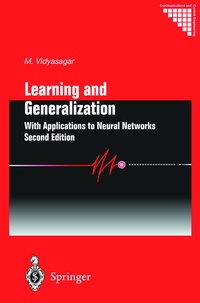
Learning and Generalisation
With Applications to Neural Networks
2nd Edition
Published on 27. September 2002
Book
Hardback
XXI, 488 pages
978-1-85233-373-7 (ISBN)
Description
The author is extremely well known and respected in this field and he provides a very comprehensive text with a broad focus covering all aspects of learning theory and it's applications.
More details
Series
Edition
Second Edition 2003
Language
English
Place of publication
London
United Kingdom
Target group
Professional and scholarly
Research
Edition type
New edition
Illustrations
XXI, 488 p.
Dimensions
Height: 241 mm
Width: 160 mm
Thickness: 32 mm
Weight
928 gr
ISBN-13
978-1-85233-373-7 (9781852333737)
DOI
10.1007/978-1-4471-3748-1
Schweitzer Classification
Other editions
Additional editions
E-Book
03/2013
2nd Edition
Springer
€181.89
Available for download
Book
10/2010
2nd Edition
Springer
€192.59
Shipment within 15-20 days
Previous edition
Mathukumalli Vidyasagar
A Theory of Learning and Generalization
With Applications to Neural Networks and Control Systems
Book
12/1996
Springer
€85.59
Article exhausted; check for reprint
Person
Mathukumalli Vidyasagar was born in Guntur, India on September 29, 1947. He received the B.S., M.S. and Ph.D. degrees in electrical engineering from the University of Wisconsin in Madison, in 1965, 1967 and 1969 respectively. Between 1969 and 1989, he was a Professor of Electrical Engineering at various universities in the USA and Canada. His last overseas job was with the University of Waterloo, Waterloo, ON, Canada, where he served between 1980 and 1989. In 1989 he returned to India as the Director of the newly created Centre for Artificial Intelligence and Robotics (CAIR) in Bangalore, under the Ministry of Defence, Government of India. Between 1989 and 2000, he built up CAIR into a leading research laboratory with about 40 scientists and a total of about 85 persons, working in areas such as flight control, robotics, neural networks, and image processing. In 2000 he moved to the Indian private sector as an Executive Vice President of India's largest software company, Tata Consultancy Services. In the city of Hyderabad, he created the Advanced Technology Center, an industrial R&D laboratory of around 80 engineers, working in areas such as computational biology, quantitative finance, e-security, identity management, and open source software to support Indian languages. In 2009 he retired from TCS at the age of 62, and joined the Erik Jonsson School of Engineering and Computer Science at the University of Texas at Dallas, as a Cecil and Ida Green Chair in Systems Biology Science. In March 2010 he was named as the Founding Head of the newly created Bioengineering Department. His current research interests are in the application of stochastic processes and stochastic modeling to problems in computational biology, control systems and quantitative finance.
Content
1. Introduction.- 2. Preliminaries.- 3. Problem Formulations.- 4. Vapnik-Chervonenkis, Pseudo- and Fat-Shattering Dimensions.- 5. Uniform Convergence of Empirical Means.- 6. Learning Under a Fixed Probability Measure.- 7. Distribution-Free Learning.- 8. Learning Under an Intermediate Family of Probabilities.- 9. Alternate Models of Learning.- 10. Applications to Neural Networks..- 11. Applications to Control Systems.- 12. Some Open Problems.