

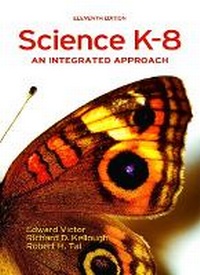
Science K-8
An Integrated Approach
11th Edition
Published on 28. August 2007
Book
Hardback
576 pages
978-0-13-199210-8 (ISBN)
Description
Packed with the science content future teachers must know, and based on the premise that integrated learning by inquiry is the cornerstone of effective science teaching, the eleventh edition of this classic again focuses on the four developmental components of both teaching and learning-the why, what, how, and how well of teaching. Unique to this text are complete content outlines covering the big ideas of life, earth, and phyisical science. Teachers can use these outlines and sequence concepts to build science units with an assurance they will be complete.
More details
Edition
11th edition
Language
English
Place of publication
United States
Publishing group
Pearson Education (US)
Target group
Professional and scholarly
Dimensions
Height: 283 mm
Width: 210 mm
Thickness: 27 mm
Weight
1334 gr
ISBN-13
978-0-13-199210-8 (9780131992108)
Copyright in bibliographic data and cover images is held by Nielsen Book Services Limited or by the publishers or by their respective licensors: all rights reserved.
Schweitzer Classification
Other editions
Previous edition
Book
05/2003
10th Edition
Pearson
€76.74
Article exhausted; check for reprint
Content
I. TEACHING SCIENCE K-8.
1. Teaching Science in Grades K-8: Then and Now.
2. Goals and Objectives for K-8 Science.
3. Understanding the Nature of Science and Sciencing.
4. Questioning and Other Behaviors that Provide the Foundation for Active Science Learning.
5. Strategies for Helping Children Learn Science.
6. Selecting and Using Media and Other Instructional Aids and Resources.
7. Planning the Instruction.
8. Assessing and Reporting Student Achievement.
II. BASIC SCIENCE INFORMATION, LEARNING ACTIVITIES, AND OTHER RESOURCES.
Earth and the Universe.
9. The Universe. 10. The Earth. 11. Water, Weather, and Climate. Living Things.
12. Plants. 13. Neither Plant nor Animal. 14. Animals. 15. The Human Body. Matter, Energy, and Technology.
16. Changes in Matter and Energy. 17. Friction and Machines. 18. Heat, Fire, and Fuels. 19. Sound. 20. Light. 21. Magnetism and Electricity. Name Index. Subject Index.
1. Teaching Science in Grades K-8: Then and Now.
2. Goals and Objectives for K-8 Science.
3. Understanding the Nature of Science and Sciencing.
4. Questioning and Other Behaviors that Provide the Foundation for Active Science Learning.
5. Strategies for Helping Children Learn Science.
6. Selecting and Using Media and Other Instructional Aids and Resources.
7. Planning the Instruction.
8. Assessing and Reporting Student Achievement.
II. BASIC SCIENCE INFORMATION, LEARNING ACTIVITIES, AND OTHER RESOURCES.
Earth and the Universe.
9. The Universe. 10. The Earth. 11. Water, Weather, and Climate. Living Things.
12. Plants. 13. Neither Plant nor Animal. 14. Animals. 15. The Human Body. Matter, Energy, and Technology.
16. Changes in Matter and Energy. 17. Friction and Machines. 18. Heat, Fire, and Fuels. 19. Sound. 20. Light. 21. Magnetism and Electricity. Name Index. Subject Index.