

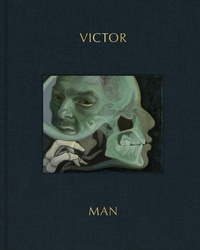
Victor Man: The Absence That We Are
David Zwirner (Publisher)
Will be published approx. on 25. June 2026
Book
Hardback
74 pages
978-1-64423-184-5 (ISBN)
Description
Victor Man is one of the most quietly commanding painters working today. His profound, enigmatic canvases occupy a singular place at the intersection of the spiritual and the material, the living and the dead.
Victor Man's paintings reveal varied, nonlinear references to literature, art, and poetry that transform essential elements of the human experience into visionary manifestations of color and form. The works collected in The Absence That We Are depict subjects imbued with a kind of sotto voce tonality. These compositions engender a complex, layered encounter, whose figures occupy and move through the transience of human life.
In these paintings, Man positions mortality as an inherent presence within and successor to life-a process intimately linking the human realm with its natural, spiritual, and animal counterparts. His work carries a contemporary immediacy and primeval beauty, and is similarly marked by a nuanced intermingling of mourning and wonder, myth and earthly life. Ultimately, with their delicate, poetic treatment, Man's paintings mediate between a sense of history and the experience of the world.
This volume is produced on the occasion of the artist's first exhibition with David Zwirner, in London, Victor Man: The Absence That We Are. David Zwirner's foreword to the volume highlights his personal interest in Man's work. This catalogue also features an English translation of a traditional Romanian funerary chant recorded by the composer and ethnomusicologist Constantin Brailoiu; newly commissioned poetry by the Swedish artist Karl Holmqvist; and poetry by the Austrian poet Georg Trakl.
Victor Man's paintings reveal varied, nonlinear references to literature, art, and poetry that transform essential elements of the human experience into visionary manifestations of color and form. The works collected in The Absence That We Are depict subjects imbued with a kind of sotto voce tonality. These compositions engender a complex, layered encounter, whose figures occupy and move through the transience of human life.
In these paintings, Man positions mortality as an inherent presence within and successor to life-a process intimately linking the human realm with its natural, spiritual, and animal counterparts. His work carries a contemporary immediacy and primeval beauty, and is similarly marked by a nuanced intermingling of mourning and wonder, myth and earthly life. Ultimately, with their delicate, poetic treatment, Man's paintings mediate between a sense of history and the experience of the world.
This volume is produced on the occasion of the artist's first exhibition with David Zwirner, in London, Victor Man: The Absence That We Are. David Zwirner's foreword to the volume highlights his personal interest in Man's work. This catalogue also features an English translation of a traditional Romanian funerary chant recorded by the composer and ethnomusicologist Constantin Brailoiu; newly commissioned poetry by the Swedish artist Karl Holmqvist; and poetry by the Austrian poet Georg Trakl.
More details
Language
English
Place of publication
NY
United States
Illustrations
26 Illustrations
Dimensions
Height: 305 mm
Width: 245 mm
Weight
700 gr
ISBN-13
978-1-64423-184-5 (9781644231845)
Copyright in bibliographic data and cover images is held by Nielsen Book Services Limited or by the publishers or by their respective licensors: all rights reserved.
Schweitzer Classification
Persons
Karl Holmqvist is an artist living and working in Berlin. His work often involves different types of writing in the form of poetry and spoken word. He has performed and exhibited widely at institutions including Beau Travail, Stockholm; The Brick, Los Angeles; Fridericianum, Kassel; Centre d'Art Contemporaine, Geneva; Power Station, Dallas; and Camden Arts Centre, London. He has participated in the Venice Biennial in 2003 and 2011 and Performa, New York in 2005, 2007, 2013 and 2023.
Constantin Brailoiu was born in 1893 in Bucharest, Romania. An ethnomusicologist and composer, he was a pioneering figure in the study of traditional music and conducted extensive research on Romanian and Eastern European folk traditions. In 1944 he founded the International Archives of Folk Music in Geneva, now part of the Musee d'Ethnographie de Geneve. Brailoiu died in 1958 in Geneva, Switzerland.
Georg Trakl (1887-1914) was an Austrian Expressionist poet, whose dark, melancholic German-language works influenced writers after World Wars I and II. Trakl trained as a pharmacist, and his poetry was supported by the patronage of Ludwig Wittgenstein.
Constantin Brailoiu was born in 1893 in Bucharest, Romania. An ethnomusicologist and composer, he was a pioneering figure in the study of traditional music and conducted extensive research on Romanian and Eastern European folk traditions. In 1944 he founded the International Archives of Folk Music in Geneva, now part of the Musee d'Ethnographie de Geneve. Brailoiu died in 1958 in Geneva, Switzerland.
Georg Trakl (1887-1914) was an Austrian Expressionist poet, whose dark, melancholic German-language works influenced writers after World Wars I and II. Trakl trained as a pharmacist, and his poetry was supported by the patronage of Ludwig Wittgenstein.