

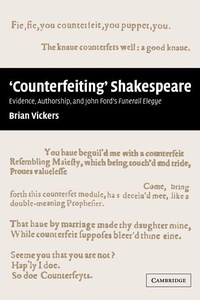
'Counterfeiting' Shakespeare
Evidence, Authorship and John Ford's Funerall Elegye
Published on 1. October 2009
Book
Paperback/Softback
600 pages
978-0-521-12035-7 (ISBN)
Description
'Counterfeiting' Shakespeare addresses the fundamental issue of what Shakespeare actually wrote, and how this is determined. In recent years his authorship has been claimed for two poems, the lyric 'Shall I die?' and A Funerall Elegye. These attributions have been accepted into certain major editions of Shakespeare's works but Brian Vickers argues that both attributions rest on superficial verbal parallels; both use too small a sample, ignore negative evidence, and violate basic principles in authorship studies. Through a fresh examination of the evidence, Professor Vickers shows that neither poem has the stylistic and imaginative qualities we associate with Shakespeare. In other words, they are 'counterfeits', in the sense of anonymously authored works wrongly presented as Shakespeare's. He argues that the poet and dramatist John Ford wrote the Elegye: its poetical language (vocabulary, syntax, prosody) is indistinguishable from Ford's, and it contains several hundred close parallels with his work. By combining linguistic and statistical analysis this book makes an important contribution to authorship studies.
Reviews / Votes
Review of the hardback: 'The reader of this long book, which largely consists of close stylistic analysis, is swept along by the power of its indignation ... this battleship of a book delivers what are likely to be the final salvos of a hard-fought literary engagement.' The Times Literary Supplement Review of the hardback: 'No one doing attribution work can ignore this book ... Vickers has set out a programme and an example for authorship studies ...' Jonathan Hope, Literary and Linguistic Computing Review of the hardback: 'Brian Vickers, a scholar brilliantly suited in intellectual acumen and feisty temperament for such a controversy ... [has produced] a very valuable study, and one that justifies its length and attention to technical detail ... This book is a tour de force of considerable beauty'. David Bevington, Renaissance Quarterly Review of the hardback: 'Marshalling a fearsome array of stylometric tables and statistical charts Vickers demonstrates in detail that every one of the linguistic, prosodic and rhetorical features that supposedly stamp the Funerall Elegye as 24-carat Shakespeare prove nothing of the sort ... Counterfeiting Shakespeare [is] a major contribution to the arcane domain of attribution studies, which has wider implications for our understanding of Shakespeare's poetry and plays. For, in the course of confuting misattributions ... Vickers equips us with the means of identifying more confidently than was previously possible, the unmistakable music of Shakespeare's mind at play in language ...' Kiernan Ryan, Timer Higher Education Supplement Review of the hardback: 'Counterfeiting' Shakespeare ... demolishes the case for including either poem in Shakespeare's canon. The book would be impressive if it did only that, but it is also a teach-by-example on how to correctly do authorship studies to an exacting standard ... It is an important work about the Ford canon'. Michael P. Jensen, The Shakespeare Newsletter Review of the hardback: 'Vickers is a well-informed and sympathetic reviewer of quantitative work in attribution, and has emerged as a notable practitioner ... His book is a profoundly interesting one and thoroughly justified as an essay on method and good practice in scholarship. It also includes valuable and persuasive evidence about revising the Ford canon ...'. Hugh Craig, Shakespeare Quarterly Review of the hardback: 'Counterfeiting Shakespeare is an admirable book, erudite, witty, incisive and vigorous in its narrative thrust. It makes important contributions to authorship studies as well as to Ford and Shakespeare scholarship and it authoritatively dispose once and for all of the 'counterfeit' claims of 'Shall I die?' and A Funerall Elegye.' Shakespeare in Southern AfricaMore details
Language
English
Place of publication
Cambridge
United Kingdom
Target group
Professional and scholarly
Product notice
Paperback (trade)
Illustrations
Worked examples or Exercises
Dimensions
Height: 229 mm
Width: 152 mm
Thickness: 35 mm
Weight
961 gr
ISBN-13
978-0-521-12035-7 (9780521120357)
Copyright in bibliographic data and cover images is held by Nielsen Book Services Limited or by the publishers or by their respective licensors: all rights reserved.
Schweitzer Classification
Other editions
Additional editions
E-Book
12/2004
1st Edition
Cambridge University Press
€54.49
Available for download
Person
Brian Vickers is Professor of English Literature, and Director of the Centre for Renaissance Studies at Eidgenossische Technische Hochschule, Zurich. He is a Corresponding Fellow of the British Academy. His publications on Shakespeare include The Artistry of Shakespeare's Prose (1968, 1979); a six-volume collection of early Shakespeare criticism, Shakespeare: the Critical Heritage, 1623-1801 (1974-1981, 1996); Returning to Shakespeare (1989); and Appropriating Shakespeare. Contemporary Critical Quarrels (1993).
Content
Prologue: Gary Taylor finds a poem; Part I. Donald Foster's 'Shakespearean' Construct: 1. 'W.S.' and the Elegye for William Peter; 2. Parallels? Plagiarisms?; 3. Vocabulary and diction; 4. Grammar: 'the Shakespearean who'; 5. Prosody, punctuation, pause patterns; 6. Rhetoric: 'the Shakespearean hendiadys'; 7. Statistics and inference; 8. A poem 'indistinguishable from Shakespeare'; Part II. John Ford's Funerall Elegye: 9. Ford's writing career: poet, moralist, playwright; 10. Ford and the Elegye's 'Shakespearean diction'; 11. The Funerall Elegye in its Fordian context; Epilogue: the politics of attribution; Appendices: 1. The text of A Funerall Elegye; 2. Verbal parallels between A Funerall Elegye and Ford's poems; 3. Establishing Ford's canon; Bibliography.