

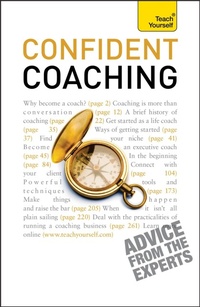
Confident Coaching
The fundamental theories and concepts of coaching: a practical guidebook
Published on 24. September 2010
Book
Paperback/Softback
352 pages
978-1-4441-0493-6 (ISBN)
Description
From executive mentoring to life coaching, more and more people are turning to and/or training as coaches.
Confident Coaching covers the principles, theories and practices of this crucial skill. It covers the fundamentals for those looking for an introduction to the subject, and also offers practice and extension for people with some existing coaching experience, whether they work inside a company or in a freelance capacity, in life coaching or executive coaching, or are managers wishing to coach their in-house teams more effectively.
The chapters each begin with a clear statement of goals and objectives, then break each topic into manageable chunks, allowing the reader to dip into sections of particular interest when needed.
Areas covered include:
- The various stages of coaching
- Fundamental models, theories and concepts
- Interventions: championing, requesting and challenging
- Timing, scheduling and duration
- Practical hints and tips for dealing with challenging situations
Sample coaching interactions are included to bring techniques to life, along with activities, case studies, anecdotes and diagrams.
NOT GOT MUCH TIME?
One and five minute introductions to key principles to get you started.
AUTHOR INSIGHTS
Lots of instant help with common problems and quick tips for success, based on the authors' many years of experience.
TEST YOURSELF
Tests in the book and online to keep track of your progress.
EXTEND YOUR KNOWLEDGE
Extra online articles at www.teachyourself.com to give you a richer understanding of coaching.
THINGS TO REMEMBER
Quick refreshers to help you remember the key facts.
TRY THIS
Innovative exercises illustrate what you've learnt and how to use it.
Confident Coaching covers the principles, theories and practices of this crucial skill. It covers the fundamentals for those looking for an introduction to the subject, and also offers practice and extension for people with some existing coaching experience, whether they work inside a company or in a freelance capacity, in life coaching or executive coaching, or are managers wishing to coach their in-house teams more effectively.
The chapters each begin with a clear statement of goals and objectives, then break each topic into manageable chunks, allowing the reader to dip into sections of particular interest when needed.
Areas covered include:
- The various stages of coaching
- Fundamental models, theories and concepts
- Interventions: championing, requesting and challenging
- Timing, scheduling and duration
- Practical hints and tips for dealing with challenging situations
Sample coaching interactions are included to bring techniques to life, along with activities, case studies, anecdotes and diagrams.
NOT GOT MUCH TIME?
One and five minute introductions to key principles to get you started.
AUTHOR INSIGHTS
Lots of instant help with common problems and quick tips for success, based on the authors' many years of experience.
TEST YOURSELF
Tests in the book and online to keep track of your progress.
EXTEND YOUR KNOWLEDGE
Extra online articles at www.teachyourself.com to give you a richer understanding of coaching.
THINGS TO REMEMBER
Quick refreshers to help you remember the key facts.
TRY THIS
Innovative exercises illustrate what you've learnt and how to use it.
More details
Series
Language
English
Place of publication
United Kingdom
Publishing group
John Murray Press
Product notice
Paperback (UK-B)
Dimensions
Height: 197 mm
Width: 131 mm
Thickness: 25 mm
Weight
339 gr
ISBN-13
978-1-4441-0493-6 (9781444104936)
Copyright in bibliographic data and cover images is held by Nielsen Book Services Limited or by the publishers or by their respective licensors: all rights reserved.
Schweitzer Classification
Other editions
Additional editions
Amanda Vickers | Steve Bavister
Confident Coaching
The fundamental theories and concepts of coaching: a practical guidebook
E-Book
09/2010
Teach Yourself Books
€3.99
Available for download
Persons
Amanda Vickers and Steve Bavister. Amanda is a Director of Speak First, a training and coaching consultancy that specialises in Presentation Skills and Personal Impact. Steve is an experienced NLP coach, therapist, trainer, author and a director of Infinite Potential, a training and coaching consultancy specialising in all aspects of communication. They are the authors of the best-selling Teach Yourself business title 'NLP'.
Content
: 1 A Brief History of Coaching
: The origins of coaching and how it has evolved and broadened over the years.
: 2 Approaches to Coaching
: All the most important models of coaching.
: 3 To Coach or Not to Coach...
: How to recognise when coaching is appropriate and when it isn't.
: 4 The Coaching Relationship
: The collaborative nature of the coaching relationship.
: 5 Coaching Your Staff/Team
: Special issues to be considered when managers and leaders opt to coach their own staff.
: 6 Working as an External Coach
: The advantages and disadvantages of working as an external coach.
: 7 Practical Matters
: All the practical things every coach needs to consider.
: 8 The Intake Session
: All the ingredients for getting things off to a good start.
: 9 Prepare Yourself
: All aspects of emotional and mental readiness.
: 10 Questions, Questions, Questions
: Different kinds of questions and what makes a question powerful.
: 11 Raising the Bar and Making Things Happen
: Some of the fundamental skills of coaching, supported by sample dialogue.
: 12 Tools and Techniques
: Ideas to help coaches facilitate change.
: 13 Acting as a Mirror for the Client
: Providing observations, reflecting back patterns or themes and articulating what you notice to your clients.
: 14 Offering Suggestions
: Asking permission to put forward suggestions.
: 15 Utilising Metaphors/Stories
: The power of working with the similes and analogies clients often come up with.
: 16 Their Stuff/Your Stuff
: What to do when clients raise issues that are all too familiar to you.
: 17 When the Going Gets Tough
: Overcoming problems and handling 'gremlins'.
: 18 Closure/Completion
: Bringing the coaching relationship to a satisfactory conclusion.
: 19 Developing Yourself as a Coach
: Evolving your own style as a coach and ways of developing coaching skills.
: 20 Coaching as a Career
: Advice for those who want to set themselves up as an independent coach.
: The origins of coaching and how it has evolved and broadened over the years.
: 2 Approaches to Coaching
: All the most important models of coaching.
: 3 To Coach or Not to Coach...
: How to recognise when coaching is appropriate and when it isn't.
: 4 The Coaching Relationship
: The collaborative nature of the coaching relationship.
: 5 Coaching Your Staff/Team
: Special issues to be considered when managers and leaders opt to coach their own staff.
: 6 Working as an External Coach
: The advantages and disadvantages of working as an external coach.
: 7 Practical Matters
: All the practical things every coach needs to consider.
: 8 The Intake Session
: All the ingredients for getting things off to a good start.
: 9 Prepare Yourself
: All aspects of emotional and mental readiness.
: 10 Questions, Questions, Questions
: Different kinds of questions and what makes a question powerful.
: 11 Raising the Bar and Making Things Happen
: Some of the fundamental skills of coaching, supported by sample dialogue.
: 12 Tools and Techniques
: Ideas to help coaches facilitate change.
: 13 Acting as a Mirror for the Client
: Providing observations, reflecting back patterns or themes and articulating what you notice to your clients.
: 14 Offering Suggestions
: Asking permission to put forward suggestions.
: 15 Utilising Metaphors/Stories
: The power of working with the similes and analogies clients often come up with.
: 16 Their Stuff/Your Stuff
: What to do when clients raise issues that are all too familiar to you.
: 17 When the Going Gets Tough
: Overcoming problems and handling 'gremlins'.
: 18 Closure/Completion
: Bringing the coaching relationship to a satisfactory conclusion.
: 19 Developing Yourself as a Coach
: Evolving your own style as a coach and ways of developing coaching skills.
: 20 Coaching as a Career
: Advice for those who want to set themselves up as an independent coach.