


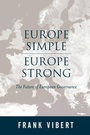
Europe Simple, Europe Strong
The Future of European Governance
1st Edition
Published on 26. October 2001
Book
Hardback
272 pages
978-0-7456-2852-3 (ISBN)
Description
A fundamental debate on the 'Future of Europe' is now underway across Europe with an official Convention headed by former French President Valerie Giscard d'Estaing considering wide ranging reforms to the existing Union. In an original and challenging contribution to this debate, Europe Simple, Europe Strong urges a radical rethink of the framework for the continent-wide political union now possible and desirable in Europe. It argues that the key to a successful system of government is the way in which it connects two systems of choice - market choice and political choice - and that Europe's present approach is likely to lead to a situation where neither system works well. The book examines the ways in which the two systems of choice have been impacted by globalisation and the information revolution and assesses how, in this new setting, European governance can be reformed to get the best out of both systems of choice. It concludes in favour of a new and simpler democratic structure. In looking at how systems of market choice and political choice relate to each other in today's setting, the book brings together contemporary thinking on the regulatory functions of government, the role of rights-based politics in relation to vote-based politics and the relevance of models of business organisation to the organisation of government. It places special emphasis on how constitutions can be designed to promote tolerance in pluralist societies.
Europe Simple, Europe Strong makes an original and challenging contribution to the European debate. It will be vital reading for a variety of academics and policy makers and for all those interested in the future of political union in Europe.
Europe Simple, Europe Strong makes an original and challenging contribution to the European debate. It will be vital reading for a variety of academics and policy makers and for all those interested in the future of political union in Europe.
Reviews / Votes
'There is intense debate about the institutional structure of the European Union. Frank Vibert's book is a crucial contribution to this. It displays a deep knowledge of the Union and of the complex theoretical discussions about its future. In short, it is indispensable.'Raymond Plant, University of Southampton
'Frank Vibert is one of the leading advocates of a European constitution that would emphasize the strengths of European government, namely the capacity to set rules that reach across the continent to secure common standards within a rapidly changing market. The message of strength through simplicity that lies at the heart of this book is both important and intriguing. Europe Simple, Europe Strong is an essential read for anyone concerned with the constitutional future of Europe.'
Albert Weale, University of Essex'An attractive blueprint for reform' European Business Review
More details
Language
English
Place of publication
Oxford
United Kingdom
Publishing group
John Wiley and Sons Ltd
Target group
College/higher education
Professional and scholarly
Product notice
sewn/stitched
Cloth over boards
Dimensions
Height: 238 mm
Width: 158 mm
Thickness: 25 mm
Weight
510 gr
ISBN-13
978-0-7456-2852-3 (9780745628523)
Copyright in bibliographic data and cover images is held by Nielsen Book Services Limited or by the publishers or by their respective licensors: all rights reserved.
Schweitzer Classification
Other editions
Additional editions
Book
10/2001
1st Edition
Polity Press
€34.50
Shipment within 15-20 days
Person
Frank Vibert is the Co-Founder and Director of the European Policy Forum in London.
Content
Preface. Acknowledgements.
Introduction.
1. How to Look at European Governance.
2. Adapting to Shock: The New Setting for Governance.
3. Projecting the Past: Conventional Scenarios for Europe's Future.
4. The Reach of Rules.
5. Signals and Noise: the Role of Rights.
6. Networks and Nexus.
7. Simplicity.
8. Coherence.
9. The Spirit of Europe.
10. Conclusions.
Notes.
Bibliography.
Index.
Introduction.
1. How to Look at European Governance.
2. Adapting to Shock: The New Setting for Governance.
3. Projecting the Past: Conventional Scenarios for Europe's Future.
4. The Reach of Rules.
5. Signals and Noise: the Role of Rights.
6. Networks and Nexus.
7. Simplicity.
8. Coherence.
9. The Spirit of Europe.
10. Conclusions.
Notes.
Bibliography.
Index.