

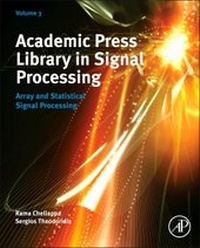
Academic Press Library in Signal Processing: Volume 3
Array and Statistical Signal Processing
Published on 5. September 2013
Book
Hardback
1012 pages
978-0-12-411597-2 (ISBN)
Description
This third volume, edited and authored by world leading experts, gives a review of the principles, methods and techniques of important and emerging research topics and technologies in array and statistical signal processing.
With this reference source you will:
Quickly grasp a new area of research
Understand the underlying principles of a topic and its application
Ascertain how a topic relates to other areas and learn of the research issues yet to be resolved
With this reference source you will:
Quickly grasp a new area of research
Understand the underlying principles of a topic and its application
Ascertain how a topic relates to other areas and learn of the research issues yet to be resolved
More details
Series
Language
English
Place of publication
San Diego
United States
Publishing group
Elsevier Science Publishing Co Inc
Target group
Professional and scholarly
R&D engineers in signal processing and wireless and mobile communications
Dimensions
Height: 235 mm
Width: 191 mm
Weight
1820 gr
ISBN-13
978-0-12-411597-2 (9780124115972)
Copyright in bibliographic data and cover images is held by Nielsen Book Services Limited or by the publishers or by their respective licensors: all rights reserved.
Schweitzer Classification
Other editions
Additional editions
Mats Viberg | Abdelhak Zoubir
Academic Press Library in Signal Processing
Array and Statistical Signal Processing
E-Book
08/2013
Academic Press
€175.00
Available for download
Persons
Sergios Theodoridis is professor emeritus of machine learning and data processing with the National and Kapodistrian University of Athens, Athens, Greece. He has also served as distinguished professor with the Aalborg University Denmark and as professor with the Chinese University of Hong Kong, Shenzhen, China. In 2023, he received an honorary doctorate degree (D.Sc) from the University of Edinburgh, U.K. He has also received a number of prestigious awards, including the 2014 IEEE Signal Processing Magazine Best Paper Award, the 2009 IEEE Computational Intelligence Society Transactions on Neural Networks Outstanding Paper Award, the 2017 European Association for Signal Processing (EURASIP) Athanasios Papoulis Award, the 2014 IEEE Signal Processing Society Carl Friedrich Gauss Education Award, and the 2014 EURASIP Meritorious Service Award. He has served as president of EURASIP and vice president for the IEEE Signal Processing Society. He is a Fellow of EURASIP and a Life Fellow of IEEE. He is the coauthor of the book Pattern Recognition, 4th edition, Academic Press, 2009 and of the book Introduction to Pattern Recognition: A MATLAB Approach, Academic Press, 2010.
Prof. Rama Chellappa received the B.E. (Hons.) degree from the University of Madras, India, in 1975 and the M.E. (Distinction) degree from Indian Institute of Science, Bangalore, in 1977. He received M.S.E.E. and Ph.D. Degrees in Electrical Engineering from Purdue University, West Lafayette, IN, in 1978 and 1981 respectively. Since 1991, he has been a Professor of Electrical Engineering and an affiliate Professor of Computer Science at University of Maryland, College Park. He is also affiliated with the Center for Automation Research (Director) and the Institute for Advanced Computer Studies (Permanent Member). In 2005, he was named a Minta Martin Professor of Engineering. Prior to joining the University of Maryland, he was an Assistant (1981-1986) and Associate Professor (1986-1991) and Director of the Signal and Image Processing Institute (1988-1990) at University of Southern California, Los Angeles.
Over the last 29 years, he has published numerous book chapters, peer-reviewed journal and conference papers. He has co-authored and edited books on MRFs, face and gait recognition and collected works on image processing and analysis. His current research interests are face and gait analysis, markerless motion capture, 3D modeling from video, image and video-based recognition and exploitation and hyper spectral processing.
Prof. Rama Chellappa received the B.E. (Hons.) degree from the University of Madras, India, in 1975 and the M.E. (Distinction) degree from Indian Institute of Science, Bangalore, in 1977. He received M.S.E.E. and Ph.D. Degrees in Electrical Engineering from Purdue University, West Lafayette, IN, in 1978 and 1981 respectively. Since 1991, he has been a Professor of Electrical Engineering and an affiliate Professor of Computer Science at University of Maryland, College Park. He is also affiliated with the Center for Automation Research (Director) and the Institute for Advanced Computer Studies (Permanent Member). In 2005, he was named a Minta Martin Professor of Engineering. Prior to joining the University of Maryland, he was an Assistant (1981-1986) and Associate Professor (1986-1991) and Director of the Signal and Image Processing Institute (1988-1990) at University of Southern California, Los Angeles.
Over the last 29 years, he has published numerous book chapters, peer-reviewed journal and conference papers. He has co-authored and edited books on MRFs, face and gait recognition and collected works on image processing and analysis. His current research interests are face and gait analysis, markerless motion capture, 3D modeling from video, image and video-based recognition and exploitation and hyper spectral processing.
Content
Introduction to Statistical Signal Processing; Model Order Selection; Non-Stationary Signal Analysis Time-Frequency Approach; Bayesian Computational Methods in Signal Processing; Distributed Signal Detection; Quickest Change Detection; Geolocation-Maps, Measurements, Models, and Methods; Performance Analysis and Bounds; Diffusion Adaptation Over Networks; Array Signal Processing: Overview of the Included Chapters; ntroduction to Array Processing; Adaptive and Robust Beamforming; Broadband Beamforming and Optimization; DOA Estimation Methods and Algorithms; Subspace Methods and Exploitation of Special Array Structures; Performance Bounds and Statistical Analysis of DOA Estimation; DOA Estimation of Nonstationary Signals; Source Localization and Tracking; Array Processing in the Face of Nonidealities; Applications of Array Signal Processing