

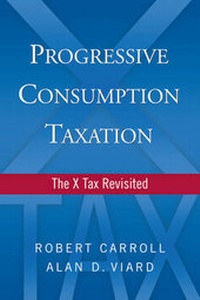
Progressive Consumption Taxation
The X-Tax Revisited
Published on 11. May 2012
Book
Hardback
222 pages
978-0-8447-4394-3 (ISBN)
Description
Alone among developed countries, the United States has no broad-based national consumption tax. Yet, economic analysis suggests that consumption taxation is superior to income taxation because it does not penalize saving and investment. The authors conclude that the U.S. income tax system should be completely replaced by a progressive consumption tax.
The authors argue that the X tax, developed by the late David Bradford, offers the best form of progressive consumption taxation for the United States. To achieve progressively, the X tax modifies the value added tax by splitting its consumption tax base into two components, wages and business cash flow. The X tax applies graduated tax rates to households' wages and applies a flat tax rate, equal to the highest wage tax rate, to business firms' cash flows. The authors outline concrete proposals for the X tax's treatment of pensions and fringe benefits, business firms, financial intermediaries, international transactions, owner-occupied housing, state and local governments, the transition, and other issues.
By adopting the X tax, the United States can preserve tax progressively while promoting economic growth through the removal of tax penalties on saving and investment.
The authors argue that the X tax, developed by the late David Bradford, offers the best form of progressive consumption taxation for the United States. To achieve progressively, the X tax modifies the value added tax by splitting its consumption tax base into two components, wages and business cash flow. The X tax applies graduated tax rates to households' wages and applies a flat tax rate, equal to the highest wage tax rate, to business firms' cash flows. The authors outline concrete proposals for the X tax's treatment of pensions and fringe benefits, business firms, financial intermediaries, international transactions, owner-occupied housing, state and local governments, the transition, and other issues.
By adopting the X tax, the United States can preserve tax progressively while promoting economic growth through the removal of tax penalties on saving and investment.
Reviews / Votes
Progressive Consumption Taxation carefully lays out the rationale for adopting a progressive consumption tax system in the United States and shows how such a system can be adopted. Carroll and Viard provide the motivating 'big picture' arguments but also tackle the many thorny details that confront this tax reform, including the appropriate treatment of financial intermediaries, international transactions, and transition from the income tax. The book is accessible to those with a policy interest, but it will also enlighten tax experts. -- Alan J. Auerbach, University of California, Berkeley Although consumption-type taxes like the Flat Tax and FairTax are beloved by GOP presidential candidates, they have never won political traction because they are widely perceived as unfair. Bob Carroll and Alan Viard take fairness considerations seriously and explain how a modern version of the X Tax could address them while preserving the efficiency advantages of a consumption tax. The book provides a comprehensive and accessible analysis of progressive consumption taxation and should be on the reading list of anyone interested in fundamental tax reform. -- Leonard E. Burman, Syracuse University and the Urban InstituteMore details
Language
English
Place of publication
Washington DC
United States
Target group
College/higher education
Dimensions
Height: 237 mm
Width: 161 mm
Thickness: 21 mm
Weight
440 gr
ISBN-13
978-0-8447-4394-3 (9780844743943)
Copyright in bibliographic data and cover images is held by Nielsen Book Services Limited or by the publishers or by their respective licensors: all rights reserved.
Schweitzer Classification
Other editions
Additional editions
E-Book
05/2012
AEI Press
€76.99
Available for download
Persons
Alan D. Viard is a resident scholar at the American Enterprise Institute.
Robert Carroll is vice president for economic policy at the Tax Foundation and co-director of the Center for Public Finance and Research at American University.
Robert Carroll is vice president for economic policy at the Tax Foundation and co-director of the Center for Public Finance and Research at American University.
Content
LIST OF ILLUSTRATIONS
ACKNOWLEDGMENTS
INTRODUCTION
1. WHY TAX CONSUMPTION?
Removing the Income Tax Penalty on Saving
Gains from Reform
Consumption-Tax Features in the Current Income Tax System
Conclusion
Box: The Trade-off Fallacy
2. THE CASE FOR THE X TAX
The Retail Sales Tax and the Value-Added Tax
The Two-Part VAT
The X Tax: A Progressive Two-Part VAT
Comparing the X Tax to the Personal Expenditures Tax
Conclusion
Box: Optics of the X Tax and the PET
3. MAINTAINING PROGRESSIVITY
Tax Rate Schedule
Assessing the Distributional Effects of the X Tax
Conclusion
Box: Zero Revenue from Taxation of Risky Returns
4. FRINGE BENEFITS AND TRANSFER PAYMENTS
Fringe Benefits
Financing Social Security and Medicare
Public and Private Transfer Payments
Conclusion
Box: Taxation of Gambling
5. BUSINESS FIRMS
General Issues
Distinguishing Wages from Business Cash Flow
Firms with Negative Business Cash Flows
Conclusion
6. FINANCIAL SERVICES
Neutral Tax Treatment
The Problem of Mislabeled Transactions
The Search for a Solution
The R+F Cash-Flow Method
Accounting Methods
Special Cases
Conclusion
7. INTERNATIONAL TRANSACTIONS
The Border Adjustment Question
The "Competitiveness" Illusion
Giving Wealth Away without Really Trying
Above-Normal Returns and Transfer Pricing
Other Cross-Border Issues
Conclusion
Box: Border Adjustment with Fixed Exchange Rates
8. THE TRANSITION
Transition Burden on Existing Capital
Normative Issues
Outline of a Transition Policy
Macroeconomic Policy during the Transition
Conclusion
9. THE NONBUSINESS SECTOR
Owner-Occupied Housing and Consumer Durables
Production by Governments, Nonprofits, and Households
Patrolling the Boundaries of the Business Cash-Flow Tax
Fiscal Federalism under the X Tax
Conclusion
Box: Taxation of Home Resales
10. THE VAT ALTERNATIVE
Subtraction and Credit-Invoice VATs
The Superiority of the VAT to the Retail Sales Tax
Recent Discussion of VAT
Using the VAT to Replace Other Taxes
The "Easy" Stuff
Monetary Policy and Other Transition Issues
Governments and Nonprofits
Implications for Social Security
Combating the "Money Machine"
Conclusion
CONCLUSION
NOTES
REFERENCES
INDEX
ABOUT THE AUTHORS
ACKNOWLEDGMENTS
INTRODUCTION
1. WHY TAX CONSUMPTION?
Removing the Income Tax Penalty on Saving
Gains from Reform
Consumption-Tax Features in the Current Income Tax System
Conclusion
Box: The Trade-off Fallacy
2. THE CASE FOR THE X TAX
The Retail Sales Tax and the Value-Added Tax
The Two-Part VAT
The X Tax: A Progressive Two-Part VAT
Comparing the X Tax to the Personal Expenditures Tax
Conclusion
Box: Optics of the X Tax and the PET
3. MAINTAINING PROGRESSIVITY
Tax Rate Schedule
Assessing the Distributional Effects of the X Tax
Conclusion
Box: Zero Revenue from Taxation of Risky Returns
4. FRINGE BENEFITS AND TRANSFER PAYMENTS
Fringe Benefits
Financing Social Security and Medicare
Public and Private Transfer Payments
Conclusion
Box: Taxation of Gambling
5. BUSINESS FIRMS
General Issues
Distinguishing Wages from Business Cash Flow
Firms with Negative Business Cash Flows
Conclusion
6. FINANCIAL SERVICES
Neutral Tax Treatment
The Problem of Mislabeled Transactions
The Search for a Solution
The R+F Cash-Flow Method
Accounting Methods
Special Cases
Conclusion
7. INTERNATIONAL TRANSACTIONS
The Border Adjustment Question
The "Competitiveness" Illusion
Giving Wealth Away without Really Trying
Above-Normal Returns and Transfer Pricing
Other Cross-Border Issues
Conclusion
Box: Border Adjustment with Fixed Exchange Rates
8. THE TRANSITION
Transition Burden on Existing Capital
Normative Issues
Outline of a Transition Policy
Macroeconomic Policy during the Transition
Conclusion
9. THE NONBUSINESS SECTOR
Owner-Occupied Housing and Consumer Durables
Production by Governments, Nonprofits, and Households
Patrolling the Boundaries of the Business Cash-Flow Tax
Fiscal Federalism under the X Tax
Conclusion
Box: Taxation of Home Resales
10. THE VAT ALTERNATIVE
Subtraction and Credit-Invoice VATs
The Superiority of the VAT to the Retail Sales Tax
Recent Discussion of VAT
Using the VAT to Replace Other Taxes
The "Easy" Stuff
Monetary Policy and Other Transition Issues
Governments and Nonprofits
Implications for Social Security
Combating the "Money Machine"
Conclusion
CONCLUSION
NOTES
REFERENCES
INDEX
ABOUT THE AUTHORS