

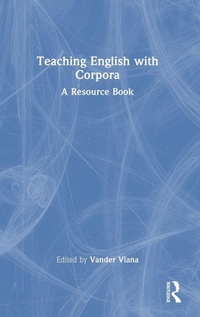
Teaching English with Corpora
A Resource Book
1st Edition
Published on 26. October 2022
Book
Hardback
368 pages
978-1-032-25299-5 (ISBN)
Description
Teaching English with Corpora is an accessible and practical introduction to the ways in which online and offline corpora can be used in English language teaching (ELT).
Featuring 70 chapters written by an international range of researchers and practitioners, this book:
* provides readers with clear, tested examples of corpus-based/driven lesson plans;
* contains activities relevant to English for general purposes and English for specific purposes;
* caters for the needs of English language teachers working with learners at different proficiency levels;
* features flexible teaching suggestions that can be explored as part of a lesson or as a full lesson.
This book is an essential purchase for pre- and in-service English language teachers as well as those studying corpus linguistics in undergraduate/Master's courses in applied linguistics, ELT and Teaching English to Speakers of Other Languages (TESOL).
Featuring 70 chapters written by an international range of researchers and practitioners, this book:
* provides readers with clear, tested examples of corpus-based/driven lesson plans;
* contains activities relevant to English for general purposes and English for specific purposes;
* caters for the needs of English language teachers working with learners at different proficiency levels;
* features flexible teaching suggestions that can be explored as part of a lesson or as a full lesson.
This book is an essential purchase for pre- and in-service English language teachers as well as those studying corpus linguistics in undergraduate/Master's courses in applied linguistics, ELT and Teaching English to Speakers of Other Languages (TESOL).
Reviews / Votes
"This book does a really admirable job of bridging the gap between theory and practice in computer-aided language learning. It is unique in providing not just a wide range of practical and motivating activities, but also a clear and accessible rationale for each activity. Crucially, this means that readers are equipped with both a set of ideas they can implement immediately and a set of sound principles they can use to design their own activities. Books like this, which foster principled practice, are all too few, and I thoroughly recommend this volume for teachers and teacher educators who would like to gain practical and theoretical understanding of this field." - Prof Ivor Timmis, Leeds Beckett University."This volume is a treasure trove of activities ready for classroom use. Corpus activities are presented in a teacher-friendly, easy to use manner, with topics ranging from General English to English for specific purposes for a variety of levels. A must have for any teacher interested in using corpus resources in their classroom." - Prof Randi Reppen, Northern Arizona University.
"English language teachers have been waiting a long time for a book like this. It is a wide-ranging and practical resource book that will give teachers so many ideas for using corpora in the classroom in a step-by-step way. This book really will bring corpora into the classroom." - Dr Anne O'Keeffe, Mary Immaculate College, University of Limerick.
"Corpora have revolutionised research in language and linguistics over the past 50 years, but also have much to offer in practical everyday aspects of language teaching. Teachers do not need to be corpus linguists to benefit from corpus tools in preparing their own materials and activities, but a general awareness of the potential of corpora and their uses should form a substantial part of any language teacher training programme. This book fills a long-standing need for simple, accessible, relevant and inspirational activities that can be used ready-made (many with online handouts) via a step-by-step outline of procedures, or inspire similar activities on related language points.
Based on the contributors' varied experiences and designed with the teacher firmly in mind, each of the 70 chapters is short (usually 3 to 5 pages) and self-contained, and can be dipped into at any point for teaching English for general or specific purposes. And dipping into it is certainly worthwhile, as the range of activities reveals the breathtaking potential of corpora to impact so many different dimensions of language teaching and learning. It soon becomes clear that corpora can help far beyond the obvious vocabulary and lexicogrammar, extending into pragmatics, discourse and pronunciation for all the skills, as well as topic-related content, from selecting level-appropriate texts and authentic examples in different registers or disciplines, to creating stimulating activities for teaching and learning, revising and self-correcting, and so on.
I was enthusiastic about this book when I saw the title and aims, more so when I read the list of contributors and then the thoughtful introduction (a chapter in its own right to set the scene and rationale before outlining the book), and finally thrilled when I actually opened the chapters! Some classic activity types alongside so many ideas I would never have thought of, some tools that were new to me and new uses of familiar ones (all of which seem to be freely available), even subverting some non-corpus tools such as Google Scholar. If I were a literary critic, I'd be using phrases like 'staggering tour de force'; suffice to say that I'll be getting several copies ordered." - Prof Alex Boulton, ATILF - CNRS & Universite de Lorraine.
More details
Language
English
Place of publication
London
United Kingdom
Publishing group
Taylor & Francis Ltd
Target group
College/higher education
Professional and scholarly
Postgraduate and Professional
Illustrations
185 s/w Abbildungen, 165 s/w Photographien bzw. Rasterbilder, 20 s/w Zeichnungen, 38 s/w Tabellen
38 Tables, black and white; 20 Line drawings, black and white; 165 Halftones, black and white; 185 Illustrations, black and white
Dimensions
Height: 240 mm
Width: 161 mm
Thickness: 26 mm
Weight
757 gr
ISBN-13
978-1-032-25299-5 (9781032252995)
Copyright in bibliographic data and cover images is held by Nielsen Book Services Limited or by the publishers or by their respective licensors: all rights reserved.
Schweitzer Classification
Other editions
Additional editions
Book
10/2022
1st Edition
Routledge
€58.30
Shipment within 10-20 days
E-Book
10/2022
1st Edition
Routledge
€49.99
Available for download
E-Book
10/2022
1st Edition
Routledge
€49.99
Available for download
Person
Vander Viana is Associate Professor in Education, directs the Master's course in TESOL and is the founder/leader of the Language in Education Research Group at the University of East Anglia. His areas of research expertise include corpus linguistics, English for academic purposes, TESOL and language teacher education.
Content
Table of contents
List of figures
List of tables
List of abbreviations
List of appendices
Acknowledgements
At-a-glance chapter taxonomy
Introduction
Corpora in and for TESOL
Vander Viana
Part A: English for General Purposes
Using concordance lines to teach participial adjectives
Sean Sutherland
Starting out with phrasal verbs
Rosie Harvey & Irene Marin Cervantes
Teaching collocations with 'Survey Says'
Robin Sulkosky
A grand problem and a jolly solution: Unmasking false friends with corpus analysis
Natalie Finlayson
Raising awareness of first-language interference using parallel corpora of subtitles
Elen Le Foll
If you speak English, take one step forward: Teaching conditionals through kinesthetic activities
Riah Werner
Preposition repair: Empowering learners to fix their errors
Amy Tate
KWIC searches for quick answers: Solving word choice problems
Pamela Everly
She said she told him: Patterning in reported speech
Michael H. Brown
Using VocabProfilers to select texts for extensive reading activities
Thi Ngoc Yen Dang
Talking about the weather: Exploring adjective use with Sketch Engine for Language Learning
John Williams
Food talks: Using corpus data to link cooking methods with types of food
Vander Viana
Profiling let and make with the Corpus of Contemporary American English
Ben Naismith
Corpus exploration of phrasal and Latinate verbs
Eric Nicaise
Minimal prep quizzes: Using online corpora to foster vocabulary learning
Nick Canning
Helping learners identify high-frequency words
Shoaziz Sharakhimov & Ulugbek Nurmukhamedov
Writing online reviews
Natalia Mora-Lopez
Exploring similes in corpus data
Natalie Finlayson
Exploring register variation in the use of indefinite pronouns
Irina Pandarova
Using corpora to explore varieties of English
Natalie Finlayson
Searching for frequent words for pronunciation activities
Roger W. Gee
Abstract nouns in picture descriptions
Tomas Mach
Tell me what your collocates are and I will tell you who you are
Tuelay Dixon & Daniel Dixon
I feel kinda blah! Investigating language use in blogs
Maristella Gatto
I see what you mean: Exploring figurative uses of language
Sally Zacharias & Jane Evison
I was able to learn a new point: Examining the difference between could and was/were able to
Martha Michieka & Theresa McGarry
Learning about words in use with StringNet Navigator
Anastasiia Kryzhanivska
Investigating adverbials in British English: Although vs. though in spoken and written language
Lu Lu
Using Voyant Tools to enhance learners' reflections on their writing
Nausica Marcos Miguel
Gender equality in the TESOL classroom: Exploring news stories from around the world
Vander Viana
Phrasal verbs in use: Investigating meaning and form
Vander Viana
Keywords in amateur online film reviews
Chad Langford & Joshua Albair
Formulaic language in amateur online film reviews
Chad Langford & Joshua Albair
Exploring semantic prosody with trainee teachers
Jenny Kemp & Luke Timms
A smile which melted her heart: Exploring metaphors in English corpora
Wendy Anderson
Small words? Discourse markers in spoken language
Loretta Fung
I'm so sorry: Intensification in American English across time
Anne Barron
Thanking and responding to thanks in American English: Language patterning and contextual appropriateness
Anne Barron
Whilst I do not object, I strongly believe... Exploring spoken argumentative and persuasive discourse
Elen Le Foll
Register variation in newspapers: Working with multidimensional analysis in English language teacher education
Vander Viana
Part B: English for Specific Purposes
Exploring terms in English for specific purposes
Nicole Brun-Mercer
Teaching verbs using learner-compiled corpora
Peter Dye
Is there a better choice? Verb-noun combinations in academic writing
Valdenia Almeida, Barbara Malveira Orfano & Deise Dutra
Problem and solution markers: Exploring lexical combinations
Eman Elturki
Cloze exercises for mixed-ability groups: Using the Academic Word List Gapmaker
Loretta Fung
Signaling transitions in academic writing
Nicole Brun-Mercer
Boosting your message: Using adverbs for impact in business writing
Linda Slattery, Catherine Prewett-Schrempf, Andrew Pullen & Matthew Urmston
Using the British National Corpus to teach phrases from spoken and academic English
Pawel Szudarski
Using keyness to teach about academic speaking
Michael Suhan & Kyle Lucas
Teaching small-group academic discussions
Valeriia Bogorevich & Elnaz Kia
Which words should I look up? Identifying unknown high-frequency words in English for academic purposes
Jenny Kemp & Laurence Anthony
Reflecting and acting on academic vocabulary use
Katie Mitchell Burrows
Which verb should I use? Disciplinary variation in reporting verbs
Joseph J. Lee
Using Google Scholar to support lexical choices in English for academic purposes
Ulugbek Nurmukhamedov & Randall Sadler
Exploring collocations in the Corpus of Contemporary American English
Sharon Hartle
How can I be more specific in my writing? Exploring relative pronouns in English for academic purposes
Jenny Kemp & Laurence Anthony
Don't write like that! Avoiding contractions in academic writing
Megan Bruce
Climate change or global warming? Analyzing, interpreting and reporting findings
Robert Poole
Research findings for all: Popular science communication on global challenges
Luciano Franco & Vander Viana
Exploring the speech act of confirming/verifying information in the Michigan Corpus of Academic Spoken English
Ildiko Porter-Szucs
Identifying noun-verb patterns in scientific abstracts
Monica Rodriguez-Castro & Spencer Salas
Using a concordancer to teach how to write about results
Tatyana Karpenko-Seccombe
Using corpora to explore vocabulary for writing conclusions
Tatyana Karpenko-Seccombe
Finding your academic voice: Use of nominalizations in academic writing
Megan Bruce
Investigating complex noun-noun modification in academic prose
Sabrina Fusari
Exploring adverbs for cohesion and critical voice
Andrew Drummond
Exploring discipline-specific and paper-specific vocabulary
Anastasiia Kryzhanivska
Language patterns and rhetorical moves in research papers
Eman Elturki
Investigating references to a celebrity in a do-it-yourself obituary corpus
Rudy Loock
Thanking politely and saying no gracefully to business invitations
Lisa Leopold
About the contributors
Index
List of figures
List of tables
List of abbreviations
List of appendices
Acknowledgements
At-a-glance chapter taxonomy
Introduction
Corpora in and for TESOL
Vander Viana
Part A: English for General Purposes
Using concordance lines to teach participial adjectives
Sean Sutherland
Starting out with phrasal verbs
Rosie Harvey & Irene Marin Cervantes
Teaching collocations with 'Survey Says'
Robin Sulkosky
A grand problem and a jolly solution: Unmasking false friends with corpus analysis
Natalie Finlayson
Raising awareness of first-language interference using parallel corpora of subtitles
Elen Le Foll
If you speak English, take one step forward: Teaching conditionals through kinesthetic activities
Riah Werner
Preposition repair: Empowering learners to fix their errors
Amy Tate
KWIC searches for quick answers: Solving word choice problems
Pamela Everly
She said she told him: Patterning in reported speech
Michael H. Brown
Using VocabProfilers to select texts for extensive reading activities
Thi Ngoc Yen Dang
Talking about the weather: Exploring adjective use with Sketch Engine for Language Learning
John Williams
Food talks: Using corpus data to link cooking methods with types of food
Vander Viana
Profiling let and make with the Corpus of Contemporary American English
Ben Naismith
Corpus exploration of phrasal and Latinate verbs
Eric Nicaise
Minimal prep quizzes: Using online corpora to foster vocabulary learning
Nick Canning
Helping learners identify high-frequency words
Shoaziz Sharakhimov & Ulugbek Nurmukhamedov
Writing online reviews
Natalia Mora-Lopez
Exploring similes in corpus data
Natalie Finlayson
Exploring register variation in the use of indefinite pronouns
Irina Pandarova
Using corpora to explore varieties of English
Natalie Finlayson
Searching for frequent words for pronunciation activities
Roger W. Gee
Abstract nouns in picture descriptions
Tomas Mach
Tell me what your collocates are and I will tell you who you are
Tuelay Dixon & Daniel Dixon
I feel kinda blah! Investigating language use in blogs
Maristella Gatto
I see what you mean: Exploring figurative uses of language
Sally Zacharias & Jane Evison
I was able to learn a new point: Examining the difference between could and was/were able to
Martha Michieka & Theresa McGarry
Learning about words in use with StringNet Navigator
Anastasiia Kryzhanivska
Investigating adverbials in British English: Although vs. though in spoken and written language
Lu Lu
Using Voyant Tools to enhance learners' reflections on their writing
Nausica Marcos Miguel
Gender equality in the TESOL classroom: Exploring news stories from around the world
Vander Viana
Phrasal verbs in use: Investigating meaning and form
Vander Viana
Keywords in amateur online film reviews
Chad Langford & Joshua Albair
Formulaic language in amateur online film reviews
Chad Langford & Joshua Albair
Exploring semantic prosody with trainee teachers
Jenny Kemp & Luke Timms
A smile which melted her heart: Exploring metaphors in English corpora
Wendy Anderson
Small words? Discourse markers in spoken language
Loretta Fung
I'm so sorry: Intensification in American English across time
Anne Barron
Thanking and responding to thanks in American English: Language patterning and contextual appropriateness
Anne Barron
Whilst I do not object, I strongly believe... Exploring spoken argumentative and persuasive discourse
Elen Le Foll
Register variation in newspapers: Working with multidimensional analysis in English language teacher education
Vander Viana
Part B: English for Specific Purposes
Exploring terms in English for specific purposes
Nicole Brun-Mercer
Teaching verbs using learner-compiled corpora
Peter Dye
Is there a better choice? Verb-noun combinations in academic writing
Valdenia Almeida, Barbara Malveira Orfano & Deise Dutra
Problem and solution markers: Exploring lexical combinations
Eman Elturki
Cloze exercises for mixed-ability groups: Using the Academic Word List Gapmaker
Loretta Fung
Signaling transitions in academic writing
Nicole Brun-Mercer
Boosting your message: Using adverbs for impact in business writing
Linda Slattery, Catherine Prewett-Schrempf, Andrew Pullen & Matthew Urmston
Using the British National Corpus to teach phrases from spoken and academic English
Pawel Szudarski
Using keyness to teach about academic speaking
Michael Suhan & Kyle Lucas
Teaching small-group academic discussions
Valeriia Bogorevich & Elnaz Kia
Which words should I look up? Identifying unknown high-frequency words in English for academic purposes
Jenny Kemp & Laurence Anthony
Reflecting and acting on academic vocabulary use
Katie Mitchell Burrows
Which verb should I use? Disciplinary variation in reporting verbs
Joseph J. Lee
Using Google Scholar to support lexical choices in English for academic purposes
Ulugbek Nurmukhamedov & Randall Sadler
Exploring collocations in the Corpus of Contemporary American English
Sharon Hartle
How can I be more specific in my writing? Exploring relative pronouns in English for academic purposes
Jenny Kemp & Laurence Anthony
Don't write like that! Avoiding contractions in academic writing
Megan Bruce
Climate change or global warming? Analyzing, interpreting and reporting findings
Robert Poole
Research findings for all: Popular science communication on global challenges
Luciano Franco & Vander Viana
Exploring the speech act of confirming/verifying information in the Michigan Corpus of Academic Spoken English
Ildiko Porter-Szucs
Identifying noun-verb patterns in scientific abstracts
Monica Rodriguez-Castro & Spencer Salas
Using a concordancer to teach how to write about results
Tatyana Karpenko-Seccombe
Using corpora to explore vocabulary for writing conclusions
Tatyana Karpenko-Seccombe
Finding your academic voice: Use of nominalizations in academic writing
Megan Bruce
Investigating complex noun-noun modification in academic prose
Sabrina Fusari
Exploring adverbs for cohesion and critical voice
Andrew Drummond
Exploring discipline-specific and paper-specific vocabulary
Anastasiia Kryzhanivska
Language patterns and rhetorical moves in research papers
Eman Elturki
Investigating references to a celebrity in a do-it-yourself obituary corpus
Rudy Loock
Thanking politely and saying no gracefully to business invitations
Lisa Leopold
About the contributors
Index