

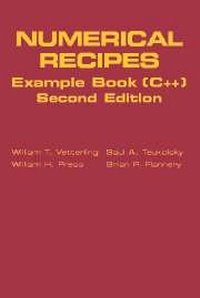
Numerical Recipes Example Book (C++)
The Art of Scientific Computing
2nd Edition
Published on 7. February 2002
Book
Paperback/Softback
330 pages
978-0-521-75034-9 (ISBN)
Description
This example book contains C++ source programs that exercise and demonstrate all of the subroutines, procedures, and functions in Numerical Recipes in C++. The book will be a valuable aid to readers wishing to incorporate Numerical Recipes procedures and subroutines into larger programs and to conduct simple validation tests. Each example program contains comments and is prefaced by a short description of what it does and of which Numerical Recipes routines it exercises. In cases where the demonstration programs require input data, those data are also supplied. In some cases, sample output is also shown.
More details
Edition
2nd Revised edition
Language
English
Place of publication
Cambridge
United Kingdom
Target group
College/higher education
Professional and scholarly
Edition type
Revised edition
Product notice
Paperback (trade)
Illustrations
Worked examples or Exercises
Dimensions
Height: 229 mm
Width: 153 mm
Thickness: 18 mm
Weight
457 gr
ISBN-13
978-0-521-75034-9 (9780521750349)
Copyright in bibliographic data and cover images is held by Nielsen Book Services Limited or by the publishers or by their respective licensors: all rights reserved.
Schweitzer Classification
Other editions
New editions
William H. Press | Saul A. Teukolsky | William T. Vetterling
Numerical Recipes 3rd Edition
The Art of Scientific Computing
Book
09/2007
3rd Edition
Cambridge University Press
€128.50
Available immediately
Persons
Content
1. Preliminaries; 2. Solution of linear algebraic equations; 3. Interpolation and extrapolation; 4. Integration of functions; 5. Evaluation of functions; 6. Special functions; 7. Random numbers; 8. Sorting; 9. Root finding and nonlinear sets of equations; 10. Minimization or maximization of functions; 11. Eigensystems; 12. Fast Fourier transform; 13. Fourier and spectral applications; 14. Statistical description of data; 15. Modeling of data; 16. Integration of ordinary differential equations; 17. Two point boundary value problems; 18. Integral equations and inverse theory; 19. Partial differential equations; 20. Less-numerical algorithms; References.