

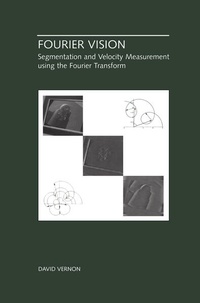
Fourier Vision
Segmentation and Velocity Measurement using the Fourier Transform
Published on 23. October 2012
Book
Paperback/Softback
X, 195 pages
978-1-4613-5541-0 (ISBN)
Description
Fourier Vision
provides a new treatment of figure-ground segmentation in scenes comprising transparent, translucent, or opaque objects. Exploiting the relative motion between figure and ground, this technique deals explicitly with the separation of additive signals and makes no assumptions about the spatial or spectral content of the images, with segmentation being carried out phasor by phasor in the Fourier domain. It works with several camera configurations, such as camera motion and short-baseline binocular stereo, and performs best on images with small velocities/displacements, typically one to ten pixels per frame. The book also addresses the use of Fourier techniques to estimate stereo disparity and optical flow. Numerous examples are provided throughout.
Fourier Vision will be of value to researchers in image processing & computer vision and, especially, to those who have to deal with superimposed transparent or translucent objects. Researchers in application areas such as medical imaging and acoustic signal processing will also find this of interest.
Fourier Vision will be of value to researchers in image processing & computer vision and, especially, to those who have to deal with superimposed transparent or translucent objects. Researchers in application areas such as medical imaging and acoustic signal processing will also find this of interest.
More details
Series
Edition
Softcover reprint of the original 1st ed. 2001
Language
English
Place of publication
New York
United States
Target group
Professional and scholarly
Research
Illustrations
X, 195 p.
Dimensions
Height: 235 mm
Width: 155 mm
Thickness: 12 mm
Weight
324 gr
ISBN-13
978-1-4613-5541-0 (9781461355410)
DOI
10.1007/978-1-4615-1413-8
Schweitzer Classification
Other editions
Additional editions
E-Book
12/2012
Springer
€149.79
Available for download
Book
06/2001
Kluwer Academic Publishers
€164.50
Shipment within 15-20 days
Content
1. Introduction.- 1. Computer Vision.- 2. Overview of the Fourier Vision Approach.- 3. Camera Configurations.- 4. Scope of the Book.- 2. Mathematical Preliminaries.- 1. The 2-D Fourier Transform.- 2. The Hough Transform.- 3. Monocular Vision - Segmentation in Additive Images.- 1. Overview.- 2. The Segmentation Problem.- 3. The Fourier Model of Segmentation.- 4. Application of the Technique.- 5. Conclusion.- 4. Monocular Vision - Segmentation in Occluding Images.- 1. Overview.- 2. Figure-Ground Segmentation of Occluding Translating Objects.- 3. Application of the Technique.- 4. Image Complexity.- 5. Outstanding Issues.- 6. A Sample of Motion/Stereo Segmentation Techniques.- 5. Articulated Binocular Vision.- 1. Motivation.- 2. Overview.- 3. Theoretical Framework.- 6. Fronto-Parallel Binocular Vision.- 1. Formulation of the Problem.- 2. The Computational Model.- 3. Application of the Technique.- 4. Caveat.- 7. Instantaneous Optical Flow.- 1. Motivation.- 2. Velocity from Phase Change.- 3. Examples.- 4. Discussion.- 5. Conclusions.- 6. Postscript: Other Approaches.- 8. Decoupled Optical Flow.- 1. The Problem of Non-Unique Multiple Local Velocities.- 2. Algorithm.- 3. Examples.- 4. Conclusion.- 9. Epilogue.- References.