

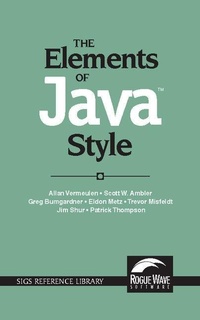
The Elements of Java (TM) Style
Published on 28. January 2000
Book
Paperback/Softback
146 pages
978-0-521-77768-1 (ISBN)
Description
The Elements of Java Style, written by renowned author Scott Ambler, Rogue Wave Software Vice President Alan Vermeulen, and a team of programmers from Rogue Wave, is for anyone who writes Java code. While there are many books that explain the syntax and basic use of Java, this book, first published in 2000, explains not just what you can do with the syntax, but what you ought to do. Just as Strunk and White's The Elements of Style provides rules of usage for the English language, this book provides a set of rules for Java practitioners to follow. While illustrating these rules with parallel examples of correct and incorrect usage, the book provides a collection of standards, conventions, and guidelines for writing solid Java code which will be easy to understand, maintain, and enhance. Anyone who writes Java code or plans to should have this book next to their computer.
Reviews / Votes
'The Elements of Java Style is perfect in what it tries to achieve. Each rule is sensible, hardly any are debatable, and there is no excuse for ignoring any of them.' JavaZone Book of the WeekMore details
Series
Language
English
Place of publication
Cambridge
United Kingdom
Target group
Professional and scholarly
College/higher education
Product notice
Paperback (trade)
Illustrations
Worked examples or Exercises
Dimensions
Height: 203 mm
Width: 127 mm
Thickness: 9 mm
Weight
165 gr
ISBN-13
978-0-521-77768-1 (9780521777681)
Copyright in bibliographic data and cover images is held by Nielsen Book Services Limited or by the publishers or by their respective licensors: all rights reserved.
Schweitzer Classification
Persons
Content
Preface; Introduction; 1. General principles; 2. Formatting conventions; 3. Naming conventions; 4. Documentation conventions; 5. Programming conventions; 6. Packaging conventions; Summary; Glossary; Bibliography; Index.