

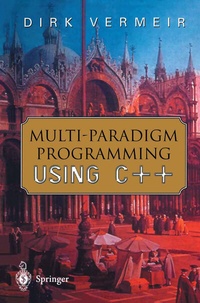
Multi-Paradigm Programming using C++
Published on 10. July 2001
Book
Paperback/Softback
XV, 287 pages
978-1-85233-483-3 (ISBN)
Description
An Introduction to Multi-Paradigm Programming using C++ is a
self-contained reference book for those studying and using C++. Starting
from scratch, Dirk Vermeir explains the idea of address, value and type in
C++ before quickly moving on to cover the more important aspects of the
language such as classes, templates, generic programming and inheritance.
He includes recent developments in C++, such as STL and the iostream
library, and there is also a chapter devoted to program design principles.
By using plenty of examples to illustrate the text, the reader is
stimulated and inspired to see how they can use what they have learnt in
other more sophisticated applications.
All the examples from the text, including some larger example programs are
available on the author's website -
http://tinf2.vub.ac.be/cpp/index.html
More details
Edition
2001 ed.
Language
English
Place of publication
London
United Kingdom
Target group
Professional and scholarly
Professional/practitioner
Illustrations
28 s/w Abbildungen
XV, 287 p. 28 illus.
Dimensions
Height: 235 mm
Width: 155 mm
Thickness: 17 mm
Weight
464 gr
ISBN-13
978-1-85233-483-3 (9781852334833)
DOI
10.1007/978-1-4471-0311-0
Schweitzer Classification
Other editions
Additional editions
Dirk Vermeir
Multi-Paradigm Programming using C++
E-Book
06/2011
Springer
€96.29
Available for download
Content
1 Basic Concepts of C++.- 1.1 Objects, Values, Types, Variables.- 1.2 Defining and Manipulating Objects.- 1.3 References.- 1.4 Functions.- 1.5 Program Structure.- 1.6 Syntactic and Lexical Considerations.- 1.7 Scopes and Namespaces.- 2 Built-inTypes.- 2.1 ArithmeticTypes.- 2.2 Conversionsfor Arithmetic Types.- 2.3 ArithmeticType Operations.- 2.4 String Literals.- 3 Functions.- 3.1 Function Declarations.- 3.2 Overloading.- 3.3 Function Definitions.- 4 User-Defined Types.- 4.1 Abstract Data Types.- 4.2 Classes.- 4.3 Enumerations.- 4.4 Typedef.- 5 Built-in Type Constructors.- 5.1 Constant Objects.- 5.2 Pointers.- 5.3 Arrays.- 5.4 Command Line Processing.- 5.5 Pointers to Functions.- 5.6 Pointers to Members.- 5.7 Memory Management.- 5.8 More Operator Overloading.- 6 User-DefinedTypeConstructors.- 6.1 Function Templates.- 6.2 Class Templates.- 7 Generic Program ming Using the STL.- 7.1 Generic Programming.- 7.2 Iterators.- 7.3 Stream Iterators.- 7.4 STL Containers.- 7.5 STL Algorithms.- 7.6 Iterator Adaptors.- 8 Subtypes and Inheritance.- 8.1 Derived Classes.- 8.2 Virtual Member Functions.- 8.3 Derivation and Access Control.- 8.4 Multiple and Virtual Inheritance.- 8.5 Object-Oriented Programming.- 8.6 Run-Time Type Identification.- 9 Exceptions.- 9.1 Throwing and Catching Exceptions.- 9.2 Run-Time Behaviour.- 9.3 Exceptions, Constructors and Destructors.- 9.4 Exception Specifications.- 9.5 Standard Exceptions.- 10 Iostreams.- 10.1 Requirements.- 10.2 Design.- 10.3 Streambuf.- 10.4 Stream Base Classes.- 10.5 Stream Classes.- 10.6 Manipulators.- 10.7 File Streams.- 10.8 String Streams.- 11 Introduction to Program Design.- 11.1 Motivation: Properties of Good Programs.- 11.2 Abstractions.- 11.3 Criteria For Good Abstractions.- 11.4 The Design Process.- A C++ Operators.- B The String Class.