

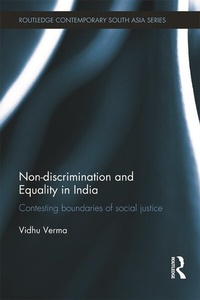
Non-discrimination and Equality in India
Contesting Boundaries of Social Justice
1st Edition
Published on 17. November 2011
Book
Hardback
272 pages
978-0-415-67775-2 (ISBN)
Description
Social Justice is a concept familiar to most Indians but one whose meaning is not always understood as it signifies a variety of government strategies designed to enhance opportunities for underprivileged groups. By tracing the trajectory of social justice from the colonial period to the present, this book examines how it informs ideas, practices and debates on discrimination and disadvantage today.
After outlining the historical context for reservations for scheduled castes and scheduled tribes that began under British colonial rule, the book examines the legal and moral strands of demands raised by newer groups since 1990. In addition the book shows how the development of quota policies has been significantly influenced by the nature and operation of democracy in India. It describes the recent proliferation of quota demands for reservations in higher education, private sector and for women and religious minorities in legislative assemblies. The book goes on to argue that while proliferation of demands address unequal incidence of poverty, deprivation and inequalities across social groups and communities, care has to be taken to ensure that existing justifications for quotas for discriminated groups due to caste hierarchies are not undermined.
Providing a rich historical background to the subject, the book is a useful contribution to the study on the evolution of multiple conceptions of social justice in contemporary India.
After outlining the historical context for reservations for scheduled castes and scheduled tribes that began under British colonial rule, the book examines the legal and moral strands of demands raised by newer groups since 1990. In addition the book shows how the development of quota policies has been significantly influenced by the nature and operation of democracy in India. It describes the recent proliferation of quota demands for reservations in higher education, private sector and for women and religious minorities in legislative assemblies. The book goes on to argue that while proliferation of demands address unequal incidence of poverty, deprivation and inequalities across social groups and communities, care has to be taken to ensure that existing justifications for quotas for discriminated groups due to caste hierarchies are not undermined.
Providing a rich historical background to the subject, the book is a useful contribution to the study on the evolution of multiple conceptions of social justice in contemporary India.
More details
Series
Language
English
Place of publication
London
United Kingdom
Publishing group
Taylor & Francis Ltd
Target group
College/higher education
Dimensions
Height: 234 mm
Width: 156 mm
Weight
690 gr
ISBN-13
978-0-415-67775-2 (9780415677752)
Copyright in bibliographic data and cover images is held by Nielsen Book Services Limited or by the publishers or by their respective licensors: all rights reserved.
Schweitzer Classification
Other editions
Additional editions
Book
05/2017
1st Edition
Routledge
€77.03
Shipment within 10-20 days
E-Book
11/2011
1st Edition
Routledge
€64.49
Available for download
E-Book
11/2011
1st Edition
Routledge
€64.49
Available for download
Person
Vidhu Verma is Professor at the Centre for Political Studies, Jawaharlal Nehru University, New Delhi, India. She is the author of Justice, Equality and Community (1999) and Malaysia: State and Civil Society in Transition (2002). Her recent areas of research include political philosophy, feminist political theory and affirmative action policies.
Content
Introduction 1. The Context of Social Justice in Modern India 2. The Limits of Liberal Constitutionalism 3. Equality and Non-discrimination 4. Expanding Domains: Democracy and Social Justice 5. Higher Education at Crossroads 6. Reservations in Private Sector 7. Gender Justice and Quotas 8. De-clustering Disadvantage: The Case of Religious Minorities 9. Conclusion