

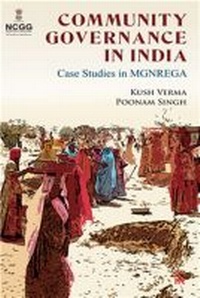
Community Governance in India
Case Studies in MGNREGA
Published on 30. July 2016
Book
Hardback
432 pages
978-93-85909-01-6 (ISBN)
Description
The Mahatma Gandhi National Rural Employment Guarantee Act (MGNREGA) aims at enhancing the livelihood security of people in rural areas by guaranteeing 100 days of wage payment in a financial year to those rural households whose adult members volunteer to do unskilled manual work. A vast majority of these individuals are marginal farmers and landless labourers whose incomes are insufficient to support their family. For long, they have been dependent on casual wage works involving migration - seasonal or on a long-term basis. Keeping such section of the population in mind, the MGNREGA was launched in 2006. The Act seeks to create durable assets and strengthen the livelihood resource base of the rural poor. The single major difference between the previous welfare schemes and MGNREGA is that all the previous schemes and programmes were allocation based while MGNREGA is a demand-based programme.
The choice of works suggested in the Act addresses causes of chronic poverty, like drought, deforestation, soil erosion, and so on, so that the process of employment generation is carried out on a sustainable basis. There are numerous examples of such exemplary works being undertaken as a part of this scheme. This volume of case studies is the culmination of an intensive documentation exercise done by a very talented pool of researchers. These case studies have been picked up from various states including Andhra Pradesh, Bihar, Jharkhand, Karnataka, Maharashtra, Rajasthan, Sikkim, Uttarakhand, Uttar Pradesh and West Bengal and serve as representative specimens of how the benefits of the scheme have been leveraged to improvise upon the natural resources and public goods.
Key Highlights: - These case studies highlight the importance and significance of good governance in rural perspective.
- The in-depth studies cover a wide range of activities from identification and capturing of onsite work snapshots for creation of durable and productive assets to preparation of labour budget in Gram Sabha with the help of Information and Communication Technology.
- It has brought out some best practices adopted for perfect planning and implementation.
- Different studies have elaborated on the effectiveness of MGNREGA and Rashtriya Swastha Bima Yojana (RSBY) and sanitation schemes.
The choice of works suggested in the Act addresses causes of chronic poverty, like drought, deforestation, soil erosion, and so on, so that the process of employment generation is carried out on a sustainable basis. There are numerous examples of such exemplary works being undertaken as a part of this scheme. This volume of case studies is the culmination of an intensive documentation exercise done by a very talented pool of researchers. These case studies have been picked up from various states including Andhra Pradesh, Bihar, Jharkhand, Karnataka, Maharashtra, Rajasthan, Sikkim, Uttarakhand, Uttar Pradesh and West Bengal and serve as representative specimens of how the benefits of the scheme have been leveraged to improvise upon the natural resources and public goods.
Key Highlights: - These case studies highlight the importance and significance of good governance in rural perspective.
- The in-depth studies cover a wide range of activities from identification and capturing of onsite work snapshots for creation of durable and productive assets to preparation of labour budget in Gram Sabha with the help of Information and Communication Technology.
- It has brought out some best practices adopted for perfect planning and implementation.
- Different studies have elaborated on the effectiveness of MGNREGA and Rashtriya Swastha Bima Yojana (RSBY) and sanitation schemes.
More details
Language
English
Place of publication
New Delhi
India
Publishing group
TechSar Pvt. Ltd
Target group
Professional and scholarly
Dimensions
Height: 225 mm
Width: 145 mm
Weight
780 gr
ISBN-13
978-93-85909-01-6 (9789385909016)
Copyright in bibliographic data and cover images is held by Nielsen Book Services Limited or by the publishers or by their respective licensors: all rights reserved.
Schweitzer Classification
Persons
Kush Verma is an IAS officer of the 1979 batch of Uttar Pradesh Cadre, and was the first Director General of National Centre for Good Governance (NCGG), Government of India. Prior to joining NCGG, he worked as Director General, National Institute of Administrative Research, Lal Bahadur Shastri National Academy of Administration, Mussoorie. He is currently holding charge as Commissioner, National Capital Region, Uttar Pradesh. Previously, he has held various notable positions in the Government of Uttar Pradesh as well as in the Government of India. He has published several papers in the field of General Administration, Development, Labour Issues, Tourism etc. He has also presented papers in various international and national level seminars & workshops. He has been granted a Ph.D. degree from Jamia Millia Islamia University, New Delhi on the challenging topic, 'Redesigning India's Civil Services'. He has also delivered lectures at places of repute including the National Institute of Labour, NOIDA, LBSNAA, Mussoorie, Indian Institute of Public Administration, New Delhi, Bankers Institute of Rural Development, Lucknow etc.
Poonam Singh is Associate Professor, & Head, Social Development Division, National Centre for Good Governance (NCGG), DoPT, GoI, New Delhi. She holds M.A. in Political Science. She has twenty years of work experience in Social Development Sector especially in Planning, Monitoring Research and Training. She has worked as Lecturer, Gaya College, Gaya (Magadh University, Bihar) and has worked in Bihar Education Project, District Primary Education Program (DPEP) and Sarva Shiksha Abhiyan (SSA) in Bihar, Uttarakhand, Rajasthan and Uttar Pradesh. Poonam Singh has also worked as Associate Professor, National Institute of Administrative Research (NIAR), Lal Bahadur Shastri National Academy of Administration (LBSNAA), Mussoorie and coordinated various projects and studies related to Research, Monitoring and Training pertaining to Rural Governance for various states and UTs.
Poonam Singh is Associate Professor, & Head, Social Development Division, National Centre for Good Governance (NCGG), DoPT, GoI, New Delhi. She holds M.A. in Political Science. She has twenty years of work experience in Social Development Sector especially in Planning, Monitoring Research and Training. She has worked as Lecturer, Gaya College, Gaya (Magadh University, Bihar) and has worked in Bihar Education Project, District Primary Education Program (DPEP) and Sarva Shiksha Abhiyan (SSA) in Bihar, Uttarakhand, Rajasthan and Uttar Pradesh. Poonam Singh has also worked as Associate Professor, National Institute of Administrative Research (NIAR), Lal Bahadur Shastri National Academy of Administration (LBSNAA), Mussoorie and coordinated various projects and studies related to Research, Monitoring and Training pertaining to Rural Governance for various states and UTs.