

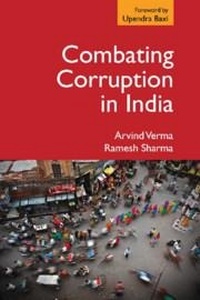
Combating Corruption in India
Published on 21. March 2019
Book
Hardback
314 pages
978-1-108-42746-3 (ISBN)
Description
As corruption continues to be a persistent problem in India, concerned citizens believe empowered police agencies independent of political control are effective ways to deal with corrupt officials and politicians. What is corruption and how is it facilitated? What are the appropriate agencies to combat corruption professionally in India? Why are these not effective in deterring corrupt practices? Are the alternative solutions to tackle corruption successful? This book seeks to engage with these questions, discuss and analyze them, and conduct a thorough analysis of law, bureaucratic organizations, official data, case studies and comparative international institutions. It analyzes vast data to argue that a corrupt state only maintains the facade of rule of law but will not permit any inquiry beyond that of individual deviance. Using criminological perspectives, it presents a novel mechanism, the 'Doctrine of Good Housekeeping', for public officials to combat and prevent corruption within their own institutions.
More details
Language
English
Place of publication
Cambridge
United Kingdom
Target group
Professional and scholarly
Product notice
sewn/stitched
Cloth over boards
Illustrations
Worked examples or Exercises
Dimensions
Height: 236 mm
Width: 231 mm
Thickness: 25 mm
Weight
544 gr
ISBN-13
978-1-108-42746-3 (9781108427463)
Copyright in bibliographic data and cover images is held by Nielsen Book Services Limited or by the publishers or by their respective licensors: all rights reserved.
Schweitzer Classification
Other editions
Additional editions
Arvind Verma | Ramesh Sharma
Combating Corruption in India
E-Book
01/2019
Cambridge University Press
€100.99
Available for download
Persons
Arvind Verma is Associate Professor in the Department of Criminal Justice and Associate Director of India Studies Program at Indiana University, Bloomington. His research interests are policing, criminal justice policy issues, Indian police, research methods, mathematical modeling, and geographical information systems. He is the Managing Editor of Police Practice and Research: An International Journal, and consultant to the Bureau of Police Research and Development, Government of India. His recent publications [some jointly] include Police Mission: Challenges and Responses (2003); 'Technological Applications for the Police' in Indian Police Journal; 'Consolidation of the Raj: Notes from a Police Station in British India: 1865-1928' in Criminal Justice History; 'Teaching Police Officers Human Rights: Some Observations' in International Journal of Human Rights and 'A Topological Representation of the Criminal Event' in Western Criminology Review. Ramesh Sharma is Executive Director at Legasis Services Pvt. Ltd, a pioneer in providing IT-enabled compliance management solutions across the Indian and international corporate world. As a former Indian Police Service (IPS) officer with a career spanning thirty-five years, he retired as Director General of Police, Madhya Pradesh, in 2013. He held senior positions in multiple challenging environments relating to law enforcement, investigation of fraud and corruption cases, internal security, counter terrorism and insurgency at international, national, state and grassroots levels.
Content
Acknowledgements; Foreword; 1. Introduction; Part I. Corruption in India: 2. Corruption: criminological perspectives; 3. Etiology of corruption in India; Part II. Combating Corruption in India: 4. Anti-corruption machinery in India; 5. Evaluating efficacy of anti-corruption agency - case study from Madhya Pradesh; 6. Lokpal: a critical examination; Part III. Way Forward: Alternate Solutions: 7. Empowering and professionalizing anti-corruption agencies; 8. Alternate solutions; References; Annexures; Index.