

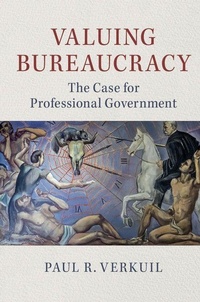
Valuing Bureaucracy
The Case for Professional Government
2nd Edition
Published on 15. May 2017
Book
Hardback
180 pages
978-1-107-17659-1 (ISBN)
Description
To be effective, government must be run by professional managers. When decisions that should be taken by government officials are delegated to private contractors without adequate oversight, the public interest is jeopardized. Verkuil uses his inside perspectives on government performance and accountability to examine the tendencies at both the federal and state levels to 'deprofessionalize' government. Viewing the turn to contractors and private sector solutions in ideological and functional terms, he acknowledges that the problem cannot be solved without meaningful civil service reforms that make it easier to hire, incent and, where necessary, fire career employees and officials. The indispensable goal is to revitalize bureaucracy so it can continue to competently deliver essential services. By highlighting the leadership that already exists in the career ranks, Verkuil senses a willingness, or even eagerness, to make government, like America, great again.
Reviews / Votes
'Paul R. Verkuil is one of the most knowledgeable observers of American government, and understands better than anyone the reasons why it appears to be so ineffective to many Americans. This book points directly to the underlying problem of government outsourcing, and to some possible solutions.' Francis Fukuyama, Olivier Nomellini Senior Fellow, Stanford University, California 'Paul R. Verkuil knows how government works inside and out, from his own service to his many roles studying and analyzing policy and process. This deep and insightful book is concrete and deep, using real life examples of government successes and failures, along with the folly of outsourcing and privatization, to make the case for how and why professional government saves and improves lives. At a time when professional experience in government is widely disdained, Valuing Bureaucracy is a vital corrective.' Norman Ornstein, American Enterprise Institute, Washington, DC 'This isn't an easy time to make the powerful, impassioned, and important argument of Paul R. Verkuil's book. But that makes it all the more important that his message gets through. Government bureaucracy does an enormous number of important things that we value - and that we miss when they aren't done well. In this lively and engaging book, Verkuil makes the inescapable point that we need and want much of what government does - and that even a smaller government requires a government that's even more professional. There's no more important time for us to hear the message that Verkuil's invaluable experience teaches.' Donald F. Kettl, University of Maryland, College Park 'Marshalling years of experience as a visionary scholar, lawyer, and public servant, Paul R. Verkuil has done it again. Verkuil's perfectly timed study of bureaucratic professionalism exposes the moral and practical bankruptcy of contemporary anti-government rhetoric and corresponding initiatives. And it presents a persuasive case and a clear blueprint for recommitting ourselves to dynamic, innovative, and highly effective public administration. Valuing Bureaucracy is a must read for government officials, legal scholars, students of politics and government, and anyone else seeking, in Verkuil's words, to 'make government great again'.' Jon D. Michaels, University of California, Los Angeles, School of Law 'Government is under siege - at the federal, state and local levels. Valuing Bureaucracy brings an invaluable and comprehensible perspective on how to restructure and defend the public sector. Drawing on current events, academic research and his own recent experience as Chairman of the Administrative Conference of the United States, Paul R. Verkuil convincingly evaluates the strengths and weaknesses of government agencies and private alternatives, and offers cogent reforms. No side escapes scrutiny. In his search for more 'A players' In the federal government, Verkuil takes on the veterans' preference and rigidity in the Office of Personnel Management. In his pursuit of better supervision of the private sector, he shows what went wrong with government contractors in Flint, Michigan, among other regions. This book should be required reading for scholars of public administration and administrative law, and interesting to citizens who crave more effective government.' Anne Joseph O'Connell, George Johnson Professor of Law, University of California, BerkeleyMore details
Language
English
Place of publication
Cambridge
United Kingdom
Target group
Professional and scholarly
Edition type
Revised edition
Illustrations
Worked examples or Exercises; 7 Halftones, black and white; 5 Line drawings, black and white
Dimensions
Height: 235 mm
Width: 157 mm
Thickness: 15 mm
Weight
426 gr
ISBN-13
978-1-107-17659-1 (9781107176591)
Copyright in bibliographic data and cover images is held by Nielsen Book Services Limited or by the publishers or by their respective licensors: all rights reserved.
Schweitzer Classification
Other editions
Additional editions
E-Book
05/2017
Cambridge University Press
€24.49
Available for download
E-Book
05/2017
Cambridge University Press
€27.99
Available for download
Previous edition
Paul R. Verkuil
Outsourcing Sovereignty
Why Privatization of Government Functions Threatens Democracy and What We Can Do about It
Book
07/2007
Cambridge University Press
€89.13
Article exhausted; check for reprint
Person
Paul R. Verkuil is President Emeritus of the College of William and Mary, Virginia, and served as Dean of both Cardozo School of Law, New York and Tulane University Law School, Louisiana. He served five years in the Obama administration as Chairman of the Administrative Conference of the US. He is the author of Outsourcing Sovereignty (Cambridge, 2007).
Content
1. Introduction and overview; 2. The new learning on outsourcing sovereignty; 3. The growth of contracting out in government; 4. The consequences of federal contractor government; 5. State examples of government failure; 6. Why professionals in government matter; 7. The civil service and its reform; 8. Living with and improving the multi-sector workforce; 9. In sum - reprofessionalize government.