

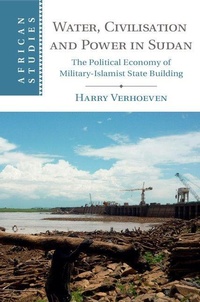
Water, Civilisation and Power in Sudan
The Political Economy of Military-Islamist State Building
Published on 5. March 2015
Book
Hardback
336 pages
978-1-107-06114-9 (ISBN)
Description
In 1989, a secretive movement of Islamists allied itself to a military cabal to violently take power in Africa's biggest country. Sudan's revolutionary regime was built on four pillars - a new politics, economic liberalisation, an Islamic revival, and a U-turn in foreign relations - and mixed militant conservatism with social engineering: a vision of authoritarian modernisation. Water and agricultural policy have been central to this state-building project. Going beyond the conventional lenses of famine, 'water wars' or the oil resource curse, Harry Verhoeven links environmental factors, development, and political power. Based on years of unique access to the Islamists, generals, and business elites at the core of the Al-Ingaz Revolution, Verhoeven tells the story of one of Africa's most ambitious state-building projects in the modern era - and how its gamble to instrumentalise water and agriculture to consolidate power is linked to twenty-first-century globalisation, Islamist ideology, and intensifying geopolitics of the Nile.
Reviews / Votes
'The Nile waters are central to the politics of north-east Africa, and Sudan is central to the hydropolitics of the Nile. Harry Verhoeven's superb study reaches deep into the complex issues of water, religion, and political power that have shaped the Islamist regime in Khartoum and reveals both its ambitions and its looming failure.' Christopher Clapham, Centre of African Studies, University of Cambridge 'Harry Verhoeven opens a new window on the Sudanese state and brings fresh air into our understanding of its politics. Drawing on interviews with many insiders, he illustrates the dilemmas faced by the current regime in promoting large-scale agriculture and dam construction. While claiming 'modernization' within the Islamic project, the program has benefited the core elite but marginalized others. Violence and widespread disaffection persisted even after the 2011 secession of South Sudan. This is an original and convincing study with wide relevance.' Wendy James, Emeritus Professor, University of Oxford 'What a fascinating book Harry Verhoeven has written, which elucidates how the Al-Ingaz has combined water resource endowment with the civilization of the Nile Valley to consolidate power in Sudan in advancing its Islamic ideology. The author identifies the centrality of development agenda, than religion, in Al-Ingaz vision of an Islamic Sudanese state. What the author calls 'hydro-agricultural mission' is demonstrated, in my view, by the Merowe dam underpinning the Islamic ideology of Al-Ingaz. This is a must read book for those who would like to understand the resilience of an Islamic Project of Al-Ingaz in Sudan and beyond.' Lual A. Deng, Member of South Sudan National Legislative Assembly and Managing Director of Ebony Center for Strategic Studies, Woodrow Wilson International Center for Scholars 'Professor Harry Verhoeven offers us an innovative, penetrating analysis of the Sudanese state and its Dam Implementation Unit. A must-read for scholars of the hydropolitics of the Nile.' Dale Whittington, University of North Carolina, Chapel Hill 'Harry Verhoeven has compiled a compelling study on Sudan that deserves the label 'seminal'. It is without question that his Water, Civilisation and Power in Sudan is an essential read for students of modern Sudan. It is therefore a highly recommended acquisition for any librarian with responsibility for African affairs.' John Anthony Allan and Martin Keulertz, Sudans Studies Association BulletinMore details
Series
Language
English
Place of publication
Cambridge
United Kingdom
Target group
College/higher education
Illustrations
1 Maps; 20 Halftones, unspecified; 20 Halftones, black and white; 9 Line drawings, black and white
Dimensions
Height: 235 mm
Width: 157 mm
Thickness: 24 mm
Weight
697 gr
ISBN-13
978-1-107-06114-9 (9781107061149)
Copyright in bibliographic data and cover images is held by Nielsen Book Services Limited or by the publishers or by their respective licensors: all rights reserved.
Schweitzer Classification
Other editions
Additional editions
Harry Verhoeven
Water, Civilisation and Power in Sudan
The Political Economy of Military-Islamist State Building
Book
06/2017
Cambridge University Press
€49.50
Shipment within 15-20 days
Harry Verhoeven
Water, Civilisation and Power in Sudan
The Political Economy of Military-Islamist State Building
E-Book
03/2015
Cambridge University Press
€27.49
Available for download
Harry Verhoeven
Water, Civilisation and Power in Sudan
The Political Economy of Military-Islamist State Building
E-Book
03/2015
Cambridge University Press
€24.49
Available for download
Person
Harry Verhoeven teaches African Politics at Oxford and is the founder and convenor of the University of Oxford China-Africa Network, as well as the founder of the Oxford Central Africa Forum. He has collaborated with UNDP Sudan, Chatham House, Greenpeace India, and Small Arms Survey and has lectured at ministries of foreign affairs, defence academies, and leading universities around the world. He has published in Civil War; Conflict, Security and Development, Development and Change, Geopolitics, the Journal of Eastern African Studies, the Journal of Modern African Studies, Middle East Policy, Philosophical Transactions of the Royal Society, the Review of African Political Economy, and The Washington Quarterly. He has recently been appointed to a professorship in Comparative Politics and International Relations at Georgetown University, Washington DC.
Content
1. Prologue: the inauguration of the Merowe dam; 2. State building, the environment, and the civilisation mission; 3. Hydraulic civilisation and land of famine: the crafting of the Sudanese state and its sources of power; 4. Mashru Al-Hadhari: the rise of Sudan's Al-Ingaz regime and its civilisation project; 5. The hydro-political economy of Al-Ingaz: economic salvation through 'dams as development'; 6. The geopolitics of the Nile: Khartoum's dam programme and agricultural revival in the global economy; 7. Military-Islamist state building and its contradictions: mirages in the desert, South Sudan's secession, and the new hydropolitics of the Nile; 8. Conclusion: water, civilisation, and power.