

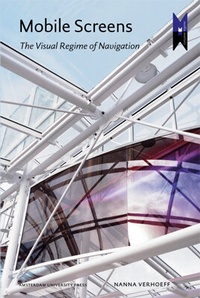
Mobile Screens
The Visual Regime of Navigation
Published on 1. March 2012
Book
Paperback/Softback
212 pages
978-90-8964-379-7 (ISBN)
Description
As far as interaction with screens is concerned, the given technology of particular interactive devices entails an ambiguous status of screens: what is shown on the screen has to do with how one interacts with it, that is, we can almost literally see what we are doing. This study is devoted to a theoretical exploration of intersections between mobility and visuality from a historical-comparative perspective, addressing the mobility of visual experience and the screen-based access to such experiences in a range of case studies.The author develops the concept through five chapters and analyzes a variety of contemporary screen technologies and the cultural practices involving these screen-based configurations - the ways in which we engage with screens as interfaces with spatial, temporal, and haptic experiences.
Reviews / Votes
"Nanna Verhoeff's new book is a a must for anybody interested in visual culture and media theory. It offers a rich and stimulating theoretical account of the central dimension of our contemporary existence - interfacing and navigating both data and physical world through a variety of screens (game consoles, mobile phones, car interfaces, GPS devices, etc.) In the process of exploring these new screen practices, Verhoeff offers fresh perspectives on many of the key questions in media and new media studies as well as a number of new original theoretical concepts. As the first theoretical manual for the society of mobile screens, this book will become an essential reference for all future investigations of our mobile screen condition." Lev Manovich is a Professor in Visual Arts Department, University of California, and a Director of Software Studies Initiative (softwarestudies.com) "Mobile Screens charts a "navigational turn" in contemporary media culture and recasts screened images as "performative cartographies." Fusing intermediale discussions of hand-held devices, gaming consoles, urban screens, and cinema, Verhoeff eloquently demonstrates the multi-sensorial nature of screened life while revealing how screens are reading life back to us in new ways. Lucidly written and cleverly theorized, Mobile Screens is vital for anyone interested in contemporary media culture." Lisa Parks, Professor of Film and Media Studies, University of California-Santa Barbara "Nanna Verhoeff has produced a fascinating examination of mobilities, screens and their many intersections in the digital age. Well worth reading." John Urry, Distinguished Professor of Sociology and Director of the Centre for Mobilities Research, Lancaster UniversityMore details
Series
Language
English
Place of publication
Amsterdam
Netherlands
Target group
Professional and scholarly
Illustrations
15 black and white black and white illustrations
Dimensions
Height: 234 mm
Width: 156 mm
Weight
368 gr
ISBN-13
978-90-8964-379-7 (9789089643797)
Copyright in bibliographic data and cover images is held by Nielsen Book Services Limited or by the publishers or by their respective licensors: all rights reserved.
Schweitzer Classification
Other editions
Additional editions
E-Book
10/2025
Routledge
€0.00
Available for download
E-Book
10/2025
Routledge
€0.00
Available for download
E-Book
03/2012
1st Edition
Amsterdam University Press
€0.00
Available for download
Person
Nanna Verhoeff is Professor of Screen Cultures and Society in the Department of Media and Culture Studies of the Faculty of Humanities at Utrecht University. She dedicates her research both to the comparative study of screen media, and to the development of methods and concepts for the creative humanities. Previous publications include The West in Early Cinema: After the Beginning and Mobile Screens: The Visual Regime of Navigation - both published with Amsterdam University Press. This current book on urban screens completes this trilogy, which proposes methods and concepts for comparing and analyzing screen media across times and places.
Content
Acknowledgements, List of Illustrations, Introduction, 1. Panoramic Complex, 2. Self-Reflection, 3. Theoretical Consoles, 4. Urban Screens, 5. Performative Cartography, Epilogue: You Are Here! Notes, Bibliography, Index of Names and Titles, Index of Terms.