

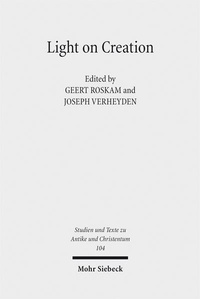
Light on Creation
Ancient Commentators in Dialogue and Debate on the Origin of the World
1st Edition
Published on 30. October 2017
Book
Paperback/Softback
324 pages
978-3-16-154314-2 (ISBN)
Description
Der vorliegende Band enthält die Ergebnisse eines internationalen Kolloquiums, welches im Februar 2015 an der geisteswissenschaftlichen Fakultät der KU Leuven abgehalten wurden und Experten in (spät)antiker Philosophie und frühchristlichen Studien zusammenbrachte. Die Beiträger wurden gebeten, über die Rezeption zweier grundlegender Texte, die sich mit dem Ursprung der Welt befassen, zu reflektieren - dem dritten Buch von Platons
Timaios
und der Schöpfungsgeschichte aus Genesis. Die Organisatoren hatten zwei Ziele: Sie wollten ein Forum bieten, um den Dialog zwischen Kollegen aus diesen Fachgebieten voranzutreiben, indem sie aus vergleichender Perspektive sowohl ein entscheidendes Thema untersuchen, welches beide Traditionen teilen, als auch die literarischen Gattungen, durch die dieses Thema entwickelt und überliefert wurde.
More details
Series
Language
English
Place of publication
Tübingen
Germany
Target group
Professional and scholarly
Product notice
Saddle-stitched
Library binding
Card cover
Illustrations
Not illustrated
Dimensions
Height: 23.4 cm
Width: 15.5 cm
Thickness: 1.8 cm
Weight
498 gr
ISBN-13
978-3-16-154314-2 (9783161543142)
Schweitzer Classification
Other editions
Additional editions
Joseph Verheyden | Geert Roskam
Light on Creation
Ancient Commentators in Dialogue and Debate on the Origin of the World
E-Book
10/2017
1st Edition
Mohr Siebeck
€114.00
Available for download
Persons
Content
I. The Middle- and Neoplatonic Tradition
Mauro Bonazzi: Middle Platonists on the Eternity of the Universe - Sarah Klitenic Wear: The Position and Function of the Demiurge in Syrianus's Cosmos - Lorenzo Ferroni: Proclus, in Timaeum , II, 340.14-341.24 Diehl. Some Textual Remarks - Gerd Van Riel: How Can the Perceptible World be Perceptible? Proclus on the Causes of Perceptibility
II. The Christian Tradition
David C. DeMarco: Basil of Caesarea's Exegesis of the Heavens in Homiliae in hexaemeron 3 - Volker Henning Drecoll: The Use of Scripture in Basil's Homilies in Hexaemeron - Samuel Pomeroy: Representing the Jews: John Chrysostom's Use of Exegetical and Theological Traditions for Gen 1:26a ( In Gen. hom. 8) - David L. Dusenbury: Judaic Authority in Nemesius of Emesa's De natura hominis (390 CE) - Benjamin Gleede: Christian Apologetics or Confessional Polemics? Context and Motivation of Philoponus' De opificio mundi - Paul M. Blowers: From Nonbeing to Eternal Well-Being: Creation ex nihilo in the Cosmology and Soteriology of Maximus the Confessor - Clement Kuehn: Christ Hero. An Epic Commentary on Creation - Dimitrios Zaganas: The Debate on Gen 1:1-3 According to Anastasius Sinaita's Hexaemeron
III. Some Other Voices
Gregory E. Sterling: "The Most Perfect Work": The Role of Matter in Philo of Alexandria - Claudio Moreschini: Calcidius between Creatio Ex Nihilo and Platonism - Gerard P. Luttikhuizen: Gnostic Views on the Origin and the Nature of the Universe
Mauro Bonazzi: Middle Platonists on the Eternity of the Universe - Sarah Klitenic Wear: The Position and Function of the Demiurge in Syrianus's Cosmos - Lorenzo Ferroni: Proclus, in Timaeum , II, 340.14-341.24 Diehl. Some Textual Remarks - Gerd Van Riel: How Can the Perceptible World be Perceptible? Proclus on the Causes of Perceptibility
II. The Christian Tradition
David C. DeMarco: Basil of Caesarea's Exegesis of the Heavens in Homiliae in hexaemeron 3 - Volker Henning Drecoll: The Use of Scripture in Basil's Homilies in Hexaemeron - Samuel Pomeroy: Representing the Jews: John Chrysostom's Use of Exegetical and Theological Traditions for Gen 1:26a ( In Gen. hom. 8) - David L. Dusenbury: Judaic Authority in Nemesius of Emesa's De natura hominis (390 CE) - Benjamin Gleede: Christian Apologetics or Confessional Polemics? Context and Motivation of Philoponus' De opificio mundi - Paul M. Blowers: From Nonbeing to Eternal Well-Being: Creation ex nihilo in the Cosmology and Soteriology of Maximus the Confessor - Clement Kuehn: Christ Hero. An Epic Commentary on Creation - Dimitrios Zaganas: The Debate on Gen 1:1-3 According to Anastasius Sinaita's Hexaemeron
III. Some Other Voices
Gregory E. Sterling: "The Most Perfect Work": The Role of Matter in Philo of Alexandria - Claudio Moreschini: Calcidius between Creatio Ex Nihilo and Platonism - Gerard P. Luttikhuizen: Gnostic Views on the Origin and the Nature of the Universe