

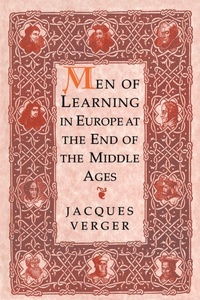
Men of Learning in Europe at the End of the Middle Ages
Published on 1. April 2000
Book
Paperback/Softback
216 pages
978-0-268-03451-1 (ISBN)
Description
Medievalists prefer that we not view the Middle Ages in a static frame but rather a dynamic one. They want us to be aware of the shifts and changes that characterize the period. In Men of Learning in Europe at the Close of the Middle Ages, Jacques Verger provides us with an important look at the evolution of social classes and an essential chapter in the study of cultural history.
By the end of the Middle Ages, societal categories which were adequate for earlier periods- "those who pray, those who fight, those who work" -no longer allowed for the growing complexity of Western society. One of the key new groups which emerged was that of learned men. Through their intellectual competency and their ability to build a social and political utility, these men came to be important figures. The fledgling modern state found them to be helpful allies and favored their ascension among the traditional elite. Thus, they contributed not only to the advancement of knowledge, making the Renaissance period possible, but also to the reshaping of late medieval political structure.
Combining cultural, social, and political history, Men of Learning in Europe at the Close of the Middle Ages measures the influence acquired by certain disciplines-in particular religious, literary, and legal-in the organization of European society. Anyone interested in the Middle Ages or intellectual history will want to read this book.
By the end of the Middle Ages, societal categories which were adequate for earlier periods- "those who pray, those who fight, those who work" -no longer allowed for the growing complexity of Western society. One of the key new groups which emerged was that of learned men. Through their intellectual competency and their ability to build a social and political utility, these men came to be important figures. The fledgling modern state found them to be helpful allies and favored their ascension among the traditional elite. Thus, they contributed not only to the advancement of knowledge, making the Renaissance period possible, but also to the reshaping of late medieval political structure.
Combining cultural, social, and political history, Men of Learning in Europe at the Close of the Middle Ages measures the influence acquired by certain disciplines-in particular religious, literary, and legal-in the organization of European society. Anyone interested in the Middle Ages or intellectual history will want to read this book.
Reviews / Votes
"[T]his exceptionally thought-provoking study... addresses almost all the most difficult problems in the intellectual history of later medieval Europe." -Journal of Ecclesiastical History"This book has commendable range and... enlightening elements. ...[T]his is a useful study...." -English Historical Review
"The book is an extremely useful synthesis of recent research. Overall, this is a stimulating and rewarding survey, which is certainly deserves to be read widely, and is bound to be influential." -The Heythrop Journal
More details
Language
English
Place of publication
Notre Dame IN
United States
Target group
College/higher education
Professional and scholarly
Dimensions
Height: 229 mm
Width: 152 mm
Thickness: 14 mm
Weight
358 gr
ISBN-13
978-0-268-03451-1 (9780268034511)
Copyright in bibliographic data and cover images is held by Nielsen Book Services Limited or by the publishers or by their respective licensors: all rights reserved.
Schweitzer Classification
Person
Jacques Verger is Professor of Medieval History at the University of Paris, vice president of the Commission internationale pour l'histoire des universites, and a specialist in the history of culture and education in the late Middle Ages.