

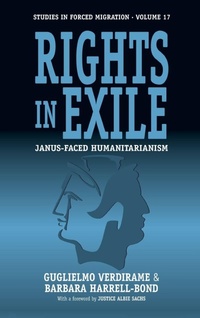
Rights in Exile
Janus-Faced Humanitarianism
1st Edition
Published on 1. April 2005
Book
Hardback
416 pages
978-1-57181-526-2 (ISBN)
Description
Of the estimated 12 million refugees in the world, more than 7 million have been confined to camps, effectively "warehoused," in some cases, for 10 years or more. Holding refugees in camps was anathema to the founders of the refugee protection regime. Today, with most refugees encamped in the less developed parts of the world, the humanitarian apparatus has been transformed into a custodial regime for innocent people. Based on rich ethnographic data, Rights in Exile exposes the gap between human rights norms and the mandates of international organisations, on the one hand, and the reality on the ground, on the other. It will be of wide interest to social scientists, and to human rights and international law scholars. Policy makers, donor governments and humanitarian organizations, especially those adopting a "rights-based" approach, will also find it an invaluable resource. But it is the refugees themselves who could benefit the most if these actors absorb its lessons and apply them.
Reviews / Votes
"[the authors] are refreshingly open about their lack of objectivity and bias towards the interests of the refugees, and Rights in Exile is stronger as a result, their clear identification with their subjects having produced some fascinating interview material, which forms the bulk of the book." * Journal of the Royal Anthropological Institute"The greatest strength of Rights in Exile is clearly its combination of hard data accompanied by stinging critique... Rights in Exile should be read by scholars, advocates and policy analysts for its revealing look at the unsettling shortcomings of refugee protection services and the real-life consequences of encampment in two African states." * Journal of Refugee Law
"This book has a... disregard for orthodoxies and sacred cows. It is harsh, for example, on the role of many NGOs in delivering assistance - and failing to protect the rights of refugees... More obviously, the UNHCR's reinterpretation of its own mandate - away from refugee protection, towards "humanitarian assistance" - is exposed as a betrayal of the whole purpose of the international refugee regime." * Richard Carver, Pambazuka News
"Detailed, direct and at times passionate, this book should be required reading for anyone who wants to know what is really happening to refugee protection. It should also require a response." * Journal of Refugee Studies
"Brace yourself. This is a painful book. Not only is the information in it extremely distressing, the main targets of its critique are the 'good guys.' The central argument is that the international and humanitarian organisations that are in charge of looking after refugees are responsible for extensive and avoidable violations of the rights of those dependent upon them." * From the Foreword
More details
Series
Language
English
Place of publication
Herndon
United States
Target group
College/higher education
Product notice
Library binding
Illustrations
Bibliography; Index
Dimensions
Height: 235 mm
Width: 157 mm
Thickness: 27 mm
Weight
750 gr
ISBN-13
978-1-57181-526-2 (9781571815262)
DOI
10.3167/9781571815262
Copyright in bibliographic data and cover images is held by Nielsen Book Services Limited or by the publishers or by their respective licensors: all rights reserved.
Schweitzer Classification
Other editions
Additional editions
E-Book
04/2005
Berghahn Books
€32.49
Available for download
Persons
Guglielmo Verdirame is a Lecturer in Law at the University of Cambridge and a Fellow of Corpus Christi College. He is also the author of a forthcoming book on the accountability of the United Nations.
Content
Foreword
Justice Albie Sachs
Preface
Acknowledgements
List of Abbreviations
Introduction
The setting
Main movements of refugees into Kenya and Uganda
Aims and objectives of the research
Assumptions underlying the research
Research methods
Main findings
A research and advocacy agenda for the future
Chapter 1. Refugee Law and Policy in Kenya and Uganda
Introduction
The Legal Framework in Kenya
The Legal Framework in Uganda
Refugee policy in Kenya
Refugee policy in Uganda
Refugee law-making in fits and starts
Conclusion
Chapter 2. Getting In
Introduction
The influence of donor countries
The OAU Convention and group recognition
Admission: standards and procedures
Legal hurdles to admission
Ordeals of arrival
New arrivals and local people
Conclusion
Chapter 3. Status-Determination Procedures: '... and when you go to UNHCR, pray'
Introduction
Procedural standards in status determination
Who is in charge?
The role of NGOs
Confidentiality
Interpreters
Advocacy
Standards of evidence
Decisions
Exclusion
Cessation
Conclusion
Chapter 4. Civil and Political Rights
Introduction
Non-discrimination
Right to Life
Freedom from torture and from cruel, inhuman, or degrading treatment or punishment
Freedom from slavery and forced labour
Liberty and security of the person
Freedom of movement
Access to courts and right to fair trial
Privacy and family life
Freedom of expression, thought, conscience and religion, and freedom of assembly and association
Conclusion
Chapter 5. Economic, Social, and Cultural Rights
Introduction
Employment
An adequate standard of living
The highest attainable standard of physical and mental health
Education
Cultural rights
Conclusion
Chapter 6. Refugee Protection: What Is Going Wrong?
Introduction
Host countries
Donor countries
Resettlement
UNHCR
NGOs
Conclusion
Conclusions
Bibliography
Index
Justice Albie Sachs
Preface
Acknowledgements
List of Abbreviations
Introduction
The setting
Main movements of refugees into Kenya and Uganda
Aims and objectives of the research
Assumptions underlying the research
Research methods
Main findings
A research and advocacy agenda for the future
Chapter 1. Refugee Law and Policy in Kenya and Uganda
Introduction
The Legal Framework in Kenya
The Legal Framework in Uganda
Refugee policy in Kenya
Refugee policy in Uganda
Refugee law-making in fits and starts
Conclusion
Chapter 2. Getting In
Introduction
The influence of donor countries
The OAU Convention and group recognition
Admission: standards and procedures
Legal hurdles to admission
Ordeals of arrival
New arrivals and local people
Conclusion
Chapter 3. Status-Determination Procedures: '... and when you go to UNHCR, pray'
Introduction
Procedural standards in status determination
Who is in charge?
The role of NGOs
Confidentiality
Interpreters
Advocacy
Standards of evidence
Decisions
Exclusion
Cessation
Conclusion
Chapter 4. Civil and Political Rights
Introduction
Non-discrimination
Right to Life
Freedom from torture and from cruel, inhuman, or degrading treatment or punishment
Freedom from slavery and forced labour
Liberty and security of the person
Freedom of movement
Access to courts and right to fair trial
Privacy and family life
Freedom of expression, thought, conscience and religion, and freedom of assembly and association
Conclusion
Chapter 5. Economic, Social, and Cultural Rights
Introduction
Employment
An adequate standard of living
The highest attainable standard of physical and mental health
Education
Cultural rights
Conclusion
Chapter 6. Refugee Protection: What Is Going Wrong?
Introduction
Host countries
Donor countries
Resettlement
UNHCR
NGOs
Conclusion
Conclusions
Bibliography
Index