

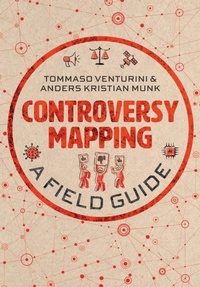
Controversy Mapping
A Field Guide
1st Edition
Published on 21. October 2021
Book
Paperback/Softback
385 pages
978-1-5095-4451-6 (ISBN)
Description
As disputes concerning the environment, the economy, and pandemics occupy public debate, we need to learn to navigate matters of public concern when facts are in doubt and expertise is contested.
Controversy Mapping is the first book to introduce readers to the observation and representation of contested issues on digital media. Drawing on actor-network theory and digital methods, Venturini and Munk outline the conceptual underpinnings and the many tools and techniques of controversy mapping. They review its history in science and technology studies, discuss its methodological potentials, and unfold its political implications. Through a range of cases and examples, they demonstrate how to chart actors and issues using digital fieldwork and computational techniques. A preface by Richard Rogers and an interview with Bruno Latour are also included.
A crucial field guide and hands-on companion for the digital age, Controversy Mapping is an indispensable resource for students and scholars of media and communication, as well as activists, journalists, engaged citizens, and decision makers.
More details
Other editions
Additional editions
E-Book
12/2021
1st Edition
Wiley
€19.99
Available for download
Book
10/2021
1st Edition
Polity Press
€86.00
Shipment within 15-20 days
Persons
Dr Tommaso Venturini is a researcher at the CNRS Centre for Internet and Society, and co-founder of the médialab of Sciences Po, Paris.
Professor Anders Kristian Munk is Director of the Techno-Anthropology Lab at the University of Aalborg in Copenhagen and co-founder of the Public Data Lab.
Content
Acknowledgements
Preface: The politics of association on display (by Richard Rogers)
Introduction
FEATURES OF CONTROVERSIAL LANDSCAPES
1. Why map controversies?
2. A proliferation of issues
3. Making room for more actors
TOOLS OF SOCIAL CARTOGRAPHY
4. Exploring controversies as actor-networks
5. Exploring controversies with digital methods
6. Collecting and curating digital records
7. Visual network analysis
POLITICS OF MAPMAKING
8. Representing controversies
9. Mapmaking as a form of intervention
Controversy mapping in the shadow of Gaia
A conversation with Bruno Latour
References
Index