

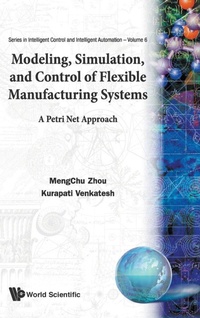
Modeling, Simulation, And Control Of Flexible Manufacturing Systems: A Petri Net Approach
Published on 2. February 1999
Book
Hardback
428 pages
978-981-02-3029-6 (ISBN)
Description
One critical barrier leading to successful implementation of flexible manufacturing and related automated systems is the ever-increasing complexity of their modeling, analysis, simulation, and control. Research and development over the last three decades has provided new theory and graphical tools based on Petri nets and related concepts for the design of such systems. The purpose of this book is to introduce a set of Petri-net-based tools and methods to address a variety of problems associated with the design and implementation of flexible manufacturing systems (FMSs), with several implementation examples.There are three ways this book will directly benefit readers. First, the book will allow engineers and managers who are responsible for the design and implementation of modern manufacturing systems to evaluate Petri nets for applications in their work. Second, it will provide sufficient breadth and depth to allow development of Petri-net-based industrial applications. Third, it will allow the basic Petri net material to be taught to industrial practitioners, students, and academic researchers much more efficiently. This will foster further research and applications of Petri nets in aiding the successful implementation of advanced manufacturing systems.
More details
Series
Language
English
Place of publication
Singapore
Singapore
Target group
Professional and scholarly
Dimensions
Height: 235 mm
Width: 157 mm
Thickness: 28 mm
Weight
770 gr
ISBN-13
978-981-02-3029-6 (9789810230296)
Copyright in bibliographic data and cover images is held by Nielsen Book Services Limited or by the publishers or by their respective licensors: all rights reserved.
Schweitzer Classification
Persons
Content
Flexible manufacturing systems - an overview; Petri nets as an integrated tool and methodology in FMS design; fundamentals of Petri nets; modelling FMS with Petri nets; FMS performance analysis; Petri net simulation and tools; performance evaluation of pull and push paradigms in flexible automation; augmented-timed Petri nets for modelling breakdown handling; real-time Petri nets for discrete event control; comparison of real-time Petri nets and ladder logic diagrams; an object-oriented design methodology for development of FMS control software; scheduling using Petri nets; Petri nets and future research.