

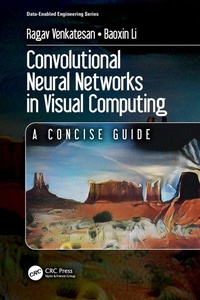
Convolutional Neural Networks in Visual Computing
A Concise Guide
1st Edition
Published on 7. September 2017
Book
Paperback/Softback
168 pages
978-1-138-74795-1 (ISBN)
Description
This book covers the fundamentals in designing and deploying techniques using deep architectures. It is intended to serve as a beginner's guide to engineers or students who want to have a quick start on learning and/or building deep learning systems. This book provides a good theoretical and practical understanding and a complete toolkit of basic information and knowledge required to understand and build convolutional neural networks (CNN) from scratch. The book focuses explicitly on convolutional neural networks, filtering out other material that co-occur in many deep learning books on CNN topics.
More details
Series
Language
English
Place of publication
London
United Kingdom
Publishing group
Taylor & Francis Ltd
Target group
College/higher education
Professional Practice & Development
Illustrations
23 s/w Photographien bzw. Rasterbilder, 37 s/w Zeichnungen, 5 s/w Tabellen
5 Tables, black and white; 37 Line drawings, black and white; 23 Halftones, black and white
Dimensions
Height: 234 mm
Width: 156 mm
Thickness: 10 mm
Weight
295 gr
ISBN-13
978-1-138-74795-1 (9781138747951)
Copyright in bibliographic data and cover images is held by Nielsen Book Services Limited or by the publishers or by their respective licensors: all rights reserved.
Schweitzer Classification
Other editions
Additional editions
E-Book
10/2017
CRC Press
€85.49
Available for download
E-Book
10/2017
1st Edition
CRC Press
€85.99
Available for download
Book
09/2017
1st Edition
CRC Press
€245.12
Shipment within 15-20 days
Persons
Ragav Venkatesan is currently completing his Ph.D. study in Computer Science in the School of Computing, Informatics and Decision Systems Engineering at Arizona State University. He has been a Research Associate with the Visual Representation and Processing Group in ASU, and has worked as a Teaching Assistant for several graduate-level courses in machine learning, pattern recognition, video processing and computer vision. Prior to this, he was a Research Assistant with the Image Processing and Applications Lab in the School of Electrical & Computer Engineering at ASU, where he obtained an M.S. degree in 2012. From 2013 to 2014, Venkatesan was with the Intel Corporation as a computer vision research intern working on technologies for autonomous vehicles. Venkatesan regularly serves as a reviewer for several peer-reviewed journals and conferences in machine learning and computer vision.
Baoxin Li received his Ph.D. in electrical engineering from the University of Maryland, College Park, in 2000. He is currently a Professor and Chair of the Computer Science and Engineering program, and a Graduate Faculty in Electrical Engineering and Computer Engineering programs at Arizona State University, Tempe. From 2000 to 2004, he was a Senior Researcher with SHARP Laboratories of America, Camas, Washington, where he was a technical lead in developing SHARP's trademarked HiMPACT Sports technologies. From 2003-2004, he was also an Adjunct Professor with the Portland State University, Oregon. He holds eighteen issued U.S. patents and his current research interests include computer vision and pattern recognition, multimedia, social computing, machine learning, and assistive technologies. He won twice the SHARP Laboratories' President Award, in 2001 and 2004 respectively. He also won the SHARP Laboratories' Inventor of the Year Award in 2002. He was a recipient of the National Science Foundation's CAREER Award.
Baoxin Li received his Ph.D. in electrical engineering from the University of Maryland, College Park, in 2000. He is currently a Professor and Chair of the Computer Science and Engineering program, and a Graduate Faculty in Electrical Engineering and Computer Engineering programs at Arizona State University, Tempe. From 2000 to 2004, he was a Senior Researcher with SHARP Laboratories of America, Camas, Washington, where he was a technical lead in developing SHARP's trademarked HiMPACT Sports technologies. From 2003-2004, he was also an Adjunct Professor with the Portland State University, Oregon. He holds eighteen issued U.S. patents and his current research interests include computer vision and pattern recognition, multimedia, social computing, machine learning, and assistive technologies. He won twice the SHARP Laboratories' President Award, in 2001 and 2004 respectively. He also won the SHARP Laboratories' Inventor of the Year Award in 2002. He was a recipient of the National Science Foundation's CAREER Award.
Content
Dedication; Acknowledgements; About the Author; Preface ; Chapter 1: Introduction to visual computing; Chapter 2: Learning as a regression problem; Chapter 3: Artificial neural networks; Chapter 4: Convolutional neural networks; Chapter 5: Modern and novel usages of CNNs; Appendix; Postscript