

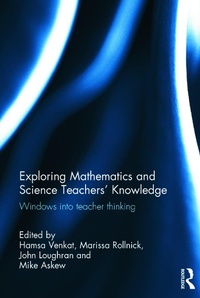
Exploring Mathematics and Science Teachers' Knowledge
Windows into teacher thinking
1st Edition
Published on 1. May 2014
Book
Hardback
236 pages
978-0-415-71387-0 (ISBN)
Description
Globally, mathematics and science education faces three crucial challenges: an increasing need for mathematics and science graduates; a declining enrolment of school graduates into university studies in these disciplines; and the varying quality of school teaching in these areas. Alongside these challenges, internationally more and more non-specialists are teaching mathematics and science at both primary and secondary levels, and research evidence has revealed how gaps and limitations in teachers' content understandings can lead to classroom practices that present barriers to students' learning.
This book addresses these issues by investigating how teachers' content knowledge interacts with their pedagogies across diverse contexts and perspectives. This knowledge-practice nexus is examined across mathematics and science teaching, traversing schooling phases and countries, with an emphasis on contexts of disadvantage. These features push the boundaries of research into teachers' content knowledge. The book's combination of mathematics and science enriches each discipline for the reader, and contributes to our understandings of student attainment by examining the nature of specialised content knowledge needed for competent teaching within and across the two domains.
Exploring Mathematics and Science Teachers' Knowledge will be key reading for researchers, doctoral students and postgraduates with a focus on Mathematics, Science and teacher knowledge research.
This book addresses these issues by investigating how teachers' content knowledge interacts with their pedagogies across diverse contexts and perspectives. This knowledge-practice nexus is examined across mathematics and science teaching, traversing schooling phases and countries, with an emphasis on contexts of disadvantage. These features push the boundaries of research into teachers' content knowledge. The book's combination of mathematics and science enriches each discipline for the reader, and contributes to our understandings of student attainment by examining the nature of specialised content knowledge needed for competent teaching within and across the two domains.
Exploring Mathematics and Science Teachers' Knowledge will be key reading for researchers, doctoral students and postgraduates with a focus on Mathematics, Science and teacher knowledge research.
More details
Language
English
Place of publication
London
United Kingdom
Publishing group
Taylor & Francis Ltd
Target group
College/higher education
Postgraduate
Product notice
sewn/stitched
Paper over boards
Illustrations
44 s/w Abbildungen, 44 s/w Zeichnungen, 19 s/w Tabellen
19 Tables, black and white; 44 Line drawings, black and white; 44 Illustrations, black and white
Dimensions
Height: 236 mm
Width: 160 mm
Thickness: 18 mm
Weight
499 gr
ISBN-13
978-0-415-71387-0 (9780415713870)
Copyright in bibliographic data and cover images is held by Nielsen Book Services Limited or by the publishers or by their respective licensors: all rights reserved.
Schweitzer Classification
Other editions
Additional editions
Hamsa Venkat | Marissa Rollnick | John Loughran
Exploring Mathematics and Science Teachers' Knowledge
Windows into teacher thinking
E-Book
05/2014
1st Edition
Routledge
€60.49
Available for download
Hamsa Venkat | Marissa Rollnick | John Loughran
Exploring Mathematics and Science Teachers' Knowledge
Windows into teacher thinking
E-Book
05/2014
1st Edition
Routledge
€60.49
Available for download
Persons
Hamsa Venkat holds the SA Numeracy Chair at the University of the Witwatersrand, Johannesburg, South Africa.
Marissa Rollnick is Chair of Science Education in the Marang Centre for Science and Mathematics Education, University of the Witwatersrand, Johannesburg, South Africa.
John Loughran is Foundation Chair in Curriculum and Pedagogy, and Dean of the Faculty of Education, Monash University, Melbourne, Australia.
Mike Askew is Foundation Chair of Primary Education at Monash University, Melbourne, Australia.
Marissa Rollnick is Chair of Science Education in the Marang Centre for Science and Mathematics Education, University of the Witwatersrand, Johannesburg, South Africa.
John Loughran is Foundation Chair in Curriculum and Pedagogy, and Dean of the Faculty of Education, Monash University, Melbourne, Australia.
Mike Askew is Foundation Chair of Primary Education at Monash University, Melbourne, Australia.
Content
Part 1: Overviews of Mathematics and Science Knowledge for Teaching Mathematics Teachers' Content Knowledge Mike Askew. Science Teachers' Content Knowledge Vanessa Kind Part 2: Challenges to Current Formulations Improving PCK and CK in Science Teachers Elizabeth Mavhunga. Recognising and Illuminating Connections in Proportional Relationships Sarah Bansilal. Novice Unqualified Graduate Science Teachers' Topic Specific Pedagogical Content Knowledge, Content Knowledge and their Beliefs About Teaching Phihlo Pitjeng. Teaching Division: The Importance of Coherence in What is Made Available to Learn Corin Mathews. Profiling Chemistry Teachers' Changing PCK Trajectories Mpunki Nakedi Part 3: Applying/Combining Existing Frameworks - New Insights Planting the Seed: Scaffolding the PCK Development of Pre-Service Science Teachers Adam Bertram and John Loughran. Teachers' Mathematical Discourse in Instruction: Focus on Examples and Explanations Jill Adler and Hamsa Venkat. Using Self-Study to Learn New Topics in Chemistry - A Case Study of Three Practising Teachers Marissa Rollnick. A Love for Mathematical Playfulness as a Key Ingredient of Mathematical Knowledge for Teaching Mellony Graven and Marc Schafer. Developing an Instrument to Assess Grade 12 Teachers' Topic Specific PCK in Organic Chemistry Bette Davidowitz and Nonkanyiso Vokwana. Recognizing and Valuing Teachers' Professional Knowledge of Practice John Loughran.