

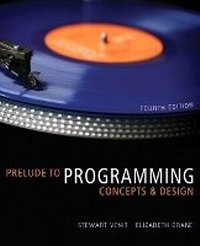
Prelude to Programming
Concepts and Design
4th Edition
Published on 1. December 2008
Book
Paperback/Softback
552 pages
978-0-321-52175-0 (ISBN)
Description
Prelude to Programming provides beginning students with a language-independent framework for learning core programming concepts and effective design techniques. This approach gives students the foundation they need to understand the logic behind program design and to establish effective programming skills.
Fully revised, the Fourth Edition offers students a lively and accessible presentation as they learn core programming concepts - including data types, control structures, data files and arrays, and program design techniques such as top-down modular design and proper program documentation and style. Problem-solving skills are developed when students learn how to use basic programming tools and algorithms, which include data validation, defensive programming, calculating sums and averages, and searching and sorting lists. A copy of the RAPTOR flow-charting software is included with the Fourth Edition.
Fully revised, the Fourth Edition offers students a lively and accessible presentation as they learn core programming concepts - including data types, control structures, data files and arrays, and program design techniques such as top-down modular design and proper program documentation and style. Problem-solving skills are developed when students learn how to use basic programming tools and algorithms, which include data validation, defensive programming, calculating sums and averages, and searching and sorting lists. A copy of the RAPTOR flow-charting software is included with the Fourth Edition.
More details
Edition
4th edition
Language
English
Place of publication
United States
Publishing group
Pearson Education (US)
Target group
College/higher education
Dimensions
Height: 254 mm
Width: 202 mm
Weight
880 gr
ISBN-13
978-0-321-52175-0 (9780321521750)
Copyright in bibliographic data and cover images is held by Nielsen Book Services Limited or by the publishers or by their respective licensors: all rights reserved.
Schweitzer Classification
Other editions
New editions
Book
12/2010
5th Edition
Pearson
€100.27
Article exhausted; check for reprint
Content
Chapter 0: Introduction
A Brief History of Computers
Computer Basics
Software and Programming Languages
Chapter 1: An Introduction to Programming What Is Programming?
Basic Programming Concepts
Data Processing and Output
Character and String Data
Integer Data
Floating Point Data
Chapter 2: Developing a Program The Program Development Cycle
Program Design
Coding, Documenting, and Testing a Program
Commercial Programs: Testing and Documenting
Structured Programming
Chapter 3: Selection Structures: Making Decisions An Introduction to Selection Structures
Relational and Logical Operators
ASCII Code
Selecting from Several Alternatives
Applications of Selection Structures
Focus on Problem Solving: A New Car Price Calculator
Chapter 4: Repetition Structures: Looping An Introduction to Repetition Structures: Computers Never Get Bored!
Types of Loops
The For Loop
Applications of Repetition Structures
Focus on Problem Solving: A Cost, Revenue, and Profit Problem
Chapter 5: More About Loops and Decisions Combining Loops with If-Then Statements
Combining Loops with If-Then Structures in Longer Programs
Random Numbers
Nested Loops
Focus on Problem Solving: A Guessing Game
Chapter 6: Arrays: Lists and Tables One-Dimensional Arrays
Searching and Sorting Arrays
More about Searching and Sorting
Strings As Arrays of Characters
Two-Dimensional Arrays
Focus on Problem Solving: A Grade Management Program
Chapter 7: Sequential Data Files An Introduction to Data Files
Modifying a Sequential File
Merging Sequential Files
Focus on Problem Solving: Control Break Processing
Focus on Problem Solving: An Invoice Preparation Program
Chapter 8: More about Program Modules and Subprograms Data Flow Diagrams and Parameters
More About Subprograms
Functions
Recursion
Focus on Problem Solving: A Grade Management Problem
Chapter 9: An Introduction to Object-Oriented Programming Classes and Objects
More Features of Object-Oriented Programming
Object-Oriented Program Design and UML
Focus on Problem Solving: OOPU Uses OOP Programming to Solve the Parking Lot Problem
Appendix A: Decimal, Binary, and Hexadecimal Representation
Bases and Exponents
The Binary System
The Hexadecimal System
Appendix B: Integer Representation
Unsigned Integer Format
Sign and Magnitude Format
Two's Complement Format
Representation of Two's Complement Integers
Appendix C: Floating Point Number Representation
Binary Conversions to Floating Point
Putting the Two Parts Together
Single Precision Floating Point Numbers
Base 10 Normalization
Normalizing Binary Floating Point Numbers
Hexadecimal Representation
A Brief History of Computers
Computer Basics
Software and Programming Languages
Chapter 1: An Introduction to Programming What Is Programming?
Basic Programming Concepts
Data Processing and Output
Character and String Data
Integer Data
Floating Point Data
Chapter 2: Developing a Program The Program Development Cycle
Program Design
Coding, Documenting, and Testing a Program
Commercial Programs: Testing and Documenting
Structured Programming
Chapter 3: Selection Structures: Making Decisions An Introduction to Selection Structures
Relational and Logical Operators
ASCII Code
Selecting from Several Alternatives
Applications of Selection Structures
Focus on Problem Solving: A New Car Price Calculator
Chapter 4: Repetition Structures: Looping An Introduction to Repetition Structures: Computers Never Get Bored!
Types of Loops
The For Loop
Applications of Repetition Structures
Focus on Problem Solving: A Cost, Revenue, and Profit Problem
Chapter 5: More About Loops and Decisions Combining Loops with If-Then Statements
Combining Loops with If-Then Structures in Longer Programs
Random Numbers
Nested Loops
Focus on Problem Solving: A Guessing Game
Chapter 6: Arrays: Lists and Tables One-Dimensional Arrays
Searching and Sorting Arrays
More about Searching and Sorting
Strings As Arrays of Characters
Two-Dimensional Arrays
Focus on Problem Solving: A Grade Management Program
Chapter 7: Sequential Data Files An Introduction to Data Files
Modifying a Sequential File
Merging Sequential Files
Focus on Problem Solving: Control Break Processing
Focus on Problem Solving: An Invoice Preparation Program
Chapter 8: More about Program Modules and Subprograms Data Flow Diagrams and Parameters
More About Subprograms
Functions
Recursion
Focus on Problem Solving: A Grade Management Problem
Chapter 9: An Introduction to Object-Oriented Programming Classes and Objects
More Features of Object-Oriented Programming
Object-Oriented Program Design and UML
Focus on Problem Solving: OOPU Uses OOP Programming to Solve the Parking Lot Problem
Appendix A: Decimal, Binary, and Hexadecimal Representation
Bases and Exponents
The Binary System
The Hexadecimal System
Appendix B: Integer Representation
Unsigned Integer Format
Sign and Magnitude Format
Two's Complement Format
Representation of Two's Complement Integers
Appendix C: Floating Point Number Representation
Binary Conversions to Floating Point
Putting the Two Parts Together
Single Precision Floating Point Numbers
Base 10 Normalization
Normalizing Binary Floating Point Numbers
Hexadecimal Representation