

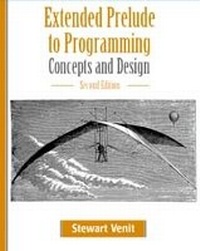
Extended Prelude to Programming
Concepts and Design
2nd Edition
Published on 25. May 2005
Book
Paperback/Softback
360 pages
978-1-57676-132-8 (ISBN)
Description
This book, in a language-free context, helps students learn general programming topics (e.g. data types, control structures, files, arrays, subprograms), structured programming principles (e.g. top-down design, modular design, documentation and style), how to use basic tools and algorithms (e.g. data validation, defensive programming, searching and sorting), and about other programming paradigms (e.g. object-oriented, event-driven). It includes three additional chapters not found in "Precise Prelude to Programming" (chapters 7 - 9).
More details
Edition
2nd edition
Language
English
Place of publication
Harlow
United Kingdom
Publishing group
Pearson Education Limited
Target group
College/higher education
Dimensions
Height: 235 mm
Width: 187 mm
Weight
562 gr
ISBN-13
978-1-57676-132-8 (9781576761328)
Copyright in bibliographic data and cover images is held by Nielsen Book Services Limited or by the publishers or by their respective licensors: all rights reserved.
Schweitzer Classification
Other editions
New editions
Stewart Venit | Elizabeth Drake
Extended Prelude to Programming
Book
11/2006
3rd Edition
Pearson
€65.60
Article is exhausted; no reprint
Content
Introduction
A Brief History of Computers
Computer Basics
Software and Programming Languages
Chapter 1 An Introduction to Programming
1.1 What Is Programming?
1.2 Basic Programming Concepts
1.3 Data Processing and Output
1.4 Data Types
Chapter 2 Developing a Program
2.1 The Program Development Cycle
2.2 Program Design
2.3 Coding, Documenting, and Testing a Program
2.4 Structured Programming
2.5 An Introduction to GUIs and OOP
Chapter 3 Selection Structures: Making Decisions
3.1 An Introduction to Selection Structures
3.2 Relational and Logical Operators
3.3 Selecting from Several Alternatives
3.4 Applications of Selection Structures
3.5 Focus on Problem Solving
Chapter 4 Repetition Structures: Looping
4.1 An Introduction to Repetition Structures
4.2 Counter-controlled Loops
4.3 Applications of Repetition Structures
4.4 Nested Loops
4.5 Focus on Problem Solving
Chapter 5 Sequential Data Files
5.1 Sequential File Basics
5.2 Modifying a Sequential File
5.3 Merging Sequential Files
5.4 Focus on Problem Solving
Chapter 6 Arrays: Lists and Tables
6.1 One-dimensional Arrays
6.2 Searching and Sorting Arrays
6.3 Other Uses of Arrays
6.4 Two-dimensional Arrays
6.5 Focus on Problem Solving
Chapter 7 More on Program Modules and Subprograms
7.1 Data Flow Diagrams and Parameters
7.2 More on Subprograms
7.3 Functions
7.4 Recursion
7.5 Focus on Problem Solving
Chapter 8 More on OOP and GUIs
8.1 Classes and Objects
8.2 More on Object-oriented Programming
8.3 Graphical User Interfaces Revisited
8.4 Event-driven Programming
8.5 Focus on Problem Solving
Chapter 9 Additional Topics
9.1 Random Numbers
9.2 The ASCII Code
9.3 More on Sorting and Searching
9.4 An Introduction to Direct-Access Files
9.5 More on Direct-Access Files
A Brief History of Computers
Computer Basics
Software and Programming Languages
Chapter 1 An Introduction to Programming
1.1 What Is Programming?
1.2 Basic Programming Concepts
1.3 Data Processing and Output
1.4 Data Types
Chapter 2 Developing a Program
2.1 The Program Development Cycle
2.2 Program Design
2.3 Coding, Documenting, and Testing a Program
2.4 Structured Programming
2.5 An Introduction to GUIs and OOP
Chapter 3 Selection Structures: Making Decisions
3.1 An Introduction to Selection Structures
3.2 Relational and Logical Operators
3.3 Selecting from Several Alternatives
3.4 Applications of Selection Structures
3.5 Focus on Problem Solving
Chapter 4 Repetition Structures: Looping
4.1 An Introduction to Repetition Structures
4.2 Counter-controlled Loops
4.3 Applications of Repetition Structures
4.4 Nested Loops
4.5 Focus on Problem Solving
Chapter 5 Sequential Data Files
5.1 Sequential File Basics
5.2 Modifying a Sequential File
5.3 Merging Sequential Files
5.4 Focus on Problem Solving
Chapter 6 Arrays: Lists and Tables
6.1 One-dimensional Arrays
6.2 Searching and Sorting Arrays
6.3 Other Uses of Arrays
6.4 Two-dimensional Arrays
6.5 Focus on Problem Solving
Chapter 7 More on Program Modules and Subprograms
7.1 Data Flow Diagrams and Parameters
7.2 More on Subprograms
7.3 Functions
7.4 Recursion
7.5 Focus on Problem Solving
Chapter 8 More on OOP and GUIs
8.1 Classes and Objects
8.2 More on Object-oriented Programming
8.3 Graphical User Interfaces Revisited
8.4 Event-driven Programming
8.5 Focus on Problem Solving
Chapter 9 Additional Topics
9.1 Random Numbers
9.2 The ASCII Code
9.3 More on Sorting and Searching
9.4 An Introduction to Direct-Access Files
9.5 More on Direct-Access Files