

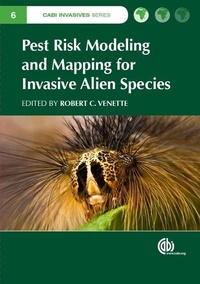
Pest Risk Modelling and Mapping for Invasive Alien Species
Will be published approx. on 26. March 2015
Book
Hardback
252 pages
978-1-78064-394-6 (ISBN)
Description
Over the past century, the number of species that have been transported to areas outside their native range has increased steadily. New pests and pathogens place biological pressure on valuable resident species, but strict bans may conflict with trading and travel needs. An overview of how the conflict can be managed using pest risk mapping and modelling, this book uses worked examples to explain modelling and help development of tool kits for assessment.
More details
Series
Language
English
Place of publication
Wallingford
United Kingdom
Target group
College/higher education
Product notice
sewn/stitched
Cloth over boards
Dimensions
Height: 252 mm
Width: 172 mm
Thickness: 21 mm
Weight
785 gr
ISBN-13
978-1-78064-394-6 (9781780643946)
Copyright in bibliographic data and cover images is held by Nielsen Book Services Limited or by the publishers or by their respective licensors: all rights reserved.
Schweitzer Classification
Other editions
Additional editions
Robert C. Venette
Pest Risk Modelling and Mapping for Invasive Alien Species
E-Book
03/2015
CABI Publishing
€68.49
Available for download
Persons
Robert C. Venette, USDA Forest Service, USA
Editor
USDA Forest Service, USA
Contributions
Michigan State University, USA
CSIRO EcoSciences Precinct, Australia
US Geological Service, USA
North Carolina State University, USA
CSIRO Ecosystem Sciences, Australia
Bio-Protection Research Centre, Lincoln University, New Zealand
INRA Orleans - Unite de Recherches de Zoologie Forestiere, France
USDA Forest Service, USA
Department of Agriculture and Food, Australia
Content
0: Preface 1: The Challenge of Modelling and Mapping the Future Distribution and Impact of Invasive Alien Species 2: Mapping Endangered Areas for Pest Risk Analysis 3: Following the Transportation Trail to Anticipate Human-mediated Invasions in Terrestrial Ecosystems 4: Simulation Modelling of Long-distance Windborne Dispersal for Invasion Ecology 5: Using the MAXENT Program for Species Distribution Modelling to Assess Invasion Risk 6: The NCSU/APHIS Plant Pest Forecasting System (nappfast) 7: Detecting and Interpreting Patterns within Regional Pest Species Assemblages using Self-organizing Maps and Other Clustering Methods 8: Modelling the Spread of Invasive Species to Support Pest Risk Assessment: Principles and Application of a Suite of Generic Models 9: Estimating Spread Rates of Non-native Species: The Gypsy Moth as a Case Study 10: Predicting the Economic Impacts of Invasive Species: The Eradication of the Giant Sensitive Plant from Western Australia 11: Spatial Modelling Approaches for Understanding and Predicting the Impacts of Invasive Alien Species on Native Species and Ecosystems 12: Process-based Pest Risk Mapping using Bayesian Networks and GIS 13: Identifying and Assessing Critical Uncertainty Thresholds in a Forest Pest Risk Model 14: Making Invasion Models Useful for Decision Makers: Incorporating Uncertainty, Knowledge Gaps and Decision-making Preferences 15: Assessing the Quality of Pest Risk Models