

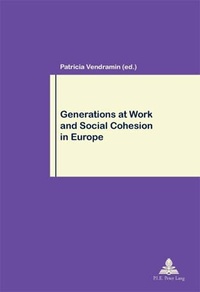
Generations at Work and Social Cohesion in Europe
Will be published approx. on 29. September 2010
Book
Paperback/Softback
326 pages
978-90-5201-647-4 (ISBN)
Description
Work has always been and remains a powerful integrator in society. It provides places, duties and rights and classifies individuals on a scale of social prestige. Over a long period of time, however, the meaning of work has changed. It has become more diversified and it is now a matter for high expectations, of different kinds - instrumental, social, symbolic - that do not replace each other.
In post-industrial societies, work and identities are still strongly intertwined despite a progressive distance vis-à-vis work (if work is considered as a value per se). Work remains a social integrator but it no longer has a hegemonic value.
There is a generational component in these changes, both in the subjective meaning of work and in its objective conditions (status, trajectories, security, etc.). Do such generational differentiations unavoidably lead to fractures in social cohesion? That is the key question of this book.
More details
Other editions
Additional editions
Patricia Vendramin
Generations at Work and Social Cohesion in Europe
Histoire d'un État rayé de la carte du monde
E-Book
02/2011
180th Edition
Peter Lang Verlag
€79.69
Available for download
Person
Patricia Vendramin is a research director at the Fondation Travail-Université (BE) and a Professor at the University Louvain-la-Neuve (UCL) where she teaches sociology and labour science. She has a PhD in sociology and masters in communication sciences and development studies. Her research and publications address issues relating to work, including: atypical work practices, organisation, working time, quality of work, women's work, industrial relations, youth employment and social bonding.
Content
Contents: Patricia Vendramin/John Cultiaux: The Social Challenges of Changing Relationship to Work - Lucie Davoine/Dominique Méda: The Importance and Meaning of Work in Europe. Trends and Differences between Countries - John Cultiaux/Patricia Vendramin: The Diversity of Relationships to Work. A Belgian Perspective - Götz Richter: A Generational Perspective on Workplace Relationships. A German Perspective - Béatrice Delay/Dominique Méda/Marie-Christine Bureau: How do Socio-Organisational Systems Support Competition or Synergies between Age Groups? A French Perspective - Katalin Füleki/Orsolya Polyacskó/Júlia Vajda: Transition in Work, Work in Transition. A Hungarian Perspective - Adele Lebano/Maria Teresa Franco/Silvana Greco: So Far so Close. Generations and Work in Italy. An Italian Perspective - Ana Margarida Passos/Paula Castro/Sandra Carvalho/Célia Soares: Self, Work and Career in a Changing Environment. A Portuguese Perspective - Marina Monaco: How do European Policy Practices Address the Intergenerational Challenge Regarding Work? - Anna M. Ponzellini: Perspectives for Good Management of the Generations at Work and Pathways for Greater Social Cohesion - Patricia Vendramin: Conclusion. Generations at Work and Social Cohesion in Europe.