


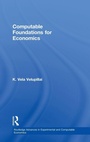
Computable Foundations for Economics
1st Edition
Published on 22. February 2010
Book
Paperback/Softback
500 pages
978-0-415-58620-7 (ISBN)
Description
Computable Foundations for Economics is a unified collection of essays, some of which are published here for the first time and all of which have been updated for this book, on an approach to economic theory from the point of view of algorithmic mathematics. By algorithmic mathematics the author means computability theory and constructive mathematics. This is in contrast to orthodox mathematical economics and game theory, which are formalised with the mathematics of real analysis, underpinned by what is called the ZFC formalism, i.e., set theory with the axiom of choice. This reliance on ordinary real analysis and the ZFC system makes economic theory in its current mathematical mode completely non-algorithmic, which means it is numerically meaningless.
The book provides a systematic attempt to dissect and expose the non-algorithmic content of orthodox mathematical economics and game theory and suggests a reformalization on the basis of a strictly rigorous algorithmic mathematics. This removes the current schizophrenia in mathematical economics and game theory, where theory is entirely divorced from algorithmic applicability - for experimental and computational exercises.
The chapters demonstrate the uncomputability and non-constructivity of core areas of general equilibrium theory, game theory and recursive macroeconomics. The book also provides a fresh look at the kind of behavioural economics that lies behind Herbert Simon's work, and resurrects a role for the noble classical traditions of induction and verification, viewed and formalised, now, algorithmically. It will therefore be of particular interest to postgraduate students and researchers in algorithmic economics, game theory and classical behavioural economics.
The book provides a systematic attempt to dissect and expose the non-algorithmic content of orthodox mathematical economics and game theory and suggests a reformalization on the basis of a strictly rigorous algorithmic mathematics. This removes the current schizophrenia in mathematical economics and game theory, where theory is entirely divorced from algorithmic applicability - for experimental and computational exercises.
The chapters demonstrate the uncomputability and non-constructivity of core areas of general equilibrium theory, game theory and recursive macroeconomics. The book also provides a fresh look at the kind of behavioural economics that lies behind Herbert Simon's work, and resurrects a role for the noble classical traditions of induction and verification, viewed and formalised, now, algorithmically. It will therefore be of particular interest to postgraduate students and researchers in algorithmic economics, game theory and classical behavioural economics.
More details
Series
Language
English
Place of publication
London
United Kingdom
Publishing group
Taylor & Francis Ltd
Target group
College/higher education
Dimensions
Height: 234 mm
Width: 156 mm
Thickness: 27 mm
Weight
755 gr
ISBN-13
978-0-415-58620-7 (9780415586207)
Copyright in bibliographic data and cover images is held by Nielsen Book Services Limited or by the publishers or by their respective licensors: all rights reserved.
Schweitzer Classification
Other editions
Additional editions

K. Vela Velupillai
Computable Foundations for Economics
E-Book
07/2012
Routledge
€52.49
Available for download

K. Vela Velupillai
Computable Foundations for Economics
E-Book
07/2012
Routledge
€52.49
Available for download
K. Vela Velupillai
Computable Foundations for Economics
Book
03/2010
1st Edition
Routledge
€264.00
Shipment within 15-20 days
Person
Vela Velupillai is a Professor of Economics, both in the faculty of economics and in its graduate school, CIFREM, at the University of Trento, Italy. He is also a Senior Visiting Professor at the Madras School of Economics.
Content
Part I: Foundations 1. The Incomputable, the Non-constructive and the Undecidable in Mathematical Economics 2. Advanced Computational Complexity Theory from an Elementary Standpoint 3. Economic Dynamics and Computation - Recursion Theoretic Foundations for the Icarus Tradition 4: Let's Take the Con out of Mathematical Economics Part II: General Equilibrium Theory 5. Effectivity and Constructivity in Economic Theory 6. Algorithmic Foundations of Computable General Equilibrium Theory 7. Uncomputability and Undecidability in Economic Theory Part III: Methodology 8. The Unreasonable Ineffectivity of Mathematics in Economics 9. A Constructive Interpretation of Sraffa's Mathematical Economics 10. The Computable Alternative in the Mathematization of Economics Part IV: Simon's Behavioural Economics - A Computable Vision 11. Computable Rationality 12. Boundedly Rational Choice and Satisficing Decisions 13. Simon's Epicurean Adventures - A Prolegomena. Appendix 1 to Part IV: Artificing a Rationally Unbounded Life. Appendix 2 to Part IV: The Logic of Discovery, Problem Solving and Retroduction. Appendix 3 to Part IV: Herbert Simon's Letter on Computable Economics Part V: Inductive Reflections 14. De-Mystifying Induction, Falsification and other Popperian Extravaganzas 15. Re-reading Jevons's Principles of Science: Induction Redux 16. Impossibility of Effectively Computable Inductive Policies in a Complex Dynamic Economy. Part VI: Concluding Notes 17. Epilogue - A Research Program for the Algorithmic Social Sciences