

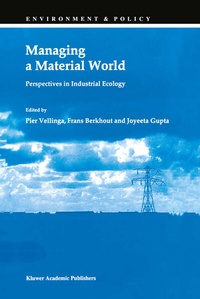
Managing a Material World
Perspectives in Industrial Ecology
Published on 30. June 1998
Book
Hardback
XI, 349 pages
978-0-7923-5153-5 (ISBN)
Description
As we reach the end of the 20th century, the question of how to meet human needs and preferences while safeguarding the global environment is a major concern facing humanity. This book reflects the state of the art of thinking on the necessary concepts, tools and instruments that are likely to help producers, consumers and governments to adjust their policies and practices. It covers theories and concepts, practical approaches and visions of industry and government. The book has been written by a team of authors that includes the most forward thinking researchers and managers on the issue. It is a handbook for all those involved in decisions about product design and eco-efficiency, about environment and resource use policies. Moreover it can serve as a handbook for all those who are studying with the aim to become involved in such issues.
More details
Series
Edition
1998 ed.
Language
English
Place of publication
Dordrecht
Netherlands
Target group
Professional and scholarly
Research
Illustrations
XI, 349 p.
Dimensions
Height: 241 mm
Width: 160 mm
Thickness: 25 mm
Weight
717 gr
ISBN-13
978-0-7923-5153-5 (9780792351535)
DOI
10.1007/978-94-011-5125-2
Schweitzer Classification
Other editions
Additional editions
Pier Vellinga | Frans Berkhout | J. Gupta
Managing a Material World
E-Book
12/2012
Springer
€96.29
Available for download
Pier Vellinga | Frans Berkhout | J. Gupta
Managing a Material World
Perspectives in Industrial Ecology
Book
06/1998
Kluwer Academic Publishers
€106.99
Shipment within 15-20 days
Content
1. Rationale for a physical account of economic activities.- 2. Substance flows through environment and society.- 3. Towards the end of waste.- 4. Dematerialisation.- 5. Analytical tools for chain management.- 6. Material flow accounts: definitions and data.- 7. Environmental research and modelling.- 8. Software for material flow analysis.- 9. Integrating life cycle assessment and economic evaluation.- 10. Dematerialisation and rematerialisation.- 11. Aggregate resource efficiency.- 12. The industrial ecology of lead and electric vehicles.- 13. Dissipative emissions.- 14. Recycling of materials.- 15. Philips Sound and Vision.- 16. Unilever.- 17. AT&T.- 18. Dow Europe.- 19. The control of waste materials in Germany.- 20. Dematerialisation and innovation policy.- 21. The substance flow approach.- 22. The EU eco-label.- 23. Towards industrial transformation.