

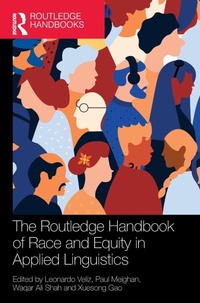
The Routledge Handbook of Race and Equity in Applied Linguistics
1st Edition
Will be published approx. on 23. July 2026
Book
Hardback
424 pages
978-1-041-04908-1 (ISBN)
Description
The Routledge Handbook of Race and Equity in Applied Linguistics provides an authoritative overview of research on racial and epistemic inequities in TESOL and applied linguistics. It focuses on intersecting systems of oppression in institutional, pedagogical, curricular, and policy spaces.
Across 27 chapters, contributors critically examine everyday policies and practices, such as hiring bias and discriminatory job ads, which disadvantage multilingual learners and teachers, while amplifying agentive voices seeking change. Organized into four parts and spanning the geographic and epistemic Global South and North, the handbook is both critique and praxis: it offers practical tools for valuing students' full repertoires, challenging native-speaker norms, redesigning curricula and assessment, and linking classroom decisions to program and policy reform. It adopts diverse and groundbreaking lenses-linguistic racism, native-speakerism, commodified hiring, translanguaging, phenomenology, pedagogy of love, Ebunlingualism, decolonial hermeneutics, intersectionality, and critical ethnographies-that counter linguistic, epistemic, racial, and institutional hegemonies.
This timely handbook charts a clear decolonial path for students and scholars in TESOL, Applied Linguistics, and Education, while equipping educators and policymakers with the tools to build more just and inclusive environments.
Across 27 chapters, contributors critically examine everyday policies and practices, such as hiring bias and discriminatory job ads, which disadvantage multilingual learners and teachers, while amplifying agentive voices seeking change. Organized into four parts and spanning the geographic and epistemic Global South and North, the handbook is both critique and praxis: it offers practical tools for valuing students' full repertoires, challenging native-speaker norms, redesigning curricula and assessment, and linking classroom decisions to program and policy reform. It adopts diverse and groundbreaking lenses-linguistic racism, native-speakerism, commodified hiring, translanguaging, phenomenology, pedagogy of love, Ebunlingualism, decolonial hermeneutics, intersectionality, and critical ethnographies-that counter linguistic, epistemic, racial, and institutional hegemonies.
This timely handbook charts a clear decolonial path for students and scholars in TESOL, Applied Linguistics, and Education, while equipping educators and policymakers with the tools to build more just and inclusive environments.
More details
Series
Language
English
Place of publication
London
United Kingdom
Publishing group
Taylor & Francis Ltd
Target group
College/higher education
Professional and scholarly
Academic, Postgraduate, and Undergraduate Advanced
Illustrations
20 s/w Tabellen, 13 s/w Zeichnungen, 7 s/w Photographien bzw. Rasterbilder, 20 s/w Abbildungen
20 Tables, black and white; 11 Line drawings, black and white; 9 Halftones, black and white; 20 Illustrations, black and white
Dimensions
Height: 246 mm
Width: 174 mm
ISBN-13
978-1-041-04908-1 (9781041049081)
Copyright in bibliographic data and cover images is held by Nielsen Book Services Limited or by the publishers or by their respective licensors: all rights reserved.
Schweitzer Classification
Other editions
Additional editions
Leonardo Veliz | Paul Meighan | Waqar Ali Shah
The Routledge Handbook of Race and Equity in Applied Linguistics
E-Book
approx. 07/2026
1st Edition
Routledge
€63.49
Available for download
Leonardo Veliz | Paul Meighan | Waqar Ali Shah
The Routledge Handbook of Race and Equity in Applied Linguistics
E-Book
approx. 07/2026
1st Edition
Routledge
€63.49
Available for download
Persons
Leonardo Veliz is an Associate Professor in Language and Literacy in the School of Education at the University of New England, Australia. He is also an adjunct professor in the MTESOL program at Facultad de Educacion, Universidad San Sebastian, Concepcion, Chile. His research critically explores multilingualism, multiculturalism, and broader sociopolitical dimensions of language education, with a particular interest in equity, linguistic justice, and decolonial perspectives in diverse educational contexts, including Australia, Latin America, and the Global South.
Paul Meighan is a Gael sociolinguist, Indigenous to the Scottish Highlands and Islands. He is Research Project Manager for Learning from the Lands at the University of Guelph and an ESL Professor at Sheridan College, Canada. His research explores the intersections of language, land, identity, and power through Indigenous language revitalization, multilingual pedagogies, and Indigenous knowledge systems..
Waqar Ali Shah is an Assistant Professor at Mehran University of Engineering and Technology, Pakistan. He has obtained his PhD in Applied Linguistics from University of Jyvaeskylae, Finland. His research interests include critical applied linguistics, critical (multimodal) discourse studies, critical multilingualism, and decoloniality in TESOL. Waqar has published extensively in international peer-reviewed journals.
Xuesong Gao is a language teacher educator and leading scholar at the School of Education, Faculty of Arts, Design and Architecture, University of New South Wales, Australia. His research interests include international students' educational experiences, language learner agency, language and literacy education, language education policy and language teacher education, particularly applications of sociocultural/ecological perspectives on education.
Paul Meighan is a Gael sociolinguist, Indigenous to the Scottish Highlands and Islands. He is Research Project Manager for Learning from the Lands at the University of Guelph and an ESL Professor at Sheridan College, Canada. His research explores the intersections of language, land, identity, and power through Indigenous language revitalization, multilingual pedagogies, and Indigenous knowledge systems..
Waqar Ali Shah is an Assistant Professor at Mehran University of Engineering and Technology, Pakistan. He has obtained his PhD in Applied Linguistics from University of Jyvaeskylae, Finland. His research interests include critical applied linguistics, critical (multimodal) discourse studies, critical multilingualism, and decoloniality in TESOL. Waqar has published extensively in international peer-reviewed journals.
Xuesong Gao is a language teacher educator and leading scholar at the School of Education, Faculty of Arts, Design and Architecture, University of New South Wales, Australia. His research interests include international students' educational experiences, language learner agency, language and literacy education, language education policy and language teacher education, particularly applications of sociocultural/ecological perspectives on education.
Content
List of Tables
List of Figures
List of Contributors
Foreword
Race, Power, and Epistemic Struggles in TESOL and Applied Linguistics: An Introduction
Leonardo Veliz, Paul Meighan, Waqar Ali Shah, and Xuesong (Andy) Gao
PART I
Racial and Epistemic Inequities within Institutionalized Settings
1 Linguistic Racism and Discrimination in Higher Education
Stephen May and Mi Yung Park
2 Native-Speakerism and Employment Discrimination in Shadow Education Industry: Voices of English Language Teacher-Tutors in Kazakhstan
Anas Hajar
3 Sexism, Ageism, and Lookism in Language Education: A Critical Examination of the Commodification of Teachers and Hiring Practices
Takako Kawabata
4 Internationalization without Multilingualism: The Question of Institutional Care at Anglophone Universities
Agnes Bodis, Leigh Swigart, Ji Chen, Apeksha Gandhi, Nhi Le, Karen McAuliffe and Vivien Vien
5 ". . .Expected to Take All of Their Courses Alongside Native English Speakers": Framings of English Proficiency Requirements in U.S. Higher Education
Qudus Ayinde Adebayo
6 "Does Oral Proficiency Make a Good TA": A Phenomenological Study Interrogating Equity in the English Requirements for Asian IGTAs in Ohio Public Universities
Ionell Jay R. Terogo, Yun-Han Weng and Chia-Hsin Yin
7 "Can You Prove You Are an EAL/D Student?" Re-Examining Eligibility Criteria for EAL/D ATAR Courses in Australia
Toni Dobinson and Stephanie Dryden
PART II
Racial and Epistemic Inequities in Pedagogy and Practice: Challenges and Innovations
8 A Pedagogy of Love in Hostile Times: Immigrant Teachers Resisting with Care
Victoria Norford and Leonardo Veliz
9 ??bunlingualism: Decentering Racialization and Epistemic Injustice in African Language Praxis
Yetunde S. Alabede
10 Rethinking Listening as an Anti-Racist Practice
Vijay A. Ramjattan
11 The Teacher-as-Reading Subject: A Decolonial Hermeneutic Model for L2 Writing Assessment
Sitong Wang
12 Decolonizing Academic English Writing: Pedagogical Strategies for Multilingual Students in Higher Education
Onur OEzkaynak and Xinyue Lu
13 What's Your Idiolect? Promoting Linguistic and Epistemic Access in EMI and Anglophone Universities through Translanguaging (and Englishing) Strategies
Yaseen Ali
14 Confronting Epistemic Inequities in TESOL in Chile: Curricular Nuclearization as an Experimental Tool to Conceptual and Professional Reappropriation
Diego Cabezas and Tatiana Carcamo-Rojas
15 Reimagining EAP through (Dis)comfort: Race, Identity, and Emotion in Academic English
Olive Nabukeera
16 Reimagining EAP Teaching in the Journey of Decolonization: Deconstructing and Disrupting
Trisha Dowling
17 Voices of Multilingual Students: Examining an English for Specific Purposes (ESP) Curriculum for Linguistic and Cultural Inclusion
Nurlaily, Gary Bonar and Anne Keary
PART III
Racial and Epistemic Resistance for Diversity and Inclusion
18 Translanguaging as an Interactive Scaffold for Australian Aboriginal
Students in TESOL Classrooms
Sender Dovchin, Rhonda Oliver and Lissy Jackson
19 Transresistance through Teacher-Activated School Transformation: Theoretical Foundations, Global Contexts, and Policy Implications for Translingual Learners
Madjiguene Fall
20 The Role of Race in Bilingual Education: An Intersectional Perspective on Teacher Training in Brazil
Bruno Andrade
21 Students' Epistemic Resistance in Adult Basic Education
H?i Nguy?n, Johanna Ennser-Kananen and Venla Rantanen
22 Anti-Asian Racism: Perspectives from Three Asian English Language Educators
Vashti Wai Yu Lee, Lee Her and Peter I. De Costa
23 TESOL Teachers' Experiences of Discrimination and Resilience in Pakistan
Ameer Ali, Illahi Bakhsh, Shafqat Hussain, Maya Khemlani David, Angela Rumina and Muhammad Hassan Abbasi
PART IV
Critical Ethnographies of Racial and Epistemic Injustice and Resistance
24 A Critical Autoethnography of an Emerging EFL Scholar from the Global South Confronting Racial, Linguistic, and Epistemic Injustices in TESOL
Jepri Ali Saiful
25 Marginalizations of Multicultural Faculty in Japan: Collaborative Autoethnography of Six "Non-Native" Female Instructors
Aika Ishige, Elisabeth (Libby) Ann Williams, Oana Cusen, Mahboubeh Rakhshandehroo, Girlie Ann Herrera, and Yan Li
26 Navigating Academia with a Racialized Multilingual Body: A Multilingual Woman Scholar's Perspective
Grace Lee-Amuzie
27 Countering Epistemological and Institutional Racism in Applied Linguistics and TESOL: A Decolonial Intersectional Perspective
Waqar Ali Shah, Paul J. Meighan, and Leonardo Veliz
Index
List of Figures
List of Contributors
Foreword
Race, Power, and Epistemic Struggles in TESOL and Applied Linguistics: An Introduction
Leonardo Veliz, Paul Meighan, Waqar Ali Shah, and Xuesong (Andy) Gao
PART I
Racial and Epistemic Inequities within Institutionalized Settings
1 Linguistic Racism and Discrimination in Higher Education
Stephen May and Mi Yung Park
2 Native-Speakerism and Employment Discrimination in Shadow Education Industry: Voices of English Language Teacher-Tutors in Kazakhstan
Anas Hajar
3 Sexism, Ageism, and Lookism in Language Education: A Critical Examination of the Commodification of Teachers and Hiring Practices
Takako Kawabata
4 Internationalization without Multilingualism: The Question of Institutional Care at Anglophone Universities
Agnes Bodis, Leigh Swigart, Ji Chen, Apeksha Gandhi, Nhi Le, Karen McAuliffe and Vivien Vien
5 ". . .Expected to Take All of Their Courses Alongside Native English Speakers": Framings of English Proficiency Requirements in U.S. Higher Education
Qudus Ayinde Adebayo
6 "Does Oral Proficiency Make a Good TA": A Phenomenological Study Interrogating Equity in the English Requirements for Asian IGTAs in Ohio Public Universities
Ionell Jay R. Terogo, Yun-Han Weng and Chia-Hsin Yin
7 "Can You Prove You Are an EAL/D Student?" Re-Examining Eligibility Criteria for EAL/D ATAR Courses in Australia
Toni Dobinson and Stephanie Dryden
PART II
Racial and Epistemic Inequities in Pedagogy and Practice: Challenges and Innovations
8 A Pedagogy of Love in Hostile Times: Immigrant Teachers Resisting with Care
Victoria Norford and Leonardo Veliz
9 ??bunlingualism: Decentering Racialization and Epistemic Injustice in African Language Praxis
Yetunde S. Alabede
10 Rethinking Listening as an Anti-Racist Practice
Vijay A. Ramjattan
11 The Teacher-as-Reading Subject: A Decolonial Hermeneutic Model for L2 Writing Assessment
Sitong Wang
12 Decolonizing Academic English Writing: Pedagogical Strategies for Multilingual Students in Higher Education
Onur OEzkaynak and Xinyue Lu
13 What's Your Idiolect? Promoting Linguistic and Epistemic Access in EMI and Anglophone Universities through Translanguaging (and Englishing) Strategies
Yaseen Ali
14 Confronting Epistemic Inequities in TESOL in Chile: Curricular Nuclearization as an Experimental Tool to Conceptual and Professional Reappropriation
Diego Cabezas and Tatiana Carcamo-Rojas
15 Reimagining EAP through (Dis)comfort: Race, Identity, and Emotion in Academic English
Olive Nabukeera
16 Reimagining EAP Teaching in the Journey of Decolonization: Deconstructing and Disrupting
Trisha Dowling
17 Voices of Multilingual Students: Examining an English for Specific Purposes (ESP) Curriculum for Linguistic and Cultural Inclusion
Nurlaily, Gary Bonar and Anne Keary
PART III
Racial and Epistemic Resistance for Diversity and Inclusion
18 Translanguaging as an Interactive Scaffold for Australian Aboriginal
Students in TESOL Classrooms
Sender Dovchin, Rhonda Oliver and Lissy Jackson
19 Transresistance through Teacher-Activated School Transformation: Theoretical Foundations, Global Contexts, and Policy Implications for Translingual Learners
Madjiguene Fall
20 The Role of Race in Bilingual Education: An Intersectional Perspective on Teacher Training in Brazil
Bruno Andrade
21 Students' Epistemic Resistance in Adult Basic Education
H?i Nguy?n, Johanna Ennser-Kananen and Venla Rantanen
22 Anti-Asian Racism: Perspectives from Three Asian English Language Educators
Vashti Wai Yu Lee, Lee Her and Peter I. De Costa
23 TESOL Teachers' Experiences of Discrimination and Resilience in Pakistan
Ameer Ali, Illahi Bakhsh, Shafqat Hussain, Maya Khemlani David, Angela Rumina and Muhammad Hassan Abbasi
PART IV
Critical Ethnographies of Racial and Epistemic Injustice and Resistance
24 A Critical Autoethnography of an Emerging EFL Scholar from the Global South Confronting Racial, Linguistic, and Epistemic Injustices in TESOL
Jepri Ali Saiful
25 Marginalizations of Multicultural Faculty in Japan: Collaborative Autoethnography of Six "Non-Native" Female Instructors
Aika Ishige, Elisabeth (Libby) Ann Williams, Oana Cusen, Mahboubeh Rakhshandehroo, Girlie Ann Herrera, and Yan Li
26 Navigating Academia with a Racialized Multilingual Body: A Multilingual Woman Scholar's Perspective
Grace Lee-Amuzie
27 Countering Epistemological and Institutional Racism in Applied Linguistics and TESOL: A Decolonial Intersectional Perspective
Waqar Ali Shah, Paul J. Meighan, and Leonardo Veliz
Index