

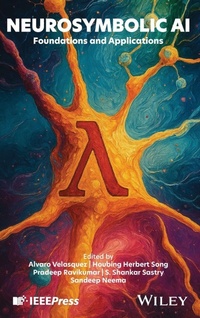
Neurosymbolic AI
Foundations and Applications
1st Edition
Published on 25. March 2026
Book
Hardback
496 pages
978-1-394-30237-6 (ISBN)
Description
An up-to-date and expert discussion of neuro-symbolic artificial intelligence development
In Neuro-symbolic AI: Foundations and Applications, a team of distinguished researchers delivers a comprehensive overview of the emerging field of neuro-symbolic artificial intelligence. Expert contributors explain the integration of symbolic representations with neural networks, demonstrating state-of-the-art practices in the field.
The book fosters collaboration amongst diverse disciplines and promotes a deeper understanding of the challenges posed by deep learning, including generalizability, explainability, and robustness. It is an authoritative, self-contained reference text that provides a solid foundation for newcomers to the field as well as seasoned researchers and developers.
Readers will find:
A systematic perspective on the foundations of neuro-development AI system development
Comprehensive explorations of key concepts in neuro-symbolic artificial intelligence
Discussions of real-world applications of neuro-symbolic AI in fields such as healthcare, finance, autonomous driving, and the military
Complete treatments of the foundations of neuro-symbolic AI from multiple disciplinary perspectives, including computer science, software engineering, and academic research
Perfect for researchers and professionals in artificial intelligence involved industries, including autonomous driving, military, healthcare, and finance, Neuro-symbolic AI: Foundations and Applications will also benefit students of computer science, software engineering, data science, and machine learning.
In Neuro-symbolic AI: Foundations and Applications, a team of distinguished researchers delivers a comprehensive overview of the emerging field of neuro-symbolic artificial intelligence. Expert contributors explain the integration of symbolic representations with neural networks, demonstrating state-of-the-art practices in the field.
The book fosters collaboration amongst diverse disciplines and promotes a deeper understanding of the challenges posed by deep learning, including generalizability, explainability, and robustness. It is an authoritative, self-contained reference text that provides a solid foundation for newcomers to the field as well as seasoned researchers and developers.
Readers will find:
A systematic perspective on the foundations of neuro-development AI system development
Comprehensive explorations of key concepts in neuro-symbolic artificial intelligence
Discussions of real-world applications of neuro-symbolic AI in fields such as healthcare, finance, autonomous driving, and the military
Complete treatments of the foundations of neuro-symbolic AI from multiple disciplinary perspectives, including computer science, software engineering, and academic research
Perfect for researchers and professionals in artificial intelligence involved industries, including autonomous driving, military, healthcare, and finance, Neuro-symbolic AI: Foundations and Applications will also benefit students of computer science, software engineering, data science, and machine learning.
More details
Language
English
Place of publication
United States
Publishing group
John Wiley & Sons Inc
Target group
Professional and scholarly
Dimensions
Height: 238 mm
Width: 161 mm
Thickness: 34 mm
Weight
818 gr
ISBN-13
978-1-394-30237-6 (9781394302376)
Copyright in bibliographic data and cover images is held by Nielsen Book Services Limited or by the publishers or by their respective licensors: all rights reserved.
Schweitzer Classification
Other editions
Additional editions
Alvaro Velasquez | Houbing Herbert Song | Pradeep Ravikumar
Neurosymbolic AI
Foundations and Applications
E-Book
03/2026
1st Edition
Wiley
€120.99
Available for download
Alvaro Velasquez | Houbing Herbert Song | Pradeep Ravikumar
Neurosymbolic AI
Foundations and Applications
E-Book
03/2026
1st Edition
Wiley
€120.99
Available for download
Persons
Alvaro Velasquez, PhD, is a Program Manager at Defense Advanced Research Projects Agency. He is also a Visiting Professor in the Department of Computer Science at the University of Colorado Boulder.
Houbing Herbert Song, PhD, is a Tenured Associate Professor, Director of the NSF Center for Aviation Big Data Analytics (Planning), an Associate Director for Leadership of the DOT Transportation Cybersecurity Center for Advanced Research and Education, and Director of Security and Optimization for the Networked Globe Laboratory at the University of Maryland.
Pradeep Ravikumar, PhD, is an Assistant Professor in the Department of Computer Science at the University of Texas at Austin.
S. Shankar Sastry, PhD, is a Professor of Electrical Engineering and Computer Sciences, Bio-Engineering, and Mechanical Engineering at the University of California, Berkeley.
Sandeep Neema, PhD, is a Professor in the Department of Computer Science and the Director of the Institute for Software Integrated Systems at Vanderbilt University.
Houbing Herbert Song, PhD, is a Tenured Associate Professor, Director of the NSF Center for Aviation Big Data Analytics (Planning), an Associate Director for Leadership of the DOT Transportation Cybersecurity Center for Advanced Research and Education, and Director of Security and Optimization for the Networked Globe Laboratory at the University of Maryland.
Pradeep Ravikumar, PhD, is an Assistant Professor in the Department of Computer Science at the University of Texas at Austin.
S. Shankar Sastry, PhD, is a Professor of Electrical Engineering and Computer Sciences, Bio-Engineering, and Mechanical Engineering at the University of California, Berkeley.
Sandeep Neema, PhD, is a Professor in the Department of Computer Science and the Director of the Institute for Software Integrated Systems at Vanderbilt University.
Content
List of Contributors xv
About the Authors xxi
Part I Fundamentals 1
1 What Is Neurosymbolic AI? An Overview and Frontier Problems 3
Alvaro Velasquez, Lucas White, Patrick Cooper, Antony Zhao, and Lekai Chen
1.1 Introduction 3
1.2 Neurosymbolic Artificial Intelligence 4
1.2.1 Explicit to Implicit: From Symbolic Representations to Neural Networks 5
1.2.2 Implicit to Explicit: From Neural Networks to Symbolic Representations 6
1.3 Frontiers Problems 7
1.3.1 Neurosymbolic AI for Synthetic Biology 7
1.3.2 Neurosymbolic AI for Robust Autonomy 9
1.3.3 Neurosymbolic AI for Creative Scientific Discovery 11
1.4 Conclusion 11
References 12
2 Reasoning in Neurosymbolic AI 15
Son Tran, Edjard Mota, and Artur d'Avila Garcez
2.1 What Is Reasoning in Neural Networks? 15
2.1.1 Reasoning in LLMs 16
2.1.2 AI from a Neurosymbolic Perspective 19
2.2 Background: Logic and RBMs 21
2.2.1 Illustrating Logical Reasoning with the Sudoku Puzzle 23
2.2.2 Sudoku with Strategies of Sampling 26
2.2.3 Restricted Boltzmann Machines 27
2.3 Symbolic Reasoning with Energy-based Neural Networks 28
2.3.1 Related Work 28
2.3.2 Knowledge Representation in RBMs 30
2.3.3 Reasoning in RBMs 33
2.3.4 Logical Boltzmann Machines 36
2.3.5 Experimental Results 39
2.3.6 Extensions of LBMs 43
2.4 LBMs for MaxSAT 49
2.4.1 LBM with Dual Annealing 52
2.4.2 Experimental Results of LBM for MaxSAT 52
2.5 Integrating Learning and Reasoning in LBMs 54
2.6 Challenges for Neurosymbolic AI 57
2.6.1 Nonmonotonic Logic 58
2.6.2 Planning 58
2.6.3 Learning from Its Mistakes 59
2.7 Conclusion 60
References 62
3 Neurosymbolic Assurance Using Concept Probes in Foundation Models 69
Ramneet Kaur, Anirban Roy, and Susmit Jha
3.1 Introduction 69
3.2 Neural Features and Concept Probes 71
3.3 Foundation Models as Specification Lens 72
3.4 Symbolic Specification of ML Models Using Concept Probes 75
3.5 Implementation and Evaluation 78
3.6 Conclusion and Open Challenges 86
References 87
4 Toward Assured Autonomy Using Neurosymbolic Components and Systems 89
Abhishek Dubey, Taylor T. Johnson, Xenofon Koutsoukos, Baiting Luo, Diego Manzanas Lopez, Miklos Maroti, Ayan Mukhopadhyay, Nicholas Potteiger, Serena Serbinowska, Daniel Stojcsics, Yunuo Zhang, and Gabor Karsai
4.1 Introduction 89
4.2 Problem Formulation and Challenges: Maneuver Control for Autonomous Vehicles 90
4.3 Software Architecture: Components and Interactions 91
4.4 Probabilistic World Model 93
4.4.1 Obstacle Map Calculation 94
4.4.2 Reward Map Calculation 96
4.5 Planner 97
4.5.1 Formalization 98
4.5.2 Online Planning Through Monte Carlo Search 98
4.5.3 Scalability Through Hierarchical Planning 100
4.5.4 Evaluation and Analysis 101
4.5.5 Neurosymbolic Extensions for Planning Under Partial Observability 101
4.6 Trajectory Control with Evolving Behavior Trees (EBTs) 103
4.6.1 Safe Autonomous UAV Navigation 103
4.6.2 Safe EBTs for Navigation 104
4.6.3 Evaluation 106
4.7 Assurance for Neurosymbolic Systems 108
4.7.1 Neurosymbolic Verification with BehaVerify 109
4.7.2 Assurance on Grid Abstractions 111
4.7.3 Timing Results and Conclusions 112
4.7.4 Future Work 113
4.8 Conclusions 114
References 115
5 Safe Neurosymbolic Learning and Control 119
Somil Bansal and Jaime F. Fisac
5.1 Problem Setup 119
5.1.1 Dynamical Safety Problem 120
5.1.2 Running Example: Air Collision Avoidance 122
5.2 Hamilton-Jacobi (HJ) Reachability 123
5.2.1 Methods to Solve HJI-VI and Compute Unsafe Set 126
5.2.2 Running Example: Air Collision Avoidance 127
5.3 A Neurosymbolic Perspective on Learning Safe Controllers 129
5.3.1 Self-supervised Neurosymbolic Learning for Synthesizing Safe Controllers 129
5.3.2 Neurosymbolic Reinforcement Learning for Synthesizing Safe Controllers 135
5.3.3 Connections Between Reinforcement and Self-supervised Neurosymbolic Learning 143
5.4 Safety Assurances for Learned Controllers 144
5.4.1 Probabilistic Safety Assurances Through Conformal Prediction 145
5.4.2 Robust Safety Assurances Through Forward Reachability 148
5.5 Frontiers, Open Questions, and Promising Directions 150
References 151
6 Controllable Generation via Locally Constrained Resampling 159
Kareem Ahmed, Kai-Wei Chang, and Guy Van den Broeck
6.1 Introduction 159
6.2 Background 160
6.2.1 Notation and Preliminaries 160
6.2.2 A Probability Distribution over Sentences 161
6.2.3 The State of Conditional Sampling 162
6.3 Locally Constrained Resampling: A Tale of Two Distributions 163
6.3.1 Inducing a Local Tractable Distribution 164
6.3.2 Tractable Operations via Compilation 165
6.3.3 Intermezzo: Constraint Circuits and DFAs 168
6.3.4 Correcting Sample Bias: Importance Sampling... and Resampling 168
6.4 Related Work 170
6.5 Experimental Evaluation 171
6.6 Conclusion and Future Work 175
Appendix A Controllable Generation via Locally Constrained Resampling 175
A. 1 Language Detoxification 175
A. 2 Sudoku 176
A. 3 Warcraft Shortest Path 176
A. 4 Broader Impact 177
References 177
7 Tractable and Expressive Generative Modeling with Probabilistic Flow Circuits 183
Sahil Sidheekh and Sriraam Natarajan
7.1 Introduction 183
7.2 Tractable Probabilistic Modeling 188
7.2.1 Inference Queries 189
7.2.2 The Expressivity-tractability Trade-off 190
7.3 Probabilistic Circuits 191
7.3.1 Defining a Probabilistic Circuit 192
7.3.2 Structural Properties 193
7.3.3 Tractable Inference with PCs 194
7.3.4 Parameter Learning for PCs 195
7.3.5 Structure Learning for PCs 195
7.4 Normalizing Flows: A Primer 197
7.4.1 Sampling and Inference in Flows 199
7.5 Integrating Normalizing Flows and PC 200
7.5.1 The Challenge 200
7.5.2 ?-Decomposability 201
7.6 Probabilistic Flow Circuits 205
7.7 Experiments and Results 210
7.7.1 Modeling Complex 3D Manifolds 211
7.7.2 Scaling to High-dimensional Data 212
7.7.3 Sample Generation and Inference 215
7.7.4 Ablation: Influence of PC Complexity 215
7.8 Conclusion and Discussion 216
7.8.1 Key Takeaways 217
7.8.2 Limitations and Future Directions 217
Acknowledgements 218
References 219
8 Toward Verifiable and Scalable In-context Fine-tuning in Neurosymbolic AI 223
Neel P. Bhatt, Alvaro Velasquez, Zhangyang Wang, and Ufuk Topcu
8.1 Introduction 223
8.2 Neurosymbolic Fine-tuning Using Automated Feedback from Formal Verification 225
8.2.1 Introduction 225
8.2.2 Preliminaries 226
8.2.3 Methodology 227
8.2.4 Experimental Results 232
8.2.5 Conclusion 240
8.3 Uncertainty-aware Fine-tuning and Inference for Multimodal Foundation Models 242
8.3.1 Introduction 242
8.3.2 Conformal Prediction 242
8.3.3 Perception Uncertainty 244
8.3.4 Decision Uncertainty 245
8.3.5 Estimating Decision Uncertainty Score 248
8.3.6 Targeted Interventions 248
8.3.7 Experiments 251
8.3.8 Automated Refinement 253
8.3.9 Conclusion 257
8.4 Toward a Hybrid Architecture: Dynamic Interleaving of Neural and Symbolic Reasoning 257
8.5 Conclusion and Future Directions 260
8.5.1 Extending the Scope: Symbolic Tool Use for Mathematical Reasoning 261
References 262
Part II Advanced Topics 267
9 Physics-informed Deep Learning 269
Nithin Chalapathi, Yiheng Du, Sanjeev Raja, and Aditi S. Krishnapriyan
9.1 Introduction 269
9.1.1 Data Generation in Physics-informed Machine Learning 271
9.1.2 Architectures 274
9.1.3 Training Objectives 282
9.1.4 Open Challenges 288
9.1.5 Connections to Atomistic Modeling 289
References 291
10 Causal Representation Learning 307
Burak Varici, Chandler Squires, and Pradeep Ravikumar
10.1 Introduction 307
10.2 Background 310
10.2.1 Model Classes and Identifiability 311
10.2.2 Causal Graphical Models and Interventions 312
10.2.3 Causal Representation Models 314
10.2.4 CRL Identifiability and Equivalence Classes 315
10.3 Interventional CRL 317
10.4 CRL with Linear SCMs 320
10.4.1 Linear Mixing on Linear Latent SCMs 321
10.4.2 General Mixing on Linear Latent SCMs 323
10.5 CRL with General SCMs 324
10.5.1 Linear Mixing on General Latent SCMs 326
10.5.2 Multi-node Interventions 330
10.5.3 General Mixing on General Latent SCMs 332
10.6 Experiments 335
10.6.1 Linear Mixing with Synthetic Data 336
10.6.2 Experiments on Image Data 337
10.7 Other Approaches 339
10.8 Summary 340
References 341
11 Neurosymbolic Computing: Hardware-Software Co-design 347
Xiaoxuan Yang, Zhangyang Wang, Miroslav Pajic, Hai "Helen" Li, Yiran Chen, X. Sharon Hu, Chris H. Kim, Shimeng Yu, and Rajit Manohar
11.1 Introduction 347
11.2 Background 348
11.2.1 Neurosymbolic Artificial Intelligence 348
11.2.2 Emerging Hardware Computing Platforms 350
11.3 Trends and Challenges 351
11.3.1 Enhance Reasoning and Generalization 351
11.3.2 Enable Compositionality 352
11.3.3 Handle Uncertainty 353
11.3.4 Improve System Efficiency 354
11.3.5 Demonstrate Full-stack NeSy Systems 354
11.4 Applications and Future Topics 355
11.5 Conclusions 356
References 356
12 Programmatic Reinforcement Learning 365
Swarat Chaudhuri
12.1 Introduction 365
12.2 Programmatic RL 367
12.3 Imitation-projected Policy Gradients 369
12.4 Related Work 373
12.5 Conclusion 374
References 376
Part III Applications 381
13 From Symbolic to Neurosymbolic Information Extraction 383
Mihai Surdeanu, Marco A. Valenzuela-Escarcega, Gus Hahn-Powell, Robert Vacareanu, Gwendolen Herongrove, Enrique Noriega-Atala, OEzguen Babur, Emek Demir, and Clayton T. Morrison
13.1 Motivation and Overview 383
13.2 An Example of Symbolic IE 386
13.2.1 Introduction 386
13.2.2 Approach 387
13.2.3 Intrinsic Evaluation: Machine Reading Performance 394
13.2.4 Extrinsic Evaluation: Discovery of Biological Hypotheses 396
13.2.5 Conclusion 401
13.3 Problems of Symbolic IE Systems 401
13.4 Generating Rules 402
13.4.1 Introduction 402
13.4.2 Approach 403
13.4.3 Evaluation 405
13.4.4 Conclusion 409
13.5 Matching Rules 409
13.5.1 Introduction 409
13.5.2 Approach 411
13.5.3 Evaluation 415
13.5.4 Conclusion 421
13.6 Take Away 421
References 422
14 Neurosymbolic AI for Legal AI-TRISM: Trustworthy, Reliable, Interpretable, Safe Models 429
Deepa Tilwani, Yash Saxena, Ankur Padia, Srinivasan Parthasarathy, and Manas Gaur
14.1 Introduction 429
14.1.1 Neurosymbolic RAG 431
14.1.2 Advantages of Using Neurosymbolic RAG 432
14.2 Limitation of Using LLM as Legal Assistant 433
14.3 Neurosymbolic AI for Legal Domain 434
14.4 AI-TRISM with Neurosymbolic AI 436
14.4.1 KG Construction 436
14.4.2 Graph Construction Methodology 437
14.5 Symbiosis of LLM and KG for Neurosymbolic RAG in Legal Domain 439
14.6 Related Work 442
14.6.1 KG Construction 442
14.6.2 Legal Classification 444
14.6.3 Legal Question Answering 444
14.6.4 Legal Article and Case Retrieval 445
14.6.5 Citation Recommendation and Interoperability 445
14.6.6 Other Related Work 446
Acknowledgement 447
References 447
Index 455
About the Authors xxi
Part I Fundamentals 1
1 What Is Neurosymbolic AI? An Overview and Frontier Problems 3
Alvaro Velasquez, Lucas White, Patrick Cooper, Antony Zhao, and Lekai Chen
1.1 Introduction 3
1.2 Neurosymbolic Artificial Intelligence 4
1.2.1 Explicit to Implicit: From Symbolic Representations to Neural Networks 5
1.2.2 Implicit to Explicit: From Neural Networks to Symbolic Representations 6
1.3 Frontiers Problems 7
1.3.1 Neurosymbolic AI for Synthetic Biology 7
1.3.2 Neurosymbolic AI for Robust Autonomy 9
1.3.3 Neurosymbolic AI for Creative Scientific Discovery 11
1.4 Conclusion 11
References 12
2 Reasoning in Neurosymbolic AI 15
Son Tran, Edjard Mota, and Artur d'Avila Garcez
2.1 What Is Reasoning in Neural Networks? 15
2.1.1 Reasoning in LLMs 16
2.1.2 AI from a Neurosymbolic Perspective 19
2.2 Background: Logic and RBMs 21
2.2.1 Illustrating Logical Reasoning with the Sudoku Puzzle 23
2.2.2 Sudoku with Strategies of Sampling 26
2.2.3 Restricted Boltzmann Machines 27
2.3 Symbolic Reasoning with Energy-based Neural Networks 28
2.3.1 Related Work 28
2.3.2 Knowledge Representation in RBMs 30
2.3.3 Reasoning in RBMs 33
2.3.4 Logical Boltzmann Machines 36
2.3.5 Experimental Results 39
2.3.6 Extensions of LBMs 43
2.4 LBMs for MaxSAT 49
2.4.1 LBM with Dual Annealing 52
2.4.2 Experimental Results of LBM for MaxSAT 52
2.5 Integrating Learning and Reasoning in LBMs 54
2.6 Challenges for Neurosymbolic AI 57
2.6.1 Nonmonotonic Logic 58
2.6.2 Planning 58
2.6.3 Learning from Its Mistakes 59
2.7 Conclusion 60
References 62
3 Neurosymbolic Assurance Using Concept Probes in Foundation Models 69
Ramneet Kaur, Anirban Roy, and Susmit Jha
3.1 Introduction 69
3.2 Neural Features and Concept Probes 71
3.3 Foundation Models as Specification Lens 72
3.4 Symbolic Specification of ML Models Using Concept Probes 75
3.5 Implementation and Evaluation 78
3.6 Conclusion and Open Challenges 86
References 87
4 Toward Assured Autonomy Using Neurosymbolic Components and Systems 89
Abhishek Dubey, Taylor T. Johnson, Xenofon Koutsoukos, Baiting Luo, Diego Manzanas Lopez, Miklos Maroti, Ayan Mukhopadhyay, Nicholas Potteiger, Serena Serbinowska, Daniel Stojcsics, Yunuo Zhang, and Gabor Karsai
4.1 Introduction 89
4.2 Problem Formulation and Challenges: Maneuver Control for Autonomous Vehicles 90
4.3 Software Architecture: Components and Interactions 91
4.4 Probabilistic World Model 93
4.4.1 Obstacle Map Calculation 94
4.4.2 Reward Map Calculation 96
4.5 Planner 97
4.5.1 Formalization 98
4.5.2 Online Planning Through Monte Carlo Search 98
4.5.3 Scalability Through Hierarchical Planning 100
4.5.4 Evaluation and Analysis 101
4.5.5 Neurosymbolic Extensions for Planning Under Partial Observability 101
4.6 Trajectory Control with Evolving Behavior Trees (EBTs) 103
4.6.1 Safe Autonomous UAV Navigation 103
4.6.2 Safe EBTs for Navigation 104
4.6.3 Evaluation 106
4.7 Assurance for Neurosymbolic Systems 108
4.7.1 Neurosymbolic Verification with BehaVerify 109
4.7.2 Assurance on Grid Abstractions 111
4.7.3 Timing Results and Conclusions 112
4.7.4 Future Work 113
4.8 Conclusions 114
References 115
5 Safe Neurosymbolic Learning and Control 119
Somil Bansal and Jaime F. Fisac
5.1 Problem Setup 119
5.1.1 Dynamical Safety Problem 120
5.1.2 Running Example: Air Collision Avoidance 122
5.2 Hamilton-Jacobi (HJ) Reachability 123
5.2.1 Methods to Solve HJI-VI and Compute Unsafe Set 126
5.2.2 Running Example: Air Collision Avoidance 127
5.3 A Neurosymbolic Perspective on Learning Safe Controllers 129
5.3.1 Self-supervised Neurosymbolic Learning for Synthesizing Safe Controllers 129
5.3.2 Neurosymbolic Reinforcement Learning for Synthesizing Safe Controllers 135
5.3.3 Connections Between Reinforcement and Self-supervised Neurosymbolic Learning 143
5.4 Safety Assurances for Learned Controllers 144
5.4.1 Probabilistic Safety Assurances Through Conformal Prediction 145
5.4.2 Robust Safety Assurances Through Forward Reachability 148
5.5 Frontiers, Open Questions, and Promising Directions 150
References 151
6 Controllable Generation via Locally Constrained Resampling 159
Kareem Ahmed, Kai-Wei Chang, and Guy Van den Broeck
6.1 Introduction 159
6.2 Background 160
6.2.1 Notation and Preliminaries 160
6.2.2 A Probability Distribution over Sentences 161
6.2.3 The State of Conditional Sampling 162
6.3 Locally Constrained Resampling: A Tale of Two Distributions 163
6.3.1 Inducing a Local Tractable Distribution 164
6.3.2 Tractable Operations via Compilation 165
6.3.3 Intermezzo: Constraint Circuits and DFAs 168
6.3.4 Correcting Sample Bias: Importance Sampling... and Resampling 168
6.4 Related Work 170
6.5 Experimental Evaluation 171
6.6 Conclusion and Future Work 175
Appendix A Controllable Generation via Locally Constrained Resampling 175
A. 1 Language Detoxification 175
A. 2 Sudoku 176
A. 3 Warcraft Shortest Path 176
A. 4 Broader Impact 177
References 177
7 Tractable and Expressive Generative Modeling with Probabilistic Flow Circuits 183
Sahil Sidheekh and Sriraam Natarajan
7.1 Introduction 183
7.2 Tractable Probabilistic Modeling 188
7.2.1 Inference Queries 189
7.2.2 The Expressivity-tractability Trade-off 190
7.3 Probabilistic Circuits 191
7.3.1 Defining a Probabilistic Circuit 192
7.3.2 Structural Properties 193
7.3.3 Tractable Inference with PCs 194
7.3.4 Parameter Learning for PCs 195
7.3.5 Structure Learning for PCs 195
7.4 Normalizing Flows: A Primer 197
7.4.1 Sampling and Inference in Flows 199
7.5 Integrating Normalizing Flows and PC 200
7.5.1 The Challenge 200
7.5.2 ?-Decomposability 201
7.6 Probabilistic Flow Circuits 205
7.7 Experiments and Results 210
7.7.1 Modeling Complex 3D Manifolds 211
7.7.2 Scaling to High-dimensional Data 212
7.7.3 Sample Generation and Inference 215
7.7.4 Ablation: Influence of PC Complexity 215
7.8 Conclusion and Discussion 216
7.8.1 Key Takeaways 217
7.8.2 Limitations and Future Directions 217
Acknowledgements 218
References 219
8 Toward Verifiable and Scalable In-context Fine-tuning in Neurosymbolic AI 223
Neel P. Bhatt, Alvaro Velasquez, Zhangyang Wang, and Ufuk Topcu
8.1 Introduction 223
8.2 Neurosymbolic Fine-tuning Using Automated Feedback from Formal Verification 225
8.2.1 Introduction 225
8.2.2 Preliminaries 226
8.2.3 Methodology 227
8.2.4 Experimental Results 232
8.2.5 Conclusion 240
8.3 Uncertainty-aware Fine-tuning and Inference for Multimodal Foundation Models 242
8.3.1 Introduction 242
8.3.2 Conformal Prediction 242
8.3.3 Perception Uncertainty 244
8.3.4 Decision Uncertainty 245
8.3.5 Estimating Decision Uncertainty Score 248
8.3.6 Targeted Interventions 248
8.3.7 Experiments 251
8.3.8 Automated Refinement 253
8.3.9 Conclusion 257
8.4 Toward a Hybrid Architecture: Dynamic Interleaving of Neural and Symbolic Reasoning 257
8.5 Conclusion and Future Directions 260
8.5.1 Extending the Scope: Symbolic Tool Use for Mathematical Reasoning 261
References 262
Part II Advanced Topics 267
9 Physics-informed Deep Learning 269
Nithin Chalapathi, Yiheng Du, Sanjeev Raja, and Aditi S. Krishnapriyan
9.1 Introduction 269
9.1.1 Data Generation in Physics-informed Machine Learning 271
9.1.2 Architectures 274
9.1.3 Training Objectives 282
9.1.4 Open Challenges 288
9.1.5 Connections to Atomistic Modeling 289
References 291
10 Causal Representation Learning 307
Burak Varici, Chandler Squires, and Pradeep Ravikumar
10.1 Introduction 307
10.2 Background 310
10.2.1 Model Classes and Identifiability 311
10.2.2 Causal Graphical Models and Interventions 312
10.2.3 Causal Representation Models 314
10.2.4 CRL Identifiability and Equivalence Classes 315
10.3 Interventional CRL 317
10.4 CRL with Linear SCMs 320
10.4.1 Linear Mixing on Linear Latent SCMs 321
10.4.2 General Mixing on Linear Latent SCMs 323
10.5 CRL with General SCMs 324
10.5.1 Linear Mixing on General Latent SCMs 326
10.5.2 Multi-node Interventions 330
10.5.3 General Mixing on General Latent SCMs 332
10.6 Experiments 335
10.6.1 Linear Mixing with Synthetic Data 336
10.6.2 Experiments on Image Data 337
10.7 Other Approaches 339
10.8 Summary 340
References 341
11 Neurosymbolic Computing: Hardware-Software Co-design 347
Xiaoxuan Yang, Zhangyang Wang, Miroslav Pajic, Hai "Helen" Li, Yiran Chen, X. Sharon Hu, Chris H. Kim, Shimeng Yu, and Rajit Manohar
11.1 Introduction 347
11.2 Background 348
11.2.1 Neurosymbolic Artificial Intelligence 348
11.2.2 Emerging Hardware Computing Platforms 350
11.3 Trends and Challenges 351
11.3.1 Enhance Reasoning and Generalization 351
11.3.2 Enable Compositionality 352
11.3.3 Handle Uncertainty 353
11.3.4 Improve System Efficiency 354
11.3.5 Demonstrate Full-stack NeSy Systems 354
11.4 Applications and Future Topics 355
11.5 Conclusions 356
References 356
12 Programmatic Reinforcement Learning 365
Swarat Chaudhuri
12.1 Introduction 365
12.2 Programmatic RL 367
12.3 Imitation-projected Policy Gradients 369
12.4 Related Work 373
12.5 Conclusion 374
References 376
Part III Applications 381
13 From Symbolic to Neurosymbolic Information Extraction 383
Mihai Surdeanu, Marco A. Valenzuela-Escarcega, Gus Hahn-Powell, Robert Vacareanu, Gwendolen Herongrove, Enrique Noriega-Atala, OEzguen Babur, Emek Demir, and Clayton T. Morrison
13.1 Motivation and Overview 383
13.2 An Example of Symbolic IE 386
13.2.1 Introduction 386
13.2.2 Approach 387
13.2.3 Intrinsic Evaluation: Machine Reading Performance 394
13.2.4 Extrinsic Evaluation: Discovery of Biological Hypotheses 396
13.2.5 Conclusion 401
13.3 Problems of Symbolic IE Systems 401
13.4 Generating Rules 402
13.4.1 Introduction 402
13.4.2 Approach 403
13.4.3 Evaluation 405
13.4.4 Conclusion 409
13.5 Matching Rules 409
13.5.1 Introduction 409
13.5.2 Approach 411
13.5.3 Evaluation 415
13.5.4 Conclusion 421
13.6 Take Away 421
References 422
14 Neurosymbolic AI for Legal AI-TRISM: Trustworthy, Reliable, Interpretable, Safe Models 429
Deepa Tilwani, Yash Saxena, Ankur Padia, Srinivasan Parthasarathy, and Manas Gaur
14.1 Introduction 429
14.1.1 Neurosymbolic RAG 431
14.1.2 Advantages of Using Neurosymbolic RAG 432
14.2 Limitation of Using LLM as Legal Assistant 433
14.3 Neurosymbolic AI for Legal Domain 434
14.4 AI-TRISM with Neurosymbolic AI 436
14.4.1 KG Construction 436
14.4.2 Graph Construction Methodology 437
14.5 Symbiosis of LLM and KG for Neurosymbolic RAG in Legal Domain 439
14.6 Related Work 442
14.6.1 KG Construction 442
14.6.2 Legal Classification 444
14.6.3 Legal Question Answering 444
14.6.4 Legal Article and Case Retrieval 445
14.6.5 Citation Recommendation and Interoperability 445
14.6.6 Other Related Work 446
Acknowledgement 447
References 447
Index 455