

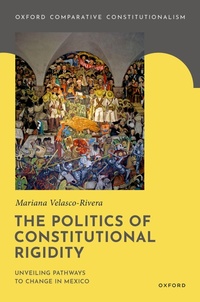
The Politics of Constitutional Rigidity
Unveiling Pathways to Change in Mexico
Published on 26. June 2025
Book
Hardback
256 pages
978-0-19-288732-0 (ISBN)
Description
What makes a constitution difficult to amend? Many assume it's the stringency of the amendment rules, as seen with the U.S. Constitution. However, Mexico, with similar rules, has one of the most amended constitutions globally. So, if it's not the stringency of the rules, what is it?
The Politics of Constitutional Rigidity: Unveiling Pathways to Change in Mexico focuses on Mexico as a case study to explore the non-institutional factors that influence the relative ease of amendment to its constitution. This book proposes a new analytical framework for understanding constitutional change, suggesting that both formal and informal changes occur within an 'economy of change.' This framework highlights how the interplay of political parties, party systems, constitutional culture, and key political actors' decisions influence political entrenchment.
Timely and original, The Politics of Constitutional Rigidity offers a systematic study of constitutional change and challenges dominant approaches to constitutional rigidity.
The Politics of Constitutional Rigidity: Unveiling Pathways to Change in Mexico focuses on Mexico as a case study to explore the non-institutional factors that influence the relative ease of amendment to its constitution. This book proposes a new analytical framework for understanding constitutional change, suggesting that both formal and informal changes occur within an 'economy of change.' This framework highlights how the interplay of political parties, party systems, constitutional culture, and key political actors' decisions influence political entrenchment.
Timely and original, The Politics of Constitutional Rigidity offers a systematic study of constitutional change and challenges dominant approaches to constitutional rigidity.
More details
Series
Language
English
Place of publication
Oxford
United Kingdom
Target group
Professional and scholarly
College/higher education
Product notice
sewn/stitched
Cloth over boards
Dimensions
Height: 238 mm
Width: 161 mm
Thickness: 23 mm
Weight
575 gr
ISBN-13
978-0-19-288732-0 (9780192887320)
Copyright in bibliographic data and cover images is held by Nielsen Book Services Limited or by the publishers or by their respective licensors: all rights reserved.
Schweitzer Classification
Person
Mariana Velasco-Rivera is an Assistant Professor in Law at Maynooth University School of Law and Criminology, Ireland. She is also a nonresident scholar at the Center for the U.S. and Mexico at Rice University's Baker Institute for Public Policy. She received her doctoral degree (Doctor of Juridical Science-JSD) and her master's degree (LLM) from Yale Law School. She also holds a law degree (Licenciatura en Derecho) from Instituto Tecnologico Autonomo de Mexico (ITAM). Before joining Maynooth University, Dr Velasco-Rivera was a postdoctoral research fellow at the Alexander von Humboldt Chair of Comparative Constitutionalism held by Professor Ran Hirschl at the University of Goettingen, Germany and an Emile Noel Fellow at New York University, School of Law . Before her graduate studies, Mariana clerked for judge Jose Ramon Cossio Diaz at the Supreme Court of Mexico.
Content
1: The Mexican Challenge
2: The Formalist and Anti-Formalist Approaches to Constitutional Rigidity
3: The Economy of Constitutional Change
4: Political Parties and Formal Constitutional Change in Contemporary Mexico
5: Constitutional Change and Constitutional Culture in Mexico
6: Actors, Choices, Decisions, and the Formation of Political Norms
7: The Supreme Court in Mexico's Economy of Constitutional Change
8: Conclusion
2: The Formalist and Anti-Formalist Approaches to Constitutional Rigidity
3: The Economy of Constitutional Change
4: Political Parties and Formal Constitutional Change in Contemporary Mexico
5: Constitutional Change and Constitutional Culture in Mexico
6: Actors, Choices, Decisions, and the Formation of Political Norms
7: The Supreme Court in Mexico's Economy of Constitutional Change
8: Conclusion