

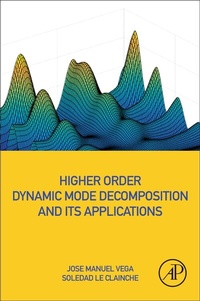
Higher Order Dynamic Mode Decomposition and Its Applications
Published on 22. September 2020
Book
Paperback/Softback
320 pages
978-0-12-819743-1 (ISBN)
Description
Higher Order Dynamic Mode Decomposition and Its Applications provides detailed background theory, as well as several fully explained applications from a range of industrial contexts to help readers understand and use this innovative algorithm. Data-driven modelling of complex systems is a rapidly evolving field, which has applications in domains including engineering, medical, biological, and physical sciences, where it is providing ground-breaking insights into complex systems that exhibit rich multi-scale phenomena in both time and space.
Starting with an introductory summary of established order reduction techniques like POD, DEIM, Koopman, and DMD, this book proceeds to provide a detailed explanation of higher order DMD, and to explain its advantages over other methods. Technical details of how the HODMD can be applied to a range of industrial problems will help the reader decide how to use the method in the most appropriate way, along with example MATLAB codes and advice on how to analyse and present results.
Starting with an introductory summary of established order reduction techniques like POD, DEIM, Koopman, and DMD, this book proceeds to provide a detailed explanation of higher order DMD, and to explain its advantages over other methods. Technical details of how the HODMD can be applied to a range of industrial problems will help the reader decide how to use the method in the most appropriate way, along with example MATLAB codes and advice on how to analyse and present results.
More details
Language
English
Place of publication
San Diego
United States
Publishing group
Elsevier Science Publishing Co Inc
Target group
Professional and scholarly
Adult education
MSc students and researchers
Dimensions
Height: 229 mm
Width: 152 mm
Weight
520 gr
ISBN-13
978-0-12-819743-1 (9780128197431)
Copyright in bibliographic data and cover images is held by Nielsen Book Services Limited or by the publishers or by their respective licensors: all rights reserved.
Schweitzer Classification
Other editions
Additional editions
Jose Manuel Vega | Soledad Le Clainche
Higher Order Dynamic Mode Decomposition and Its Applications
E-Book
09/2020
Academic Press
€140.00
Available for download
Persons
Professor Vega currently holds a Professorship in Applied Mathematics at the School of Aerospace Engineering of the Universidad Politecnica de Madrid (UPM). He received a Master and a PhD, both in Aeronautical Engineering at UPM, and a Master in Mathematics at the Universidad Complutense de Madrid. Along the years, his research has focused on applied mathematics at large, including applications to physics, chemistry, and aerospace and mechanical engineering. The main topics were connected to the analysis of partial differential
equations, nonlinear dynamical systems, pattern formation, water waves, reaction-diffusion problems, interfacial phenomena, and, more recently, reduced order models and data processing tools. The latter two topics are related, precisely, to the content of this book. Specifically, he developed (with Dr. Le Clainche as collaborator) the higher order dynamic mode decomposition method, and also several extensions, including the spatio-temporal Koopman decomposition method. His research activity resulted in the publication of more than one hundred and twenty research papers in first class referred journals, as well as around forty publications resulting from scientific meetings and conferences. Dr. Soledad Le Clainche holds a Lectureship in Applied Mathematics at the School of Aerospace Engineering of UPM. She received three Masters of Science: in Mechanical Engineering by UPCT, in Aerospace Engineering by UPM, and in Fluid Mechanics by the Von Karman Institute. In 2013 she completed her PhD in Aerospace Engineering at UPM. Her research focuses on computational
fluid dynamics and in the development of novel tools for data analysis enabling the detection of spatio-temporal patterns. More specifically, she has co-developed (with Prof. Vega) the higher order dynamic mode decomposition and variants. Additionally, she has exploited these data-driven tools to develop reduced order models that help to understand the complex physics of dynamical systems. She has also contributed to the fields of flow control, global stability analysis, synthetic jets, analysis of flow structures in complex flows (transitional and turbulent) using data-driven methods, and prediction of temporal patterns using machine learning and soft computing techniques.
equations, nonlinear dynamical systems, pattern formation, water waves, reaction-diffusion problems, interfacial phenomena, and, more recently, reduced order models and data processing tools. The latter two topics are related, precisely, to the content of this book. Specifically, he developed (with Dr. Le Clainche as collaborator) the higher order dynamic mode decomposition method, and also several extensions, including the spatio-temporal Koopman decomposition method. His research activity resulted in the publication of more than one hundred and twenty research papers in first class referred journals, as well as around forty publications resulting from scientific meetings and conferences. Dr. Soledad Le Clainche holds a Lectureship in Applied Mathematics at the School of Aerospace Engineering of UPM. She received three Masters of Science: in Mechanical Engineering by UPCT, in Aerospace Engineering by UPM, and in Fluid Mechanics by the Von Karman Institute. In 2013 she completed her PhD in Aerospace Engineering at UPM. Her research focuses on computational
fluid dynamics and in the development of novel tools for data analysis enabling the detection of spatio-temporal patterns. More specifically, she has co-developed (with Prof. Vega) the higher order dynamic mode decomposition and variants. Additionally, she has exploited these data-driven tools to develop reduced order models that help to understand the complex physics of dynamical systems. She has also contributed to the fields of flow control, global stability analysis, synthetic jets, analysis of flow structures in complex flows (transitional and turbulent) using data-driven methods, and prediction of temporal patterns using machine learning and soft computing techniques.
Content
1. General introduction and scope of the book2. Higher order dynamic mode decomposition3. HODMD applications to the analysis of flight tests and magnetic resonance4. Spatio-temporal Koopman decomposition5. Application of HODMD and STKD to some pattern forming systems6. Applications of HODMD and STKD in fluid dynamics7. Applications of HODMD and STKD in the wind industry8. HODMD and STKD as data driven reduced order models9. Conclusions