

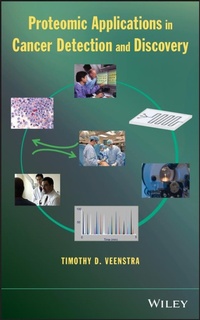
Proteomic Applications in Cancer Detection and Discovery
1st Edition
Published on 23. August 2013
Book
Hardback
320 pages
978-0-471-72406-3 (ISBN)
Description
Helps researchers in proteomics and oncology work together to understand, prevent, and cure cancer
Proteomic data is increasingly important to understanding the origin and progression of cancer; however, most oncologic researchers who depend on proteomics for their studies do not collect the data themselves. As a result, there is a knowledge gap between scientists, who devise proteomic techniques and collect the data, and the oncologic researchers, who are expected to interpret and apply proteomic data. Bridging the gap between proteomics and oncology research, this book explains how proteomic technology can be used to address some of the most important questions in cancer research.
Proteomic Applications in Cancer Detection and Discovery enables readers to understand how proteomic data is acquired and analyzed and how it is interpreted. Author Timothy Veenstra has filled the book with examples?many based on his own firsthand research experience?that clearly demonstrate the application of proteomic technology in oncology research, including the discovery of novel biomarkers for different types of cancers.
The book begins with a brief introduction to systems biology, explaining why cancer is a systems biology disease. Next, it covers such topics as:
Mass spectrometry in cancer research
Application of proteomics to global phosphorylation analysis
Search for biomarkers in biofluids
Rise and fall of proteomic patterns for cancer diagnostics
Emergence of protein arrays
Role of proteomics in personalized medicine
The final chapter is dedicated to the future prospects of proteomics in cancer research.
By guiding readers through the latest proteomic technologies and their applications in cancer research, Proteomic Applications in Cancer Detection and Discovery enhances the ability of researchers in proteomics and researchers in oncology to collaborate in order to better understand cancer and develop strategies to prevent and treat it.
Proteomic data is increasingly important to understanding the origin and progression of cancer; however, most oncologic researchers who depend on proteomics for their studies do not collect the data themselves. As a result, there is a knowledge gap between scientists, who devise proteomic techniques and collect the data, and the oncologic researchers, who are expected to interpret and apply proteomic data. Bridging the gap between proteomics and oncology research, this book explains how proteomic technology can be used to address some of the most important questions in cancer research.
Proteomic Applications in Cancer Detection and Discovery enables readers to understand how proteomic data is acquired and analyzed and how it is interpreted. Author Timothy Veenstra has filled the book with examples?many based on his own firsthand research experience?that clearly demonstrate the application of proteomic technology in oncology research, including the discovery of novel biomarkers for different types of cancers.
The book begins with a brief introduction to systems biology, explaining why cancer is a systems biology disease. Next, it covers such topics as:
Mass spectrometry in cancer research
Application of proteomics to global phosphorylation analysis
Search for biomarkers in biofluids
Rise and fall of proteomic patterns for cancer diagnostics
Emergence of protein arrays
Role of proteomics in personalized medicine
The final chapter is dedicated to the future prospects of proteomics in cancer research.
By guiding readers through the latest proteomic technologies and their applications in cancer research, Proteomic Applications in Cancer Detection and Discovery enhances the ability of researchers in proteomics and researchers in oncology to collaborate in order to better understand cancer and develop strategies to prevent and treat it.
Reviews / Votes
"By guiding readers through the latest proteomic technologies and their applications in cancer research, "Proteomic Applications in Cancer Detection and Discovery" enhances the ability of researchers in proteomics and researchers in oncology to collaborate in order to better understand cancer and develop strategies to prevent and treat it." (Newbooks.lib, 11 September 2014More details
Language
English
Place of publication
New York
United States
Target group
College/higher education
Professional and scholarly
Product notice
Unsewn / adhesive bound
Paper over boards
Dimensions
Height: 243 mm
Width: 156 mm
Thickness: 21 mm
Weight
567 gr
ISBN-13
978-0-471-72406-3 (9780471724063)
Copyright in bibliographic data and cover images is held by Nielsen Book Services Limited or by the publishers or by their respective licensors: all rights reserved.
Schweitzer Classification
Other editions
Additional editions
Timothy D. Veenstra
Proteomic Applications in Cancer Detection and Discovery,
E-Book
05/2013
1st Edition
Wiley
€80.99
Available for download
Timothy D. Veenstra
Proteomic Applications in Cancer Detection and Discovery
E-Book
05/2013
Wiley
€80.99
Available for download
Person
TIMOTHY D. VEENSTRA, PhD, is Director of the Laboratory of Proteomics and Analytical Technologies at the Frederick National Laboratory for Cancer Research. Dr. Veenstra and his lab group develop and apply chromatography and mass spectrometry approaches to characterize protein complexes and the role of post-translational modifications in these complexes. Additionally, they use high-throughput proteomic approaches for the discovery of biomarkers for disease as well as proteomic and metabolomic technology for the interrogation of clinical samples. Dr. Veenstra has coauthored more than 300 peer-reviewed publications and is the coeditor of Proteomics for Biological Discovery.
Content
Preface vii
Acknowledgments ix
1 Systems Biology 1
2 Mass Spectrometry in Cancer Research 27
3 Quantitative Proteomics 59
4 Proteomic Analysis of Posttranslational Modifications 87
5 Characterization of Protein Complexes 117
6 Global Phosphorylation Analysis 145
7 the Search for Biomarkers in Biofluids 171
8 Proteomic Patterns: a New Paradigm in Diagnostics And Therapeutics? 195
9 the Emergence of Protein Arrays 215
10 the Role of Proteomics in Personalized Medicine 241
11 the Critical Role of Bioinformatics 263
12 Future Prospects of Proteomics in Cancer Research 281
Index 305
Acknowledgments ix
1 Systems Biology 1
2 Mass Spectrometry in Cancer Research 27
3 Quantitative Proteomics 59
4 Proteomic Analysis of Posttranslational Modifications 87
5 Characterization of Protein Complexes 117
6 Global Phosphorylation Analysis 145
7 the Search for Biomarkers in Biofluids 171
8 Proteomic Patterns: a New Paradigm in Diagnostics And Therapeutics? 195
9 the Emergence of Protein Arrays 215
10 the Role of Proteomics in Personalized Medicine 241
11 the Critical Role of Bioinformatics 263
12 Future Prospects of Proteomics in Cancer Research 281
Index 305