

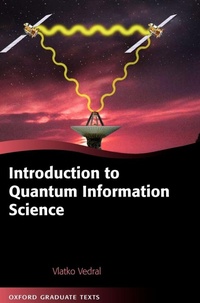
Introduction to Quantum Information Science
Published on 28. September 2006
Book
Hardback
194 pages
978-0-19-921570-6 (ISBN)
Description
This book offers a concise and up-to-date introduction to the popular field of quantum information. It has originated in a series of invited lecture courses at various universities in different countries. This is reflected in its informal style of exposition and presentation of key results in the subject. In addition to treating quantum communication, entanglement and algorithms in great depth, this book also addresses a number of interesting miscellaneous topics, such as Maxwell's demon, Landauer's erasure, the Bekenstein bound and Caratheodory's treatment of the Second law of thermodyanmics. All mathematical derivations are based on clear physical pictures which make even the most involved results - such as the Holevo bound - look comprehensible and transparent. The book is ideal as a first introduction to the subject, but may also appeal to the specialist due to its unique presentation.
Reviews / Votes
...an asset for students. * Andrey Bychkov, University of Cambridge * ...of outstanding quality. * D. Song *More details
Series
Language
English
Place of publication
Oxford
United Kingdom
Target group
Professional and scholarly
Illustrations
30 line drawings
Dimensions
Height: 250 mm
Width: 175 mm
Thickness: 15 mm
Weight
527 gr
ISBN-13
978-0-19-921570-6 (9780199215706)
Copyright in bibliographic data and cover images is held by Nielsen Book Services Limited or by the publishers or by their respective licensors: all rights reserved.
Schweitzer Classification
Other editions
Additional editions
Vlatko Vedral
Introduction to Quantum Information Science
Book
04/2013
Oxford University Press
€63.14
Shipment within 15-20 days
Previous edition

Vlatko Vedral
Introduction to Quantum Information Science
Book
Oxford University Press
€43.33
The article will not be published
Person
Vlatko Vedral, Centenary Professor of Quantum Information, University of Leeds.
Vlatko Vedral studied his undergraduate degree and PhD at Imperial College (1992-1998). After graduating from his PhD in 1998, he took up a junior research fellowship at Merton College in Oxford where he stayed for two years (1998-2000). He returned to Imperial College in 2000 as a governors' lecturer and was promoted to reader in 2003. In October 2004 he moved to Leeds University as the centenary professor of Quantum Information Science. He has taught at many different universities and held visiting professorships at Oxford, Vienna, Singapore and Perimeter Institute in Canada.
Vlatko Vedral is an active researcher in quantum information and quantum mechanics, having published over 100 papers in these fields. He enjoys explaining science to the media and has been interviewed on a number of occasions regarding his work and the state of the field. He has contributed to several introductory books on quantum computing as well as written a textbook on Quantum Optics.
Vlatko Vedral studied his undergraduate degree and PhD at Imperial College (1992-1998). After graduating from his PhD in 1998, he took up a junior research fellowship at Merton College in Oxford where he stayed for two years (1998-2000). He returned to Imperial College in 2000 as a governors' lecturer and was promoted to reader in 2003. In October 2004 he moved to Leeds University as the centenary professor of Quantum Information Science. He has taught at many different universities and held visiting professorships at Oxford, Vienna, Singapore and Perimeter Institute in Canada.
Vlatko Vedral is an active researcher in quantum information and quantum mechanics, having published over 100 papers in these fields. He enjoys explaining science to the media and has been interviewed on a number of occasions regarding his work and the state of the field. He has contributed to several introductory books on quantum computing as well as written a textbook on Quantum Optics.
Content
1. Classical Information ; 2. Quantum Mechanics ; 3. Quantum Information - The Basics ; 4. Quantum Communication with Entanglement ; 5. Quantum Information I ; 6. Quantum Information II ; 7. Quantum Entanglement - Introduction ; 8. Witnessing Quantum Entanglement ; 9. Quantum Entanglement Detection in Practice ; 10. Measures of Entanglement ; 11. Quantum Algorithms ; 12. Entanglement, Computation and Quantum Measurement ; 13. Quantum Error Correction ; 14. Outlook